
What is the best month to visit Pompeii?
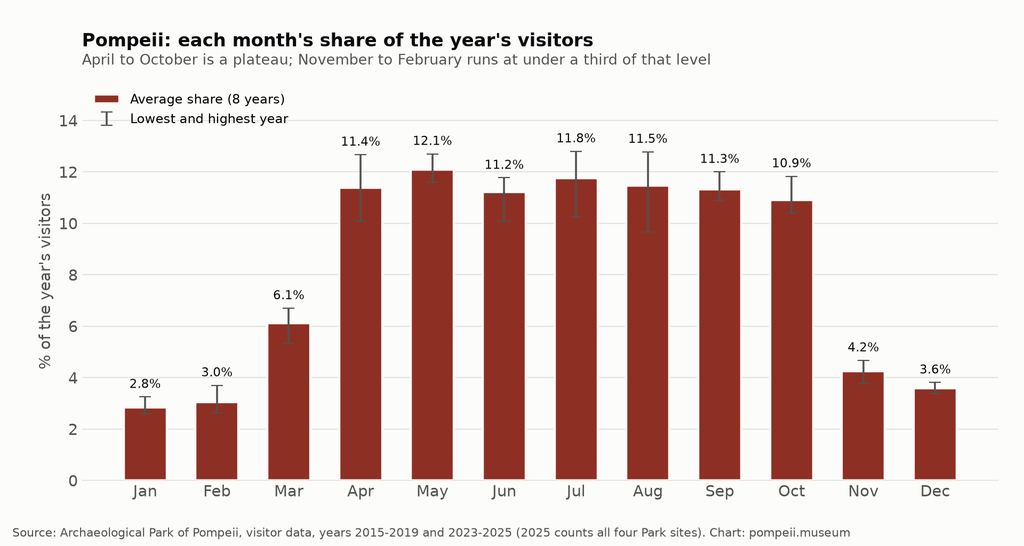
Pick the block of the year first, the month second. April to October carries 80 percent of annual visitors and the seven months are nearly flat (10.9 to 12.1 percent each). August is not busier than May.

Best time to go, destination by destination
Month-by-month grid for ten places
Numbers are calendar months: 1 is January, 12 is December. Every cell also carries its state in words.
| Month | 1 | 2 | 3 | 4 | 5 | 6 | 7 | 8 | 9 | 10 | 11 | 12 |
|---|---|---|---|---|---|---|---|---|---|---|---|---|
| Pompeii Winter has 3,900 to 8,500 visitors a day against 14,000 to 16,000 in April to October. June to August brings highs of 28 to 32 °C on an open site. | 1 | 2 | 3 | 4 | 5 | 6 | 7 | 8 | 9 | 10 | 11 | 12 |
| Herculaneum Smaller site, same weather as Pompeii. No monthly visitor counts are published for it, so this rests on climate and hours; July and August are the heat problem. | 1 | 2 | 3 | 4 | 5 | 6 | 7 | 8 | 9 | 10 | 11 | 12 |
| Naples and the National Archaeological Museum (MANN) The MANN is indoors, so rain matters less; heat in July and August is the main drag on the streets outside. The MANN is closed on Tuesdays (as of November 2026). | 1 | 2 | 3 | 4 | 5 | 6 | 7 | 8 | 9 | 10 | 11 | 12 |
| Vesuvius As of November 2026 the last access to the Gran Cono trail is 15:00 from November to February and 18:00 in July and August, and the open trail ends at the Capannuccia shelter, not at the crater. The path closes when the regional weather alert turns orange. | 1 | 2 | 3 | 4 | 5 | 6 | 7 | 8 | 9 | 10 | 11 | 12 |
| Sorrento Good base from spring to autumn. No local weather series, so the call borrows from the nearby Capri station, where wind of 10 m/s or more blows on 9 to 11 days a month from November to February. | 1 | 2 | 3 | 4 | 5 | 6 | 7 | 8 | 9 | 10 | 11 | 12 |
| Amalfi Coast Sea at 22 to 26 °C from June to September. Winter wind at Capri reaches 10 m/s or more on 9 to 11 days a month from November to February, which can disrupt sea crossings. | 1 | 2 | 3 | 4 | 5 | 6 | 7 | 8 | 9 | 10 | 11 | 12 |
| Capri Highs of 28 to 32 °C in June to September, with 23 to 26 days at 30 °C or above in July and August. From December to February the wind reaches 10 m/s or more on 9 to 11 days a month. | 1 | 2 | 3 | 4 | 5 | 6 | 7 | 8 | 9 | 10 | 11 | 12 |
| Paestum Open ground with little shade, so June to August is hard. The nearest WMO station is Capo Palinuro, about 50 km away, so the weather is a rough proxy. | 1 | 2 | 3 | 4 | 5 | 6 | 7 | 8 | 9 | 10 | 11 | 12 |
| Campi Flegrei Outdoor sites; July and August are hot. Cumae is closed on Tuesdays and the Baia museum on Mondays (as of November 2026). | 1 | 2 | 3 | 4 | 5 | 6 | 7 | 8 | 9 | 10 | 11 | 12 |
| Reggia di Caserta The gardens are the point, and the royal park closes earlier in winter months (check the monthly hours on the Reggia's timetable page). Highs in July and August hit 31 to 32 °C. | 1 | 2 | 3 | 4 | 5 | 6 | 7 | 8 | 9 | 10 | 11 | 12 |
Sources: WMO 1991-2020 normals (Capri, Grazzanise); Pompeii Archaeological Park visitor data; site timetables, 5 Nov 2026. The grading is our judgment.
Month by month at Pompeii in one table
| Month | Highs, °C (Capri / Grazzanise) | Rain days (Capri / Grazzanise) | Visitors a day | Park closes | Our read |
|---|---|---|---|---|---|
| January | 13.7 / 13.1 | 8.3 / 8.7 | 3,860 | 17:00 | Emptiest month, cold, short day |
| February | 14.3 / 13.8 | 6.8 / 8.3 | 4,921 | 17:00 | Still quiet; daylight returns |
| March | 16.8 / 16.2 | 6.7 / 7.5 | 8,476 | 17:00, then 19:00 from March 16 | Best balance: half of April's crowd |
| April | 19.8 / 19.3 | 5.5 / 7.5 | 16,213 | 19:00 | Pleasant, close to the cap |
| May | 24.4 / 23.8 | 3.9 / 5.6 | 16,198 | 19:00 | Best weather, full site |
| June | 28.7 / 28.2 | 2.3 / 3.1 | 14,887 | 19:00 | Hot and busy |
| July | 31.7 / 30.6 | 1.3 / 1.9 | 14,190 | 19:00 | 19 to 23 days at 30 °C or above |
| August | 32.4 / 31.5 | 1.7 / 2.3 | 13,724 | 19:00 | Hottest, and not the busiest |
| September | 28.3 / 27.6 | 5.5 / 6.0 | 15,092 | 19:00 | Hot early, easing late in the month |
| October | 23.5 / 23.3 | 6.7 / 7.9 | 14,868 | 19:00 until October 14, then 17:00 | Mild, busy, rain returns |
| November | 18.3 / 18.1 | 9.4 / 11.3 | 6,097 | 17:00 | Wettest month, quiet site |
| December | 14.6 / 14.1 | 8.9 / 9.6 | 4,485 | 17:00 | Quiet, short days |
Why November and March, and not January?
What does this calendar not tell you?
Go deeper on timing
Four pages, each with its own data.
Weather and climate, month by month
Temperature, rain, sea and wind from two WMO stations.
The crowd calendar
Eight years of monthly visitor counts and what the daily cap means.
Pompeii in summer
Heat, shade and the hours that work in July and August.
Pompeii in winter
Short days, shorter hours and why the low season is worth it.
Combining places: which months pair well?
Timing questions
What is the quietest time to visit Pompeii?
December, January and February, with about 4,500, 3,900 and 4,900 visitors on an average day in 2023-2025. November averages about 6,100.
Is Pompeii crowded in October?
Yes, moderately. October carries about 10.9 percent of a year's visitors, with roughly 14,900 on an average day. Only after October 14 does the shorter winter timetable begin.
Is August the busiest month at Pompeii?
No. August averages 11.5 percent of annual visitors against 12.1 percent for May. It is the hottest month, which is a different problem.
Is Pompeii open in winter?
Yes. From October 15 to March 15 the Park opens at 9:00, with the last entry at 15:30 and closing at 17:00 (as of November 2026). It closes on December 25 and January 1 unless it announces otherwise.
What is the best day of the week to visit Pompeii?
We cannot say. The Park publishes monthly counts, not counts by weekday, and we do not guess. The one day with documented extra pressure is the first Sunday of the month.
Is Pompeii too hot in July and August?
Highs average 31 to 32 °C and the site is mostly open ground. Go at 9:00, carry water and plan to be out by midday. The summer page has the detail.
What is the weather like in November?
Highs near 18 °C and the most rain of the year: 96 mm at Capri and 152 mm at Grazzanise, on 9 to 11 days. Bring a waterproof layer; the sea is still warmer than in May.
Do I need to book in the low season?
The ticket is dated and in a named visitor's name all year, as of November 2026, and the daily cap applies in every month. Read the ticket guide for the rules.
Tours that run in the best months
Guided options for Pompeii, from group visits to private tours.

Amalfi, Limoncello Tasting and Pompeii Guided Group Day Tour from Naples
A limoncello shop tasting and an optional boat ride in Amalfi precede a 2-hour guided tour of Pompeii, with the entrance fee included and lunch optional.
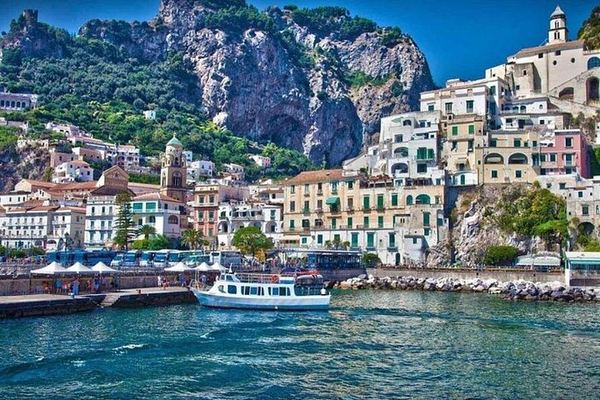
Cruise Passenger Day Tour: Positano, Sorrento and Pompeii from Naples or Salerno Port
Timed around cruise arrivals, this day tour gives one hour each in Positano and Sorrento, then a two-hour guided visit at Pompeii before the return to the ship.

Early Morning Pompeii Tour from Sorrento: Skip-the-Line Entry, Official Guide
A coach leaves Sorrento early to beat the traffic and crowds, then an official guide leads a 2 hour 30 minute walk through Pompeii with priority entrance.
Ratings collected by Viator and Tripadvisor
Data verified on . Weather: WMO 1991-2020 normals. Visitors: Park of Pompeii data. Hours and closing days as of November 2026. Season grading is ours. Editorial Policy