
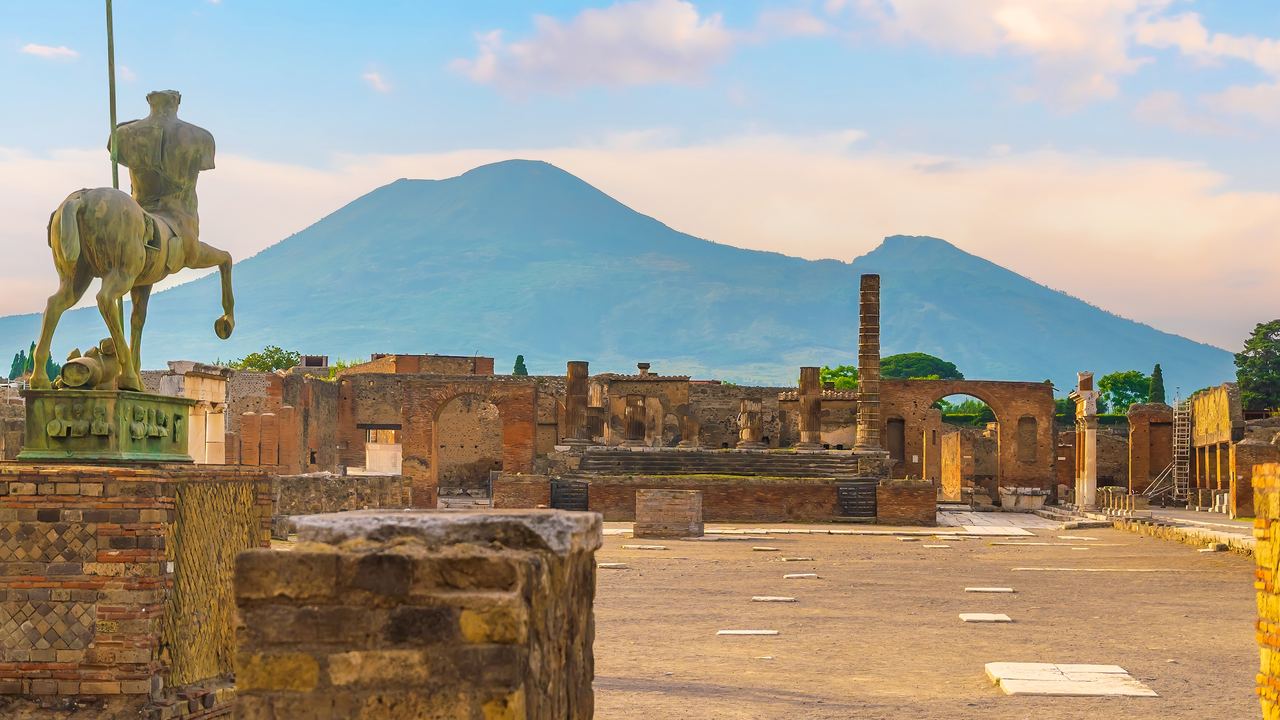
Around Vesuvius there are five places that belong with Pompeii: Herculaneum, the villas of Oplontis and Stabiae, the farm villa at Boscoreale, and the Naples Archaeological Museum (MANN), where much of what the towns produced ended up. Three more sights come up in every Campania plan and are worth knowing about, though they are not Roman sites on the volcano: the Greek temples of Paestum, the Phlegraean Fields west of Naples (Cuma, Baia, Pozzuoli) and the Bourbon Reggia di Caserta. This page puts all of them in one table, with how long each takes, how you get there and who it suits. We are an independent guide, not affiliated with any of the Parks or museums named here.
A good rule: Herculaneum, the villas and the museum are the natural companions of a Pompeii visit. Paestum, the Phlegraean Fields and Caserta each deserve a day of their own, in a different direction from Naples.
Which sites are around Pompeii, and what is each one for?
The times below are our planning estimates, not figures from the Parks, except where we say a Park gave them. For anything that costs money or has opening hours, we link the page that holds it: prices are collected, with the date we checked them, in Pompeii tickets explained.
| Site | What it is | Time to allow | How you get there | Best for |
|---|---|---|---|---|
| Pompeii | A Roman town buried in AD 79, with forum, amphitheater and houses | Half a day to a full day (our estimate; the Park's 2018 FAQ says at least 2 to 3 hours) | Circumvesuviana to Pompei Scavi-Villa dei Misteri | First-time visitors who want a whole town |
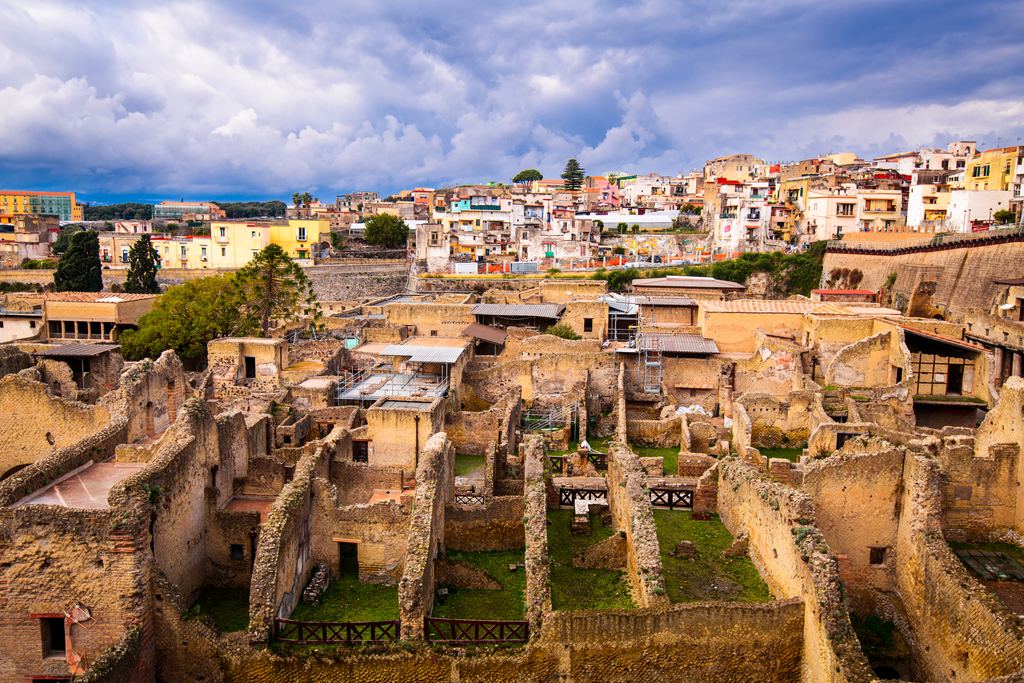
| Herculaneum | A smaller seaside town with carbonized wood and the waterfront vaults | About 2 hours (Park's FAQ) | Circumvesuviana to Ercolano Scavi, then 6 minutes on foot (Park) | A shorter, calmer visit; pairs with Pompeii |
| Oplontis | A luxurious seaside villa, known as Villa A or the Villa of Poppaea | 1 to 2 hours | Circumvesuviana to Torre Annunziata-Oplonti, or the Park's free Artebus line 2 (not Tuesdays) | Wall paintings and gardens without crowds |
| Stabiae | Three villa complexes on the Castellammare hill, and a museum | Half a day | Circumvesuviana to Castellammare di Stabia, then a local bus | Visitors who already know Pompeii |
| Boscoreale | Villa Regina, a working farm villa with a cellar, and an antiquarium | 1 to 2 hours | Circumvesuviana stop Villa Regina, or the Park's Artebus line 1 from Pompeii | Wine, farming and daily life |
| Naples Archaeological Museum (MANN) | The museum holding frescoes, mosaics and objects from the Vesuvian towns | 2 to 4 hours | Central Naples, by city transport from the stations | Rainy days; seeing what Pompeii's walls looked like |
| Paestum | Three Greek temples of the 6th and 5th centuries BC, a Roman forum and a museum | 3 to 4 hours | Trenitalia from Naples Centrale, stop Paestum, then a short walk | Greek architecture; a full day trip |
| Cuma | A Greek and Roman hilltop town with the Apollo temple and the Sibyl's cave | 2 hours | Cumana railway toward Torregaveta; check the Park's page for access | Myth and a quieter landscape |
| Baia | A Roman spa town partly under the sea, with a castle museum | 2 to 3 hours | Cumana railway toward Torregaveta, then local transport (not verified) | Roman luxury and the underwater park |
| Pozzuoli | A Flavian amphitheater and the market building known as the Serapeum | 2 hours | Cumana railway to Pozzuoli | An amphitheater without the crowds |
| Reggia di Caserta | An 18th-century royal palace and park, not a Roman site | Half a day to a full day | Caserta station, opposite the palace; high-speed trains stop there (palace's page) | Architecture and gardens |
What are the villas around Pompeii?
The country villas are separate sites and mostly quiet. Oplontis in Torre Annunziata (Villa A only, with a 61 by 17 meter pool and Second Style paintings), Stabiae on the hill of Castellammare (Villa San Marco, Villa Arianna) and Boscoreale (Villa Regina, a farm villa with 18 wine jars in its cellar) each need their own plan.
Which ticket covers them is a structural point: the Park's three-day ticket includes the villas and the shuttle, while the Pompei+ ticket adds only the suburban villas on its list, including Boscoreale. Prices are on our tickets page, and Oplontis, Stabiae and Boscoreale covers what to see and how to get there.
Where did Pompeii's finds go?
Many of the best-known objects are in Naples, not at Pompeii, and the Naples Archaeological Museum is the place to see them. It holds the frescoes cut from Vesuvian walls, a 1:100 model of Pompeii presented in 1879, the furnishings of Pompeian houses, and a section on the Villa of the Papyri at Herculaneum. Not everything is there, though. The Park lists the Hercules and the stag from the House of Sallust in Palermo, and the Boscoreale treasure divided between the Louvre and a private Rothschild collection. The papyrus scrolls are not at MANN either: they are held at the National Library of Naples.
MANN rearranges its rooms, and on 5 November 2026 its schedule listed the mosaic section and the Secret Cabinet as closed for refurbishment (to 30 November on the rooms page, until further notice on the museum's banner). The museum's own page of open rooms is the only reliable source, and it closes on Tuesdays. Our museum guide separates what is stable from what is dated.
Is Paestum worth a day from Naples?
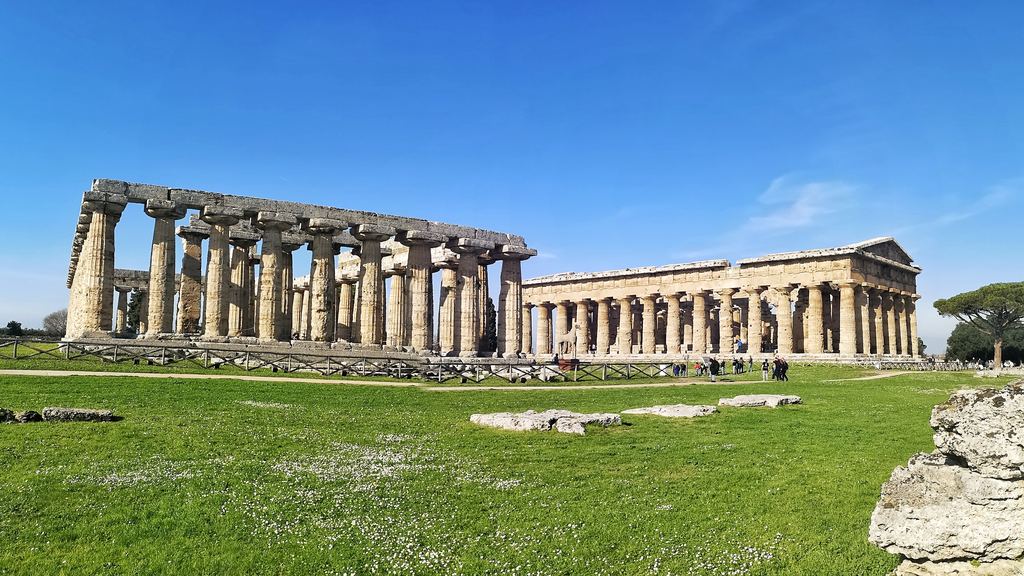
If Greek architecture is what you want, yes. Paestum began as the Greek colony of Poseidonia around 600 BC. Its three Doric temples, traditionally called the Basilica, Ceres and Neptune, are dated to roughly 560 to 520, 500 and 460 BC, and the site entered the UNESCO list in 1998 as part of the Cilento landscape. It lies in the bay of Salerno, not on the Amalfi Coast, a mistake some tour pages make, and a train from Naples Centrale toward Reggio Calabria stops at Paestum a short walk from the site. We could not verify the status of the rooms with the painted tombs, so check before promising anyone the Tomb of the Diver. Our Paestum guide has booking, timing and the rest.
What is there to see in the Phlegraean Fields?
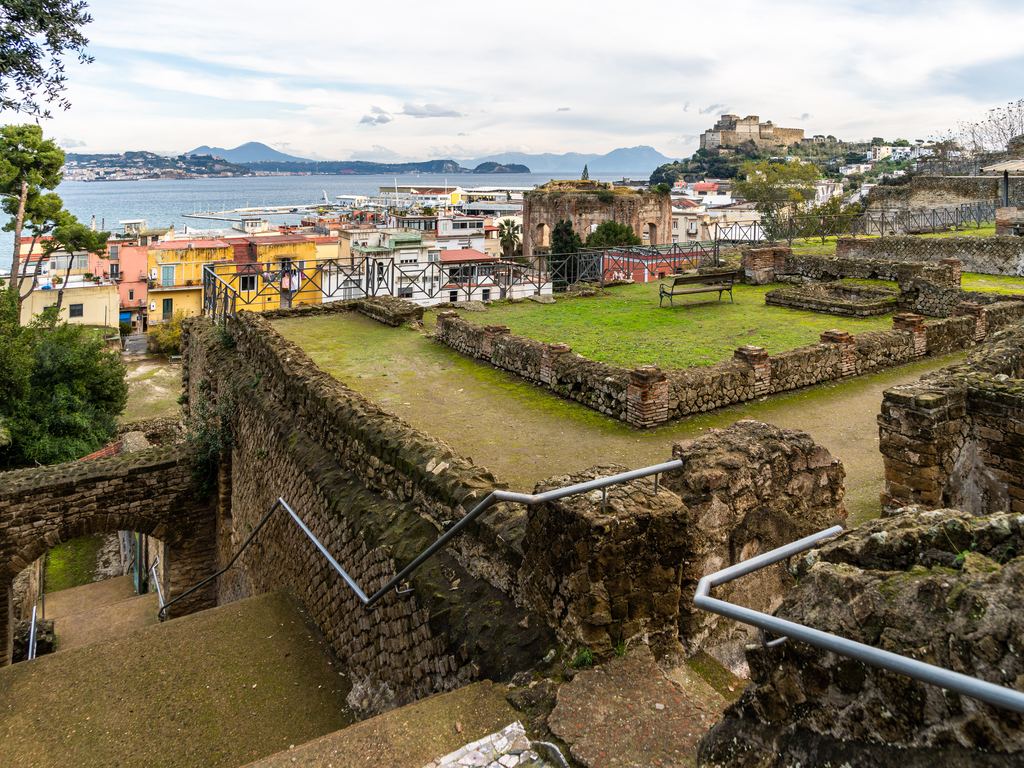
West of Naples, the Phlegraean Fields are a volcanic landscape with Greek and Roman remains. Cuma was founded in the second half of the 8th century BC by Greeks from Euboea, among the earliest Greek settlements on the Italian mainland; the "Sibyl's cave" is a famous gallery, though that it is the cave Virgil describes is not proven. Baia was a Roman resort whose bath complexes, mislabeled in the past as temples, are partly under water because the coast has sunk, and its underwater parks were established in 2002. Pozzuoli has a Flavian amphitheater and the building called the Serapeum, which was a market.
One site is missing from every sensible itinerary: the Solfatara, closed to the public since 2017. The ground in the whole area rises and falls over decades, which scholars call bradyseism, and INGV recorded a magnitude Md 4.7 earthquake there on 31 July 2026. Check the Park's page for notices before you go. Our Phlegraean Fields guide has the order for a one-day tour.
Is the Royal Palace of Caserta part of a Pompeii trip?
Not really, but visitors ask. The Reggia di Caserta is a Bourbon palace begun in 1752 to Luigi Vanvitelli's designs, inscribed by UNESCO in 1997. The station is opposite the palace according to the palace's own page, and the palace says high-speed trains arrive directly at Caserta. A palace visit plus the park fills a day, so it does not combine with Pompeii. The tour formats for it are in More of Campania.

A day of its own
Why Caserta does not fit around Pompeii
The palace sits north of Naples and Pompeii south of it, and each is an all-day visit. Combined day tours from Rome exist, but at around 12 hours they are stretched, in our judgment. If you are in Rome with a single day, choose one. If you have a week in Campania, give Caserta its own morning.
How do you combine these sites without wasting days?
Group by direction. Everything on the Circumvesuviana line is south-east of Naples: Herculaneum, Pompeii and Boscoreale, plus Oplontis and Stabiae a few stops apart. The Phlegraean Fields are west, reached by a different railway. Paestum is south by Trenitalia, and Caserta is north. A sensible Naples-based sequence, which follows the order most travelers recommend, is the museum or Pompeii first, then Herculaneum, then the villas, then the Phlegraean Fields, with Paestum if there is time and Caserta last. For the choice between the two main towns, see Pompeii or Herculaneum.
Weekly closing days matter more than hours. As of November 2026, the Naples museum, Cuma, the Flavian Amphitheater at Pozzuoli, Oplontis and Stabiae are closed on Tuesdays, and the Baia museum on Mondays. Pompeii, Boscoreale and Herculaneum have no Tuesday closure in the Parks' pages, so they are the safe anchors for a Tuesday. Recheck any of these before you commit a day, because they change with the season.
Go deeper, site by site
Each guide covers what to see, how to get there and what is closed, with the date we checked it.
Oplontis, Stabiae and Boscoreale
The quiet villas of the Pompeii Park.
Pompeii at the Naples museum
Where the frescoes, mosaics and models are, and how to pair them with a visit.
Paestum
Greek temples, the museum and how to reach them.
The Phlegraean Fields
Cuma, Baia and Pozzuoli, with what is closed.
Naples archaeology tours
Museum visits and underground Naples.
Herculaneum tours and tickets
Entry, guided visits and the Vesuvius link.
More of Campania
Paestum, the Phlegraean Fields and Caserta.
Pompeii or Herculaneum?
Facts side by side and how to do both.
Getting to Pompeii
Stations, trains and cruise-port routes.
Questions about the sites around Pompeii
What else is there to see near Pompeii?
Herculaneum, the villas of Oplontis and Stabiae, the farm villa at Boscoreale and the Naples Archaeological Museum. Paestum, the Phlegraean Fields and the Reggia di Caserta are further away and each needs its own day.
Which is better, Herculaneum or Oplontis?
Herculaneum is a whole town and takes about two hours; Oplontis is one large villa. They are not alternatives. Read Pompeii or Herculaneum for the first choice.
Can I visit Oplontis and Stabiae on the same day as Pompeii?
Both are part of the Pompeii Park, closed on Tuesdays as of November 2026, and the Park's three-day ticket covers them. Stabiae needs a bus from Castellammare, so it fits a second day better.
Is the Solfatara open?
No. The Solfatara at Pozzuoli has been closed to the public since 2017, and we found no reopening date.
Is Paestum on the Amalfi Coast?
No. It lies in the bay of Salerno, about 93 km from Naples by road, in the Cilento area.
Can I see Pompeii's mosaics and frescoes in Naples?
Many frescoes, yes. On 5 November 2026 the museum listed its mosaic section as closed for refurbishment, so check the museum's page of open rooms before you go.
Do the Phlegraean Fields need a booking?
Booking rules vary by site, so check the Park's page. Paestum does not require it, according to the Park.
Which sites suit a rainy day?
The Naples museum is indoors. Most of the others are open-air ruins, so plan the museum for the wet day.
Start with the decisions that matter most
How many days, where to start, which ticket: the planning guide takes them in order.
Data verified on . Park of Pompeii, Herculaneum, Paestum and Campi Flegrei pages; MANN schedule; Wikipedia and Wikidata for dates; train details from EAV and the cited operators. Editorial Policy