
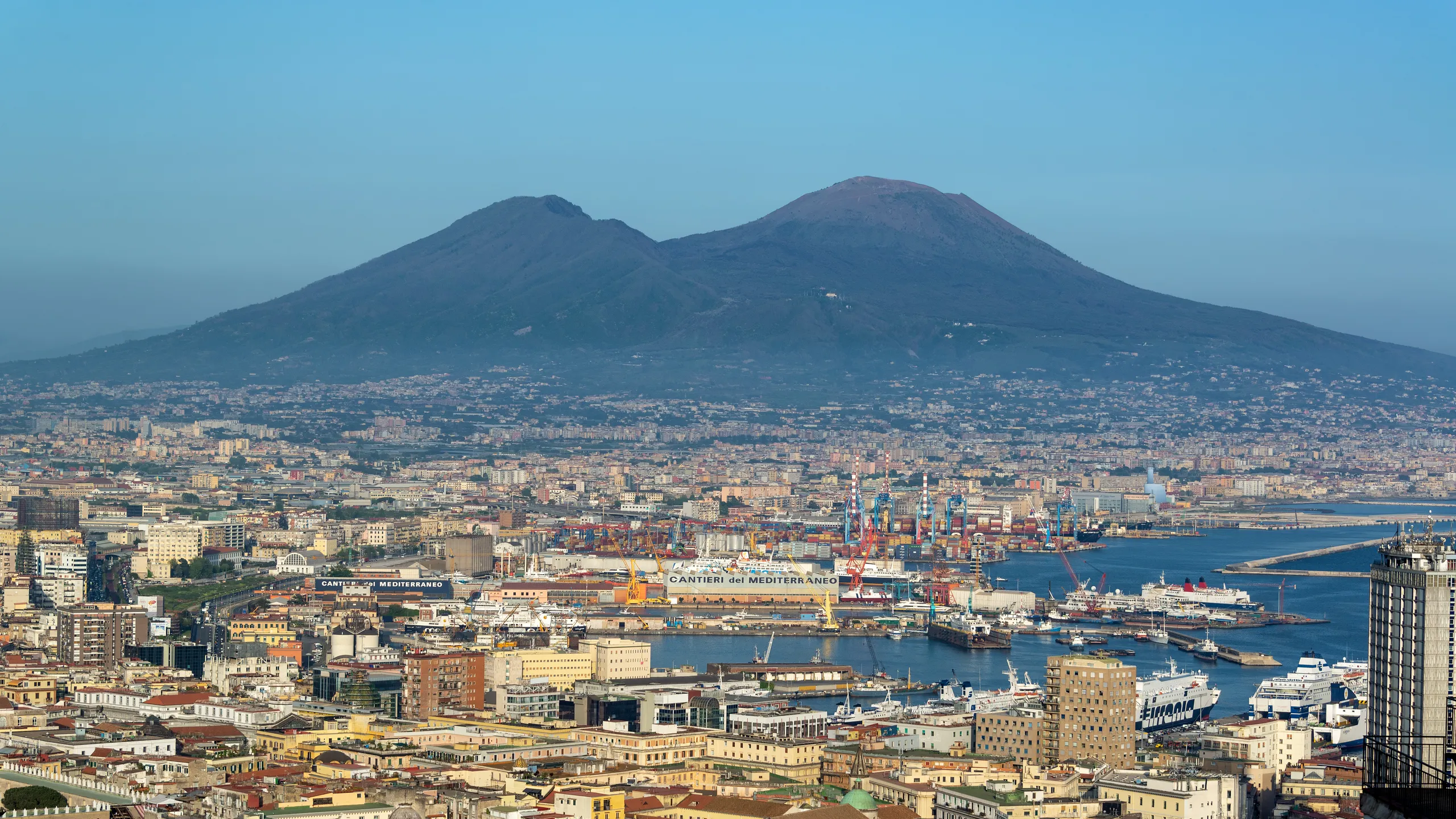
Vesuvius is the volcano that buried Pompeii in AD 79, about 10 km away, and it has been quiet since its last eruption in 1944. It is not one cone but two: Monte Somma, an older building with a collapsed rim, and the Gran Cono, the younger cone that grew inside it after the eruption that destroyed the town. Italy's Civil Protection Department lists the volcano as quiescent, with the alert level at green, and the Osservatorio Vesuviano of the national institute INGV watches it around the clock. We read that page on November 5, 2026.
What is Vesuvius, and how is it different from Monte Somma?
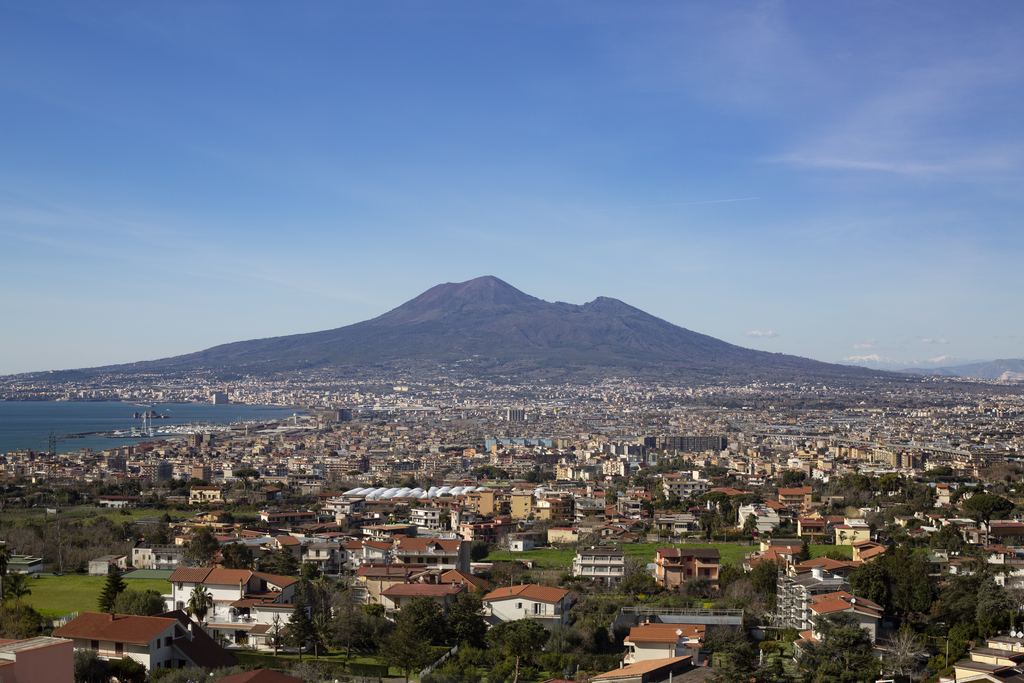
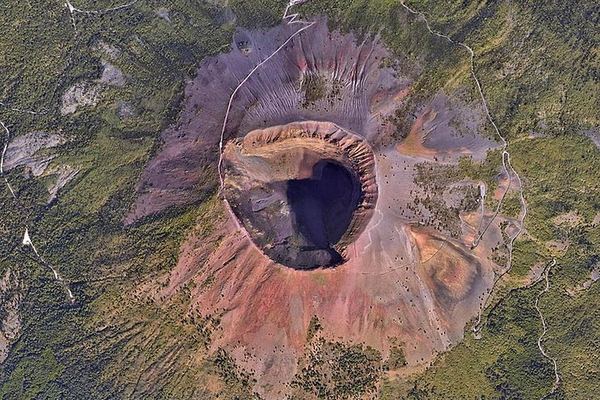
Volcanologists call the whole complex Somma-Vesuvius. According to the Civil Protection Department it has an older building, the Somma, marked by a caldera, and a younger cone, the Vesuvius proper, that grew inside the caldera after the eruption of AD 79. From the bay you can pick out the Somma as the curved ridge beside and behind the cone. Its age is under 39,000 years. Between about 39,000 and 20,000 years ago, eruptions were mostly effusive, with some low-energy explosions, and that is when the Somma was built.
The point for visitors is that the cone you see now is not the mountain the Romans knew. Strabo, writing decades before the eruption, describes the upper part as ash-colored, with rocks that looked eaten away by fire, and guessed that it had once burned. Cassius Dio, who wrote more than a century after 79, compares the mountain to a hunting theatre, hollow in the middle and ringed by intact heights. Neither is a description of the cone you see now. The cone arrived afterward.

Did the Romans know it was a volcano?
Partly. The mountain had rested for about three centuries before 79, a gap the Civil Protection Department gives, and farmland climbed its slopes. Strabo's remarks show an educated guess, not a warning. Pliny the Younger, whose two letters to Tacitus are the main written account, does not mention Pompeii or Herculaneum at all. He writes that, seen from across the bay, the cloud rose from a mountain nobody could name at first, and adds one clause:
Vesuvium fuisse postea cognitum est.
Before that, the mountain's history was a series of long rests broken by very large events. About 18,000 years ago, after a long pause, the volcano produced its first Plinian eruption (the Pomici di Base). More followed, each after a long quiet spell: the Pomici di Mercato about 8,000 years ago and the Pomici di Avellino about 3,500 years ago, before the eruption of 79. The hour-by-hour account of that day is in our guide to the eruption of AD 79. Here we start the day after.
What has Vesuvius done since AD 79?
Vesuvius in ten steps
Dates and descriptions follow the Civil Protection Department's account of the volcano. Prehistoric dates are approximate.
The origins
-
39,000 to 20,000 years ago
The Somma is built
Mostly effusive eruptions, with some low-energy explosions, form the older volcano.
-
About 18,000 years ago
First Plinian eruption
After a long rest, the Pomici di Base eruption changes the volcano's style from mostly effusive to explosive.
-
About 8,000 years ago
Pomici di Mercato
Another large Plinian eruption, again after a long period of rest.
-
About 3,500 years ago
Pomici di Avellino
The last great Plinian eruption before the one that destroyed Pompeii.
-
AD 79
The eruption that buried Pompeii
After about three centuries of rest, it lasts less than two days and sends out around 4 cubic kilometers of ash and lapilli.
The growth
-
AD 472
A sub-Plinian eruption
One of two high-energy explosive events that ended long rests. In between, countless Strombolian and effusive eruptions build the Gran Cono and send lava down the southern and western slopes.
-
1631
Rest of almost five centuries ends
Pyroclastic flows devastate the belt of towns from Pollena to Torre Annunziata and kill more than 5,000 people.
-
1906
One of the two most energetic events of the twentieth century
Explosive and effusive activity. Ash piling on roofs causes many deaths and injuries from collapse.
Today
-
1944
The last eruption
Effusive and explosive. Twenty-one people die in roof collapses and San Sebastiano, Massa di Somma and Terzigno are almost entirely destroyed.
-
As of November 2026
Quiescence
Only fumarolic activity and moderate seismic swarms since 1944. Alert level green.
From 1631 to 1906 the volcano showed almost continuous Strombolian activity with lava flows, and rests of only a few years. Scientists place the end of that open-conduit period at 1944. So "how often does Vesuvius erupt" has two answers. Between 1631 and 1944, often. Before 1631, rarely, but violently, with rests of centuries.
What happened in 1631, 1906 and 1944?
The three cases are described by the Civil Protection Department and they share one lesson. In 1631 the eruption came after a rest of almost five centuries. Pyroclastic flows moved through the towns between Pollena in the north and Torre Annunziata in the south-west and killed more than 5,000 people. The Department chose a 1631-type event as the reference scenario for the emergency plan.
In 1906 and 1944 the killer was weight. Ash and lapilli piled on roofs until they gave way. In 1944, 21 people died this way and three towns were almost destroyed. This is the same mechanism recorded at Pompeii in 79: Giacomelli and colleagues, in a 2003 study, report that within six hours of the start, roofs and parts of walls had collapsed under the pumice load. Lava, which many people picture first, is not what destroyed Pompeii: the town was buried by ash, lapilli and pyroclastic currents.
Is Vesuvius active?
The scientific word is quiescent, and the official description is specific. Since 1944 the volcano has been in a rest with a plugged, or closed, conduit. It has produced only fumarolic activity and seismic swarms of moderate energy, the Department says, with no ground deformation and no significant change in physical or chemical parameters. It also says that no precursory phenomena that would indicate a short-term resumption are being recorded. We quote that, as of November 5, 2026, and we do not forecast.
The record shows that long rests end in strong eruptions, and that the volcano has been resting since 1944. It does not show when anything will happen. Neither do we.
What do the experts consider likely? Based on recent studies, the Department says the most probable event is a violent Strombolian eruption (VEI 3) with fallout of pyroclastic material and mudflows. A geophysical survey found no shallow magma chamber large enough to produce a Plinian eruption, so it calls that unlikely. The emergency plan nevertheless uses a larger, sub-Plinian event like the one of 1631 as its reference scenario. That is what planning does: it prepares for the stronger case without saying that it is coming. Our page of Pompeii myths and facts checks several claims about the mountain.
Who watches the volcano, and what do the alert levels mean?
The monitoring network of the Osservatorio Vesuviano, the Naples section of the national institute of geophysics and volcanology (INGV), watches Vesuvius 24 hours a day. The Department names two competence centers: the Osservatorio Vesuviano and IREA, the electromagnetic sensing institute of the national research council (CNR). Based on what they report, the Civil Protection Department declares an alert level and an operational phase, in agreement with the Campania Region and after hearing the Major Risks Commission.
There are four levels: green, yellow (attention), orange (pre-alarm) and red (alarm). Green means that no anomalous phenomena are recorded compared with the ordinary activity of recent decades. The Department publishes the current level at the top of its Vesuvius page, and the national public alert system is called IT-alert. Our statement that the level was green is dated November 5, 2026; for anything later, read the Department's page and not ours.
What are the red and yellow zones, and where is Pompeii?
| Zone | Exposed to | Who is in it | What the plan does |
|---|---|---|---|
| Red zone | Pyroclastic flows (red zone 1) and a high risk of roofs collapsing under ash (red zone 2) | 25 municipalities in the provinces of Naples and Salerno, including Pompei, Ercolano, Boscoreale, Terzigno, Torre Annunziata and Torre del Greco. About 670,000 residents. | Preventive evacuation is the only protective measure. Each municipality is twinned with a region or autonomous province that would host evacuees. |
| Yellow zone | Significant fallout of ash and pyroclastic material; roofs may collapse where enough ash accumulates | 63 municipalities and three districts of Naples | Municipalities must adapt their emergency plans; national and regional intervention is planned. |
Pompeii is in the red zone. So is Herculaneum. That is a fact about administrative boundaries drawn around the hazard, and it applies to the roughly 700,000 people who live at the foot of the volcano, a figure the Department gives (the plan page gives 670,000 for the red zone). It is why the volcano appears in emergency planning for the whole area. We found no guidance from the Department or the Park asking visitors to change their plans. The plan is built for residents; if an alert level ever rose, you would follow the instructions of the authorities and of the Park's staff, as anyone else on site would.
Can you climb Vesuvius, and how does it fit with Pompeii?
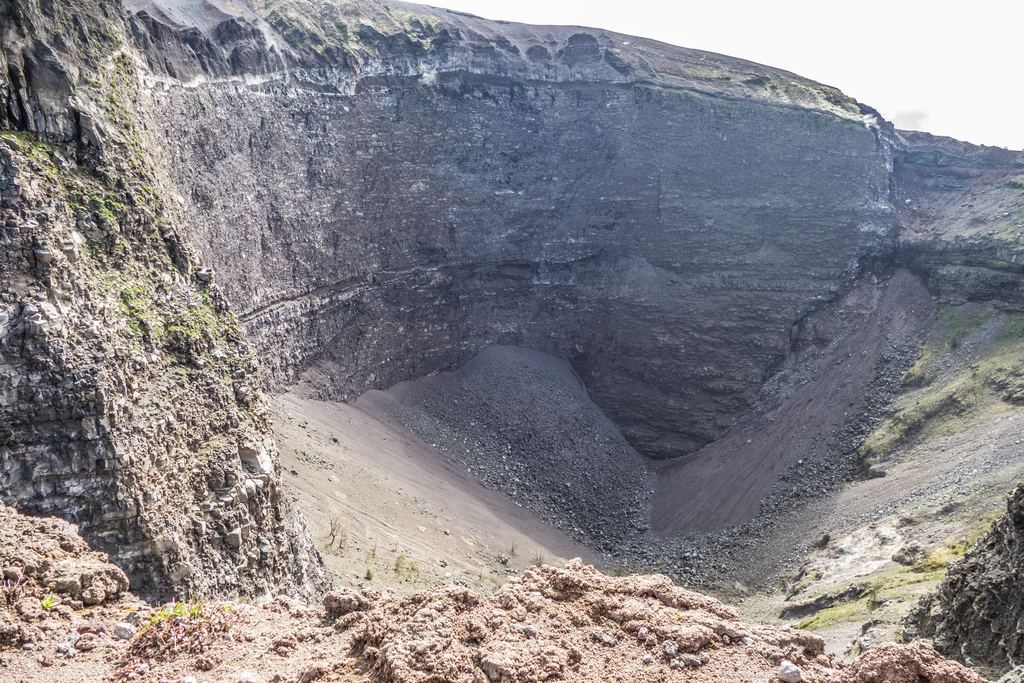
Yes, but not to the crater. As of November 2026, according to the Park of Vesuvius, the open trail ends at the Capannuccia, at 1,170 m. The loop path and the highest section are closed. The Park says tickets for the Gran Cono are sold exclusively online, and the pages we read quote two different ticket prices, so we do not print one.
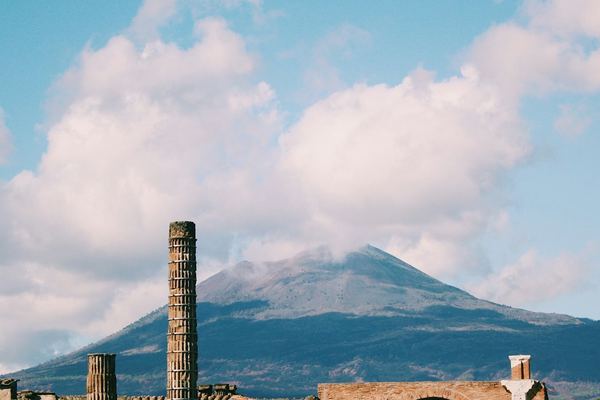
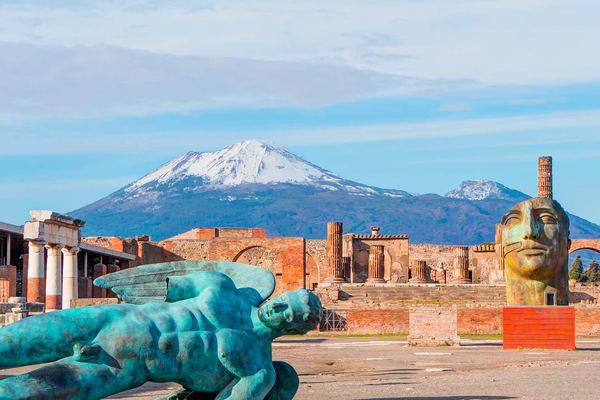
A mountain visit and a Pompeii visit work well on separate halves of the day or on separate days. For tickets and logistics, see our category Pompeii and Vesuvius, which compares combined options. For wind, rain and temperatures, see our climate page. One classic view of the volcano from the ruins is from the Forum.
Questions about Vesuvius
Will Vesuvius erupt again?
Scientists expect it to, eventually, but no one can say when. The Civil Protection Department reports quiescence since 1944, with alert level green as of November 5, 2026. No forecast exists, and we do not make one.
Is Vesuvius active or dormant?
The Department's term is quiescent: no eruptions since 1944, only fumaroles and moderate seismic swarms. It describes a plugged conduit between periods of open activity, not an extinct volcano.
How far is Vesuvius from Pompeii?
About 10 km from the vent to Pompeii (Giacomelli et al. 2003 give the same figure).
Is it safe to visit Pompeii?
Pompeii is inside the red zone of the emergency plan, as are 24 other municipalities. The alert level was green on November 5, 2026. The volcano is monitored 24 hours a day by the Osservatorio Vesuviano.
What is the difference between Monte Somma and Vesuvius?
The Somma is the older volcano with a caldera. Vesuvius is the younger cone that grew inside the caldera after the eruption of AD 79.
Did Vesuvius erupt in 1944?
Yes. It was the last eruption. It killed 21 people through roof collapses and almost destroyed San Sebastiano, Massa di Somma and Terzigno.
Can you see the crater of Vesuvius?
As of November 2026 the open trail stops at the Capannuccia shelter, at 1,170 m, and the full loop is closed. Tickets are sold online only.
Was Pompeii buried by lava?
No. It was buried by ash, pumice and pyroclastic currents. Lava flows came later in the volcano's history and ran down the southern and western slopes.
Go back to the day it happened
Phases, deposits and what Pliny saw, in order.
Pompeii with Vesuvius
Combined visits that pair the ruins with the volcano.
Pompeii and Mount Vesuvius Day Trip from Rome by Coach, with Archaeologist and Lunch
An archaeologist guides the Pompeii visit, lunch looks over the Bay of Naples, and the coach then climbs Vesuvius for a crater walk or a geologist-led hike.
Pompeii and Vesuvius Bus Day Trip from Naples with Light Lunch and Torre del Greco Ascent
Pompeii first, then a light lunch and the Vesuvius climb from Torre del Greco, by bus with pickup in Naples. The trip takes seven to eight hours in all.
Pompeii and Vesuvius Crater Day Trip by Minibus from Sorrento with Alpine Guide
An archaeologist guides Pompeii and an alpine guide leads the climb to the Vesuvius crater on this minibus day trip with Sorrento pickup and tickets included.
Ratings collected by Tiqets, Civitatis, Viator and Tripadvisor
Data verified on . Civil Protection Department (Vesuvio and national plan pages); Park of Vesuvius; Pliny, Letters 6.16; Strabo 5.4.8; Cassius Dio 66.21; Giacomelli et al. 2003. Editorial Policy