
Pompeii was never really lost, and no one found it in a single day. A canal cut through the ruins in the late 1500s without anyone noticing what it had hit. Digging at Herculaneum began under King Charles of Bourbon, and in 1748 he ordered work on the Civita hill, where Pompeii lay. The city was named from an inscription in 1763. The methods that make Pompeii readable came later: Giuseppe Fiorelli in the 1860s, Vittorio Spinazzola and Amedeo Maiuri in the twentieth century, and a run of repairs after the collapse of 2010. The timeline below gives twelve dates, and the sections after it say what each one changed.
Twelve dates in the finding of Pompeii
Dates from the Park of Pompeii where it gives them, otherwise from the standard histories, which are marked in the text below.
The origins
-
Late 1500s
A canal crosses the buried town
Count Muzio Tuttavilla has the architect Domenico Fontana cut a canal across the Civita hill to bring water to pasta mills at Torre Annunziata. It runs through the ancient city and reveals walls and inscriptions. Nobody follows the lead.
-
1738
Herculaneum is explored
Under Charles of Bourbon, the digging at Herculaneum starts. The Park of Pompeii counts about ten years of work there before the king turns to Civita.
-
1748
Digging starts on the Civita hill
Charles III of Bourbon orders excavation at Civita, where structures had come to light. The city has no name yet.
-
1763
An inscription names the city
According to standard histories, an inscription mentioning the res publica Pompeianorum identifies the town as Pompeii.
The growth
-
1860s
Fiorelli takes over
After Italian unification the state runs the site. Fiorelli makes the first plaster casts in 1863, divides the city into regions, blocks and numbered doors, and founds an archaeological school in 1866.
-
1910 to 1923
Spinazzola digs the Via dell'Abbondanza
Vittorio Spinazzola opens a long stretch of the main east-west street and its houses and shops, a campaign published in 1953 under his name.
-
1924 to 1961
Maiuri's long directorship
Amedeo Maiuri runs the site for almost four decades. Standard histories credit him with digging below the layer of AD 79 in places such as the House of the Surgeon.
-
1943
Bombs fall on the site
Allied bombing destroys the Antiquarium and damages frescoes and casts. A new Antiquarium opens in 1948.
Today
-
6 November 2010
The Schola Armaturarum collapses
The building known as the House of the Gladiators falls. Press reports linked the collapse to heavy rain and to a roof rebuilt in the 1940s and 1950s. It reopens on 3 January 2019.
-
2012
The Great Pompeii Project
A European Commission decision of 29 March 2012 funds about 105 million euros of work on excavation fronts and drainage.
-
2018
New digging in Regio V
A wedge of more than 1,000 square meters is opened beside the House of the Silver Wedding. In October a charcoal inscription turns up. The thermopolium is fully uncovered by December 2020.
-
2023 to 2025
Regio IX, Insula 10
Work begins on 27 February 2023 and produces a household shrine with its last offering, a blue-walled sanctuary, two victims and a private bath complex.
Was Pompeii forgotten for 1,700 years?
No. The ancient geographer Strabo knew a living Pompeii, a river port on the Sarno. After AD 79, according to the Park, survivors came back to recover what they could, and centuries of clandestine digging followed. Nobody was excavating systematically, but the ruins were not unknown. Fontana's canal, at the end of the sixteenth century, cut the whole hill and exposed structures and inscriptions. The Park's phrase for that moment: "the time was not yet ripe."
In the late 1500s Pompeii lacked a patron with money and a reason to dig, not information. Charles of Bourbon had both. His men were already digging at Herculaneum, and the Park says the work moved to Civita in 1748 after ten years there. The early campaigns were driven by the search for objects more than by a wish to understand a town.

What did the first excavators do between 1748 and 1860?
The early digs were run by engineers. Roque Joaquín de Alcubierre led the work at Civita (standard accounts, not a Park source), and Karl Weber made plans and surveys that historians treat as the first systematic record. Francisco La Vega took over in 1764. They worked under a king who wanted objects, and the best panels and mosaics were cut out and taken to Naples. That is why the National Archaeological Museum holds so much of what you will see described as "from Pompeii." Our guide to Pompeii at the Naples museum sorts out what went where.
The finds went to the royal collection in Naples. The lasting legacy is the paperwork: plans and surveys that record how some buildings looked when they were opened.
What changed with Fiorelli?
When Italy was unified in the 1860s, Pompeii passed to the state, and Giuseppe Fiorelli took charge (sources give 1860, 1861 or 1863 for the year he became director). He did four things that still shape the site. He dug from the top of the deposit downward. He divided the city into regions, blocks (insulae) and numbered entrances, so a door could be given an address. He made the first plaster casts of victims in 1863, as described in our page on the body casts. And he started a school of archaeology in 1866, with a library in the House of the Plaster Corpses (VI 17,27), both closed in 1875.
That address system is why a house is called "VI 15,1" and not "the one with the painted Priapus." It is also the structure behind our address book of buildings.
| Person | Years active | What they are known for |
|---|---|---|
| Domenico Fontana | Late 1500s | Built the canal that cut through the buried town. |
| Roque Joaquín de Alcubierre | From 1748 | Spanish military engineer who led the first digging on the Civita hill. |
| Karl Weber | Eighteenth century | Engineer who produced plans and surveys of the excavations. |
| Francisco La Vega | From 1764 | Took over direction of the digging from Weber. |
| Giuseppe Fiorelli | 1860s | Casts, regions and blocks, top-down excavation, school of archaeology. |
| Vittorio Spinazzola | 1910 to 1923 | Excavated the Via dell'Abbondanza and the Schola Armaturarum. |
| Amedeo Maiuri | 1924 to 1961 | Director for almost four decades; dug below the AD 79 layer. |
How did Spinazzola and Maiuri change the digging?
Spinazzola's campaign on the Via dell'Abbondanza between 1910 and 1923 exposed one of the main streets of the city along its whole length, with the frontages of its houses and shops. He found the Schola Armaturarum in 1915, and in 1914 he dug the garden of the House of the Cryptoporticus, where four casts were made. Maiuri, who directed from 1924 to 1961, carried the digging into the 1950s south of the street. By standard accounts he also became the first to dig beneath the AD 79 layer, in the House of the Surgeon, looking for what lay under the city that burned.
The stretch of the Via dell'Abbondanza that visitors walk exists because it was dug whole. So does a problem that came with it: large areas left open to rain and sun for a century.
Bombs, earthquakes and collapses
The twentieth century was hard on the site. Bombing in 1943 destroyed the Antiquarium and damaged frescoes and casts. Maiuri and his staff restored part of what was hit, and a new Antiquarium opened in 1948. The Irpinia earthquake of 1980 caused more damage, and the Antiquarium stayed closed for decades afterward. UNESCO listed the area in 1997 as "Archaeological Areas of Pompei, Herculaneum and Torre Annunziata," under criteria iii, iv and v.
On 6 November 2010 the Schola Armaturarum, a building used by an association of military type, collapsed. Newspapers tied it to heavy rain and to a roof rebuilt in the 1940s and 1950s. The building reopened on 3 January 2019. It was the shock that gave the Great Pompeii Project its urgency: a decision of the European Commission on 29 March 2012 set aside about 105 million euros of European and national money to stabilize excavation fronts and reduce the hydrogeological risk. In 2013 UNESCO-appointed experts warned that, without substantial progress within two years, an "in danger" listing would be inevitable.
The Great Pompeii Project is mostly invisible. It was about retaining walls, drainage and the edges of old trenches. If you wonder why a visitor sees so little "new" at Pompeii for the money spent, that is the reason: the work held the old digs together.
Digging less, visiting more
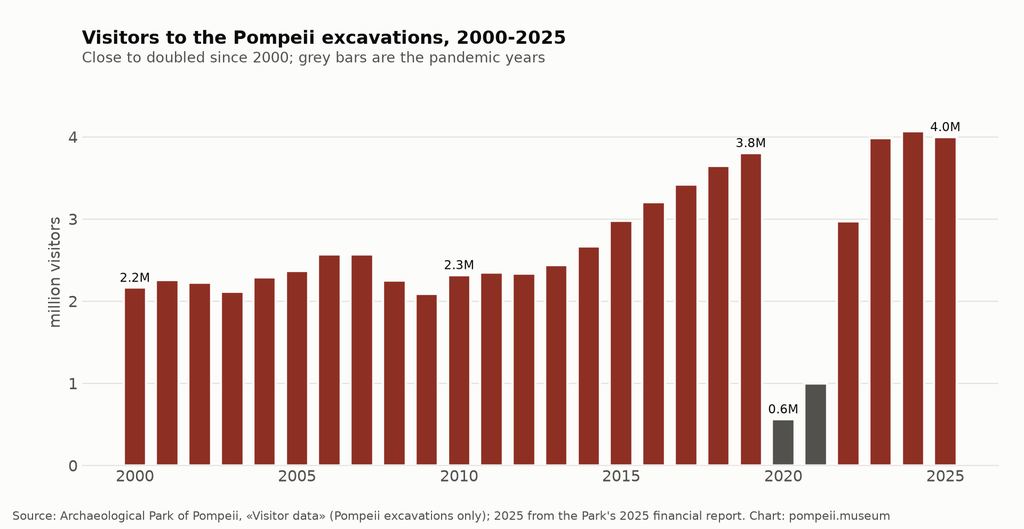
As the digging slowed, visiting grew. The Park's own series for the Pompeii excavations goes from about 2.17 million visitors in 2000 to about 3.81 million in 2019, then to about 565,000 in 2020 and about 1.0 million in 2021, the pandemic years. It passed 4.0 million in 2024 (about 4.07 million in the Park's published series; other official tables differ by a few percent) and was 4,000,090 in 2025. The chart shows the scale the Park has to manage.
What are they excavating now? Regio V and Regio IX
Since 2018 the digging has been in two places, both inside the city walls. In Regio V a wedge of more than 1,000 square meters opened between the House of the Silver Wedding and the Vicolo di Lucrezio Frontone. It produced the charcoal inscription of October 2018, discussed on our page on the eruption hour by hour, and a thermopolium, a street-food counter, painted with a Nereid riding a sea horse. It was fully excavated by December 2020 and opened to the public on 12 August 2021.
In Regio IX, Insula 10, work began on 27 February 2023. The Park's communiqués list the finds: a still life in June 2023; election slogans on walls and the last offering on a household altar in September 2023; a shrine with blue walls in June 2024; two victims, a man and a woman with coins and jewelry, in a service room in August 2024; and in January 2025 a private bath complex for up to thirty people, which the Park's communiqué ranks among the big ones known, next to a banquet hall painted black with third-style scenes of the Trojan War.
A principle behind the new digs
In its August 2024 communiqué the Park says the Regio IX digs are part of a wider project to secure the excavation fronts, with the excavation areas carefully circumscribed. Money for new excavation goes to the area around Pompeii instead: Civita Giuliana, the Villa of the Mysteries and Oplontis. It is a deliberate choice, stated in the communiqué.
It also explains why you may find no new houses to walk through even when the news carries a discovery. The finds are reported from the trench, and the building is not necessarily open.
How much of Pompeii is still buried?
About two thirds of the city has been excavated, according to Giacomelli and colleagues (2003). UNESCO's page gives about 44 hectares as the excavated area; other documents use other perimeters, and the 98 hectares in UNESCO's listing belong to the whole serial site, including Herculaneum and Torre Annunziata. The authors estimate about 464 victims still lie in the unexcavated third. The rest of the city stays under the ash, partly because of the Park's choice to leave it.
"Found in 1748" compresses a longer story. Also, visitor counts for "Pompeii" sometimes mean the four sites the Park runs; the chart above counts the excavations alone.
Where to go next
Three pages that pick up where the excavation story leaves off.
Questions about the excavation of Pompeii
Who discovered Pompeii?
No single person did. A canal built by Domenico Fontana crossed the site at the end of the 1500s. Systematic digging began in 1748 under Charles III of Bourbon, with Roque Joaquín de Alcubierre in charge in the field.
When was Pompeii discovered?
The Park of Pompeii gives 1748 as the start of excavation. The identification of the town as Pompeii, from an inscription, is dated to 1763 in standard histories.
Why was Herculaneum found before Pompeii?
Work at Herculaneum began under Charles of Bourbon, and the Park of Pompeii counts about ten years of exploration there before the king ordered digging on the Civita hill in 1748.
Was Pompeii forgotten for 1,700 years?
No. Survivors returned, looters worked the ruins, and a canal cut through the site in the late 1500s. What was missing was organized excavation.
How much of Pompeii has been excavated?
About two thirds of the ancient city, according to Giacomelli et al. (2003). UNESCO gives about 44 hectares as the excavated area.
Are they still excavating Pompeii?
Yes, in a limited way. Since 2018 the work has been in Regio V and Regio IX, and the Park says the dig areas are carefully circumscribed within a wider project to secure the excavation fronts.
What did Giuseppe Fiorelli do?
He made the first plaster casts in 1863, divided the city into regions, blocks and numbered entrances, dug from the top down, and set up an archaeological school in 1866.
What happened to the Schola Armaturarum?
It collapsed on 6 November 2010. Press reports linked the failure to heavy rain and to a roof rebuilt in the 1940s and 1950s. It reopened on 3 January 2019.
What was the Great Pompeii Project?
A program funded by European and national money, about 105 million euros, to secure excavation fronts and reduce hydrogeological risk, following a European Commission decision of 29 March 2012.
Data verified on . Dates from the Park of Pompeii where it gives them; standard histories otherwise. Checked 5 November 2026. Editorial Policy