
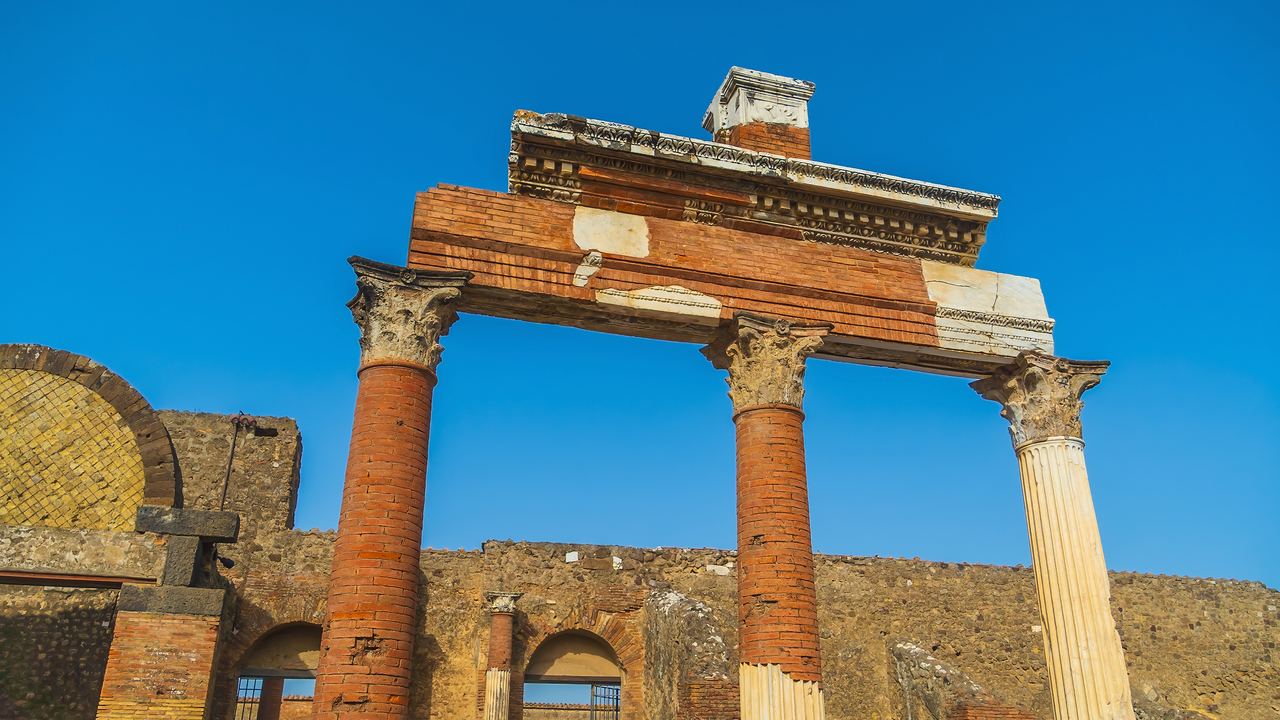
The way to beat the heat at Pompeii is to enter on the 9:00 slot, do the open streets before late morning, and be out of the sun, or out of the site, by about 13:00. The reason is geometry more than thermometers: on July 15 the sun stands 35° above the horizon at 9:00 and 71° at 13:10 (our calculation). Summer highs run 31 to 32 °C in July and August, and the ruins are open ground with little roof. The Park does not close or shorten the visit for heat, as far as we could find. What follows is the evidence, the hour-by-hour rule we derive from it, and what to do about shade, water and your own limits.
How hot does Pompeii get in July and August?
There is no weather station at Pompeii, so we use the two stations of the World Meteorological Organization (WMO) that bracket it: Capri on the coast and Grazzanise on the inland plain. The 1991-2020 normals give highs of 28 to 29 °C in June, 30.6 to 31.7 °C in July and 31.5 to 32.4 °C in August. Nights do not cool much: lows average 18.5 to 22.3 °C in July and 18.9 to 23.0 °C in August. Days at 30 °C or above number 19 (Grazzanise) to 23 (Capri) in July and 23 to 26 in August. The month-by-month tables are on our weather and climate page.
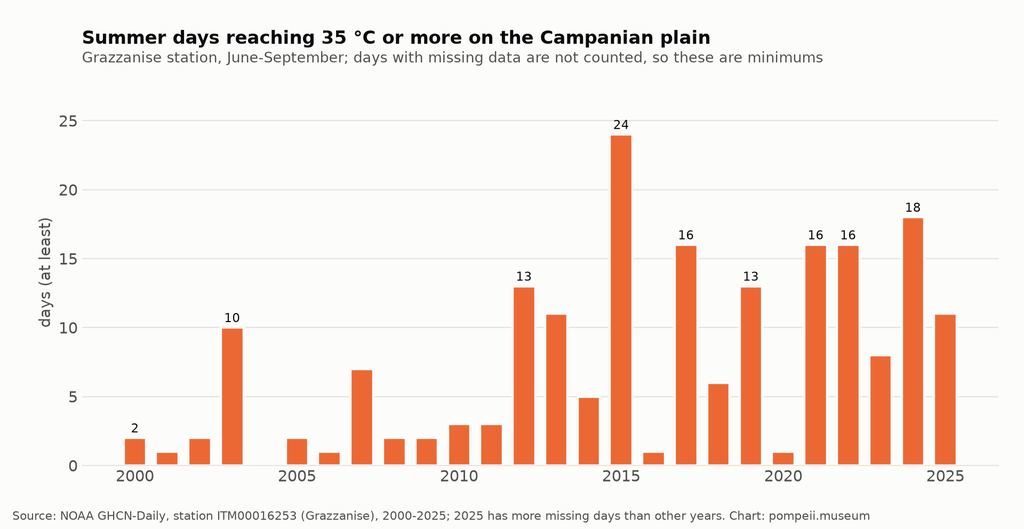
The normals describe a 30-year average, and they hide a trend. The WMO does not count days at 35 °C or above, so we counted them ourselves from the daily record of the Grazzanise station, for June to September. From 2000 to 2010 the plain saw an average of 2.9 such days a year. From 2015 to 2024 it saw 11.9, with a peak of 24 in 2015 and 16 to 18 in each of 2021, 2022 and 2024. Days at 30 °C or above rose from about 47 to about 68 a year over the same comparison. Every one of these figures is a floor: the station has gaps, with between 74 and 118 days of data out of the 122 in a June-to-September season, and 2025 is incomplete so we left it out of the averages. Pompeii is roughly 50 km south-east of Grazzanise, so these counts are a guide and not a measurement. In the WMO normals the coastal station, Capri, has the higher average highs in July and August (31.7 and 32.4 °C against 30.6 and 31.5), but we counted days at 35 °C only for Grazzanise. The direction of travel is the same.
Is the heat the problem, or the crowd?
Both, but August is not the crowd peak. Official monthly counts show an average of about 14,900 visitors a day in June, 14,200 in July and 13,700 in August (2023-2025), against 16,200 in both April and May. August is not the busiest month at Pompeii; it is slightly emptier than spring. The daily cap of 20,000 entries has applied since November 15, 2024, and as of November 2026 the Park's timetable page still lists it. Our crowd calendar has the full series.
The two problems stack. Heat sends everyone to the same few covered places at the same hours, and the site has no way to spread you out beyond the entry windows. If your dates are fixed in July or August, the useful question is not "how do I avoid the crowds" but "which hours do I give to the sun and which to the shade".
What is the best time of day to visit Pompeii in summer?
We have no hourly temperatures. The WMO tables give daily highs and lows only, and the Park publishes no counts by hour. What we do have are the Park's entry rules and the position of the sun, and they point to one rule. From March 16 to October 14 the Park opens at 9:00, takes its last entry at 17:30 and closes at 19:00 (as of November 2026). The 20,000 daily entries are split into a 9:00 to 13:00 window of up to 15,000 and a 13:00 to 17:30 window of up to 5,000. Both are entry windows, not visit lengths: you can walk in at 12:55 on a morning ticket.
| Hour | Sun height | What it's like | What to do |
|---|---|---|---|
| Before 9:00 | Low | The gate is shut. The Park's 2024 guide describes metal detectors and bag checks at the entrances. | Be in line before your slot starts, with water already in your bag. |
| 9:00 to 11:00 | 35° to 57° | The 15,000-entry morning window opens. The sun climbs fast but the streets are still partly shaded by the walls. | Do the open ground first: the Forum, the main streets, the wide squares. |
| 11:00 to 13:00 | 57° to 71° | The sun reaches its highest point at about 13:10. Walls give less shade each minute. | Move to covered spaces and gardens, or start leaving. |
| 13:00 to 15:00 | 71° to 59° | Highest sun, and air that usually keeps warming for hours after it. The smaller afternoon window of 5,000 opens. | If inside, rest in shade and drink. If not, do not start here. |
| 15:00 to 17:30 | 59° to 32° | Shadows lengthen. Last entry is 17:30. | A good time to enter if you want a shorter, gentler visit of about three hours. |
| 17:30 to 19:00 | 32° to 15° | Nobody new gets in. The Park closes at 19:00. | Final loop only, and mostly a walk out. |
| After 19:00 | Below 15° | Closed. Sunset is at about 20:32 on July 15, so the best evening light is outside the walls. | See the evening events in our guide to <a href="https://pompeii.museum/plan/pompeii-at-night/">Pompeii after dark</a>. |
Our rule for July and August: enter on the 9:00 slot, finish the exposed streets by 11:30, and be out of the sun or out of the site by 13:00. If 9:00 is impossible, enter from 15:00 and plan on three hours, not a full day.
Why 9:00 and not later in the morning? The sun is 35° high at 9:00 and 57° by 11:00, and because the morning window is the larger one, so a 9:00 ticket is the easiest to find. Why not the late-afternoon entry as the default? The pool is smaller, 5,000 entries, and we have no data on how often it sells out. Book that slot early. One caution on the 13:00 line: the sun peaks around 13:10 in July, but the air generally goes on warming for some time afterward. We cannot name the hour of the daily maximum for Pompeii, and no source we found does.

How much water, and where do you refill?
The Park's FAQ says there are many drinking water fountains inside the excavation. The 2024 accessibility guide made with the Park says much the same. None of these documents gives a number or a map reference, and the Park's heat notice of 27 June 2025 tells visitors to consult the map handed out at the gates. So we will not tell you where the taps are. Do take a refillable bottle, and fill it before you walk in.
The visitor regulations ban eating outside the designated areas and ask visitors not to leave fountain taps running. They do not mention drinks. The Ministry of Health's heat-risk page, which we read in full, gives no figure in liters, so we do not give one either. The Park's 2025 notice tells visitors to bring water and to drink even when they are not thirsty. Bag limits and the rest of the packing list are in what to wear and bring.
Where is the shade at Pompeii?
There is no permanent shade page and no count of shaded areas. What the Park does is issue a heat notice in summer, with a map, naming the shaded zones and the buildings with roofs. The most recent one we found is dated 27 June 2025 (earlier ones are from July 2023 and July 2024). In 2025 its main shaded zones were the Triangular Forum, the pine grove along Viale delle Ginestre, the Garden of Giulia Felice, the Bosco Sacro, Viale dell'Anfiteatro and the Porta Stabia necropolis, and the 2024 list added the arcades of the amphitheatre. Each notice also lists covered buildings. Which houses are open changes from week to week, so we name none; the Park keeps the current list on its houses page.
Gardens, tree-lined paths and covered rooms exist, but the street grid, the squares and the temple platforms are open to the sky. Plan the exposed part of your route for the first two hours and the shaded part for the last hour before you leave. A wide-brimmed hat and sunglasses do more than any route. Parasols are a gray area: the 2025 regulation does not list umbrellas, while the Park's 2024 guide says not to bring them. A hat avoids the question.
Heat safety: what the authorities say
The Italian Ministry of Health says heat stroke can strike outdoors, indoors, or in a place the sun does not hit directly. The first sign is often sudden malaise, followed by headache, nausea, vomiting, dizziness and confusion, and body temperature can reach 40 to 41 °C within 10 to 15 minutes. Its advice for these symptoms is to call the emergency services; the EU number, 112, works in Italy. The Ministry also runs a heat-wave bulletin that covers Naples, one of 27 cities, with forecasts at 24, 48 and 72 hours. The pages we read on November 5, 2026 give no figures for liters or hours of the day, and we do not quote any.
The Park's own rules add two things. Its regulation asks for extreme prudence from visitors with cardiovascular or mobility problems, and its 2025 notice names children and older people as the groups to keep out of the hottest hours. It also asks for hats, sunscreen, sunglasses and water. According to the Park's FAQ, the first-aid post is on Vicolo degli Augustali. If you travel with children, our guide to Pompeii with kids covers pacing and breaks.
What changes in July and August, and what does not?
The summer timetable is the same from March 16 to October 14, so July is not special on paper. We read the timetable page, the visitor regulations and the service notices on November 5, 2026 and found no rule that closes routes or shortens the day for heat. Plan as if no one will do it for you. Two things do change in practice. The Park closes at 19:00, well before the sunset at 20:32 in mid-July, so the long golden evening belongs to the outside world. And the nearby sites that depend on weather behave differently: the path on Vesuvius closes automatically, with a refund, from an orange weather alert issued by the regional civil protection. The rule we found names weather alerts, not heat. See Vesuvius and Pompeii.
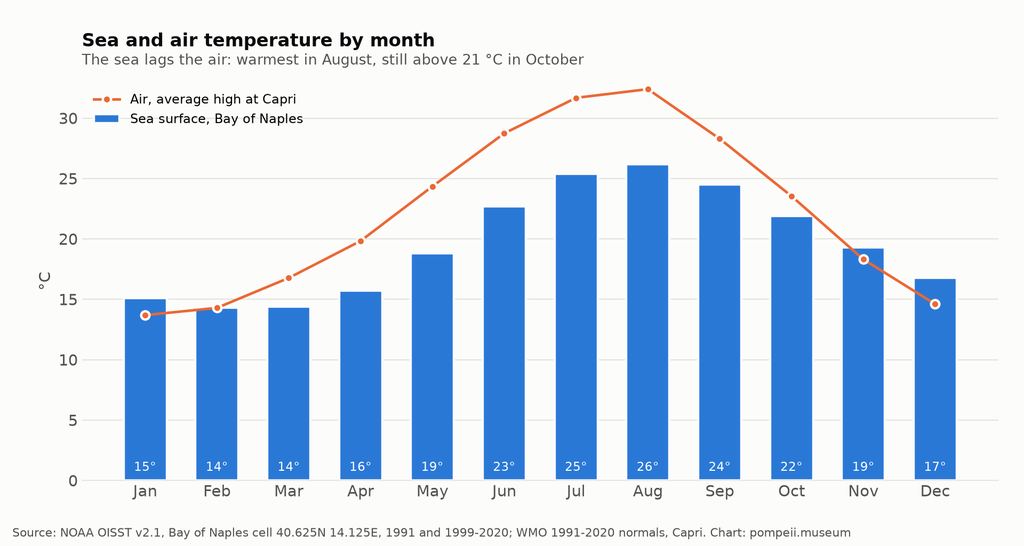
If you can choose the month, June and September have similar highs to the peak of summer (28 to 29 °C in June, 27.6 to 28.3 °C in September) and a warmer sea in September than in June. Late May reaches 24 °C. The whole comparison sits in our best time to visit guide.

Can you pair Pompeii with the sea?
Yes, and summer is the season built for it, as long as you treat the two as separate halves of a day. The Gulf of Naples averages 22.7 °C in June, 25.4 °C in July, 26.2 °C in August and 24.5 °C in September (NOAA, 23 years, open-water cell, so beaches differ). Against a daily high at Capri of 31.7 °C in July, the sea sits about 6 degrees below the air, which is the point of going in. The sea is warmer than the air only from November.
Wind helps too. Capri counts only 2.1 to 3.3 days a month with wind at 10 m/s or more from June to August, against 10.6 in December, so crossings are less likely to be cancelled. The Salerno to Amalfi service of Travelmar says its service runs all year, and the Salerno to Amalfi crossing takes about 35 minutes on its timetable. We could not verify the operating dates of the Capri lines, which publish times in a script we cannot read, so check before you plan around them. Two of our guides cover the coast: Pompeii and the Amalfi Coast and Pompeii from Naples and Sorrento.
Summer questions
Is Pompeii too hot in August?
It is hot, not unbearable, if you plan for it. Highs average 31.5 to 32.4 °C and the site has little roof. August is no more crowded than May, at about 13,700 visitors a day against 16,200.
What is the best time of day to visit Pompeii in summer?
The 9:00 entry, with the exposed streets done by about 11:30 and a plan to be in shade or outside by 13:00. An afternoon entry from 15:00 also works for a three-hour visit.
Does Pompeii close when it is too hot?
We found no rule that closes routes or shortens the day for heat. We checked the timetable, the regulations and the notices on November 5, 2026. Watch for service notices on the day.
Are there drinking fountains inside Pompeii?
The Park says there are many. It does not give their number or location, and refers visitors to the map handed out at the entrances. Bring a refillable bottle anyway.
Can I bring an umbrella for shade?
The 2025 regulation does not list umbrellas, but the Park's 2024 guide says not to bring them. A hat is the safer choice.
How many days a year does Pompeii reach 35 °C?
There is no Pompeii station. The plain station of Grazzanise, roughly 50 km to the north-west, logged at least 11.9 such days a year in 2015-2024, against 2.9 in 2000-2010. Both figures are floors.
What if someone feels ill from the heat?
The Ministry of Health says to contact the emergency services when symptoms such as sudden malaise, headache, nausea, dizziness or confusion appear. The number is 112. Move the person to shade first.
Is summer a good time to combine Pompeii with the sea?
Yes. The Gulf is at 22.7 to 26.2 °C from June to August, and the wind-cancellation risk is lowest in those months. Keep Pompeii and the beach as two halves of the day.
Know the heat, now plan the day
Packing list, shoes and bag rules for a summer visit.
Guided visits that fit a morning start
Group and private options in the Pompeii category.
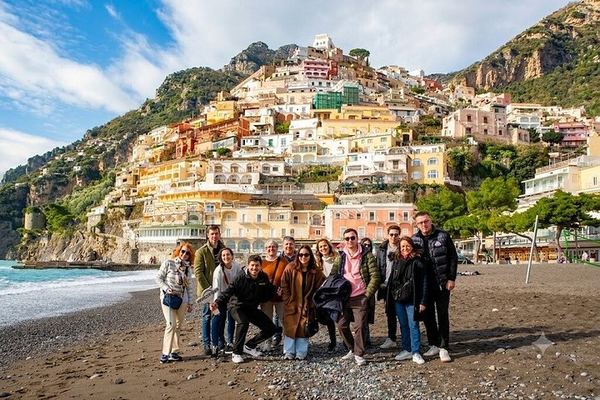
Amalfi, Limoncello Tasting and Pompeii Guided Group Day Tour from Naples
A limoncello shop tasting and an optional boat ride in Amalfi precede a 2-hour guided tour of Pompeii, with the entrance fee included and lunch optional.
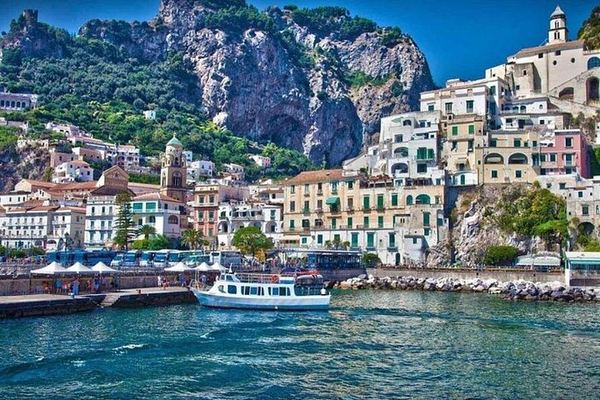
Cruise Passenger Day Tour: Positano, Sorrento and Pompeii from Naples or Salerno Port
Timed around cruise arrivals, this day tour gives one hour each in Positano and Sorrento, then a two-hour guided visit at Pompeii before the return to the ship.
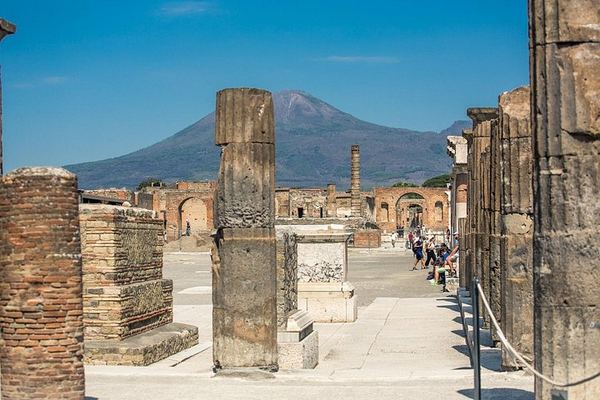
Early Morning Pompeii Tour from Sorrento: Skip-the-Line Entry, Official Guide
A coach leaves Sorrento early to beat the traffic and crowds, then an official guide leads a 2 hour 30 minute walk through Pompeii with priority entrance.
Ratings collected by Viator and Tripadvisor
Data verified on . WMO normals 1991-2020; GHCN-Daily (Grazzanise); NOAA OISST; our solar calculation; Park timetable and regulation; Ministry of Health pages. We are independent of the Park. Editorial Policy