
This is a plain-English Pompeii glossary of 98 terms: atrium and impluvium for the house, insula and regio for the map, opus sectile for the floors, tephra and pyroclastic flow for the eruption. Terms are grouped by theme, so you can read one section before a visit or look up a single word on the way. The definitions are short and paraphrased from the sources named at the bottom.
pompeii.museum is independent and not affiliated with the Archaeological Park. For the places themselves, see our address book of houses and buildings; for the paintings, the four styles; for the volcanic words in action, the eruption of AD 79.
Which words trip people up most?
Four words cause most of the confusion, because the modern use differs from the ancient one or from what a sign suggests.
- Insula in strict Latin was a block of property under one owner, and at Rome or Ostia the word also fits a block of flats. At Pompeii it is the standard name for a city block bounded by streets, which is a modern convention.
- Graffiti are incised. Most of what visitors call graffiti on the walls is paint, and the proper word is dipinti.
- Thermopolium is a modern revival of a rare literary word, not what a Pompeian would have called the snack bar.
- Oecus is applied by scholars to many different rooms, and Michael Binns, whose glossary is one of our sources, warns that the word is badly overused.
If a sign or a guidebook uses a Latin word with confidence, remember that many of them are labels modern scholars attached, not what the owners said.
The house: rooms, gardens and furnishings
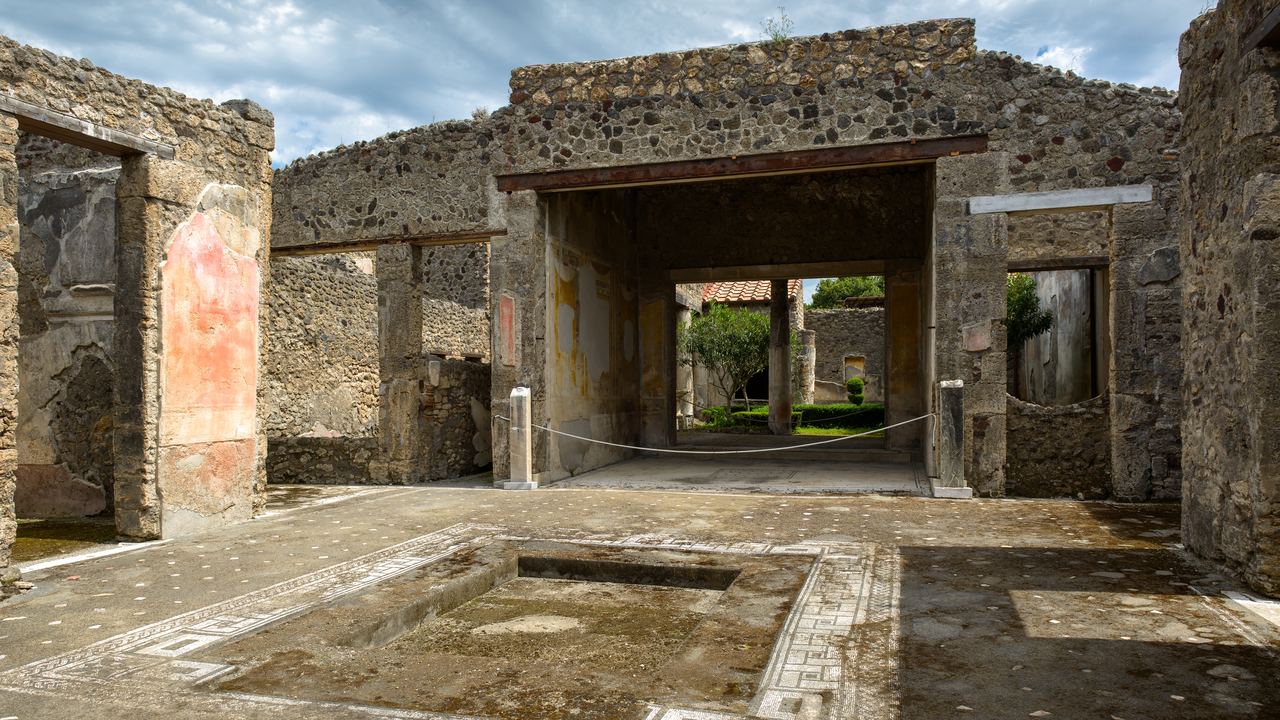
A domus is built around two spaces, the atrium and the garden court, with the reception rooms between them. The Houses of the Faun and the Vettii show the plan clearly. Examples are on our buildings page.
| Term | Meaning |
|---|---|
| domus | A town house of a well-off family, or of some rich freed slaves. |
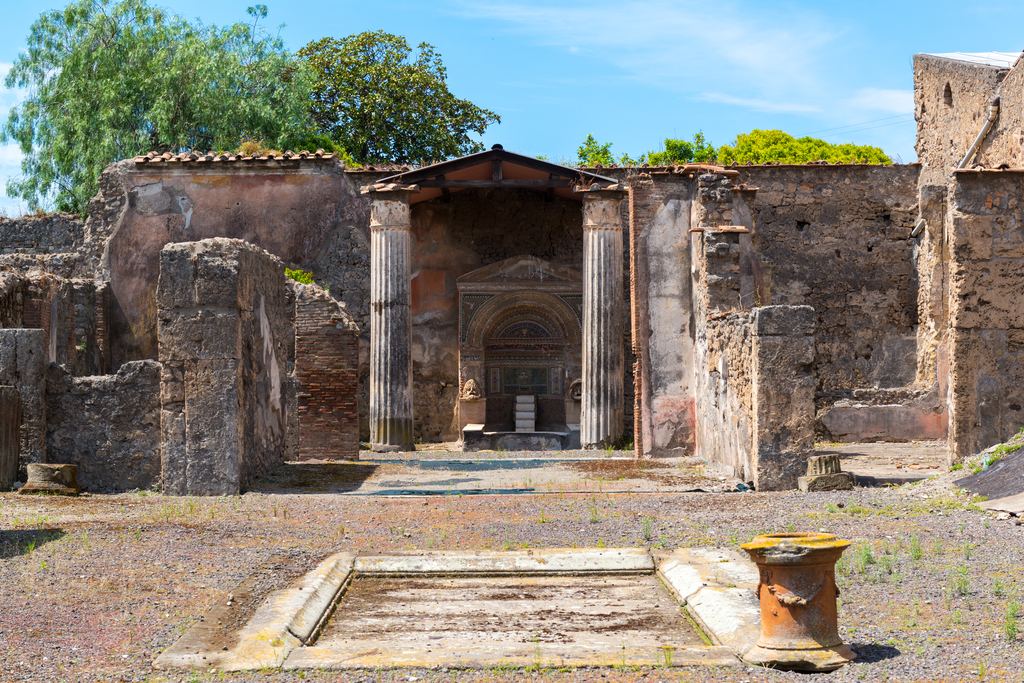
| atrium | The main hall of a domus, with an opening in the roof that let in light and air. |
| compluvium | The opening in the atrium roof through which rain fell. |
| impluvium | The basin under the compluvium that caught the rainwater. |
| fauces | The entrance passage between the street door and the atrium. The word means "throat" and is always plural. |
| ala (alae) | A side extension at the back of the atrium, more a recess than a proper room. |
| tablinum | The room between atrium and peristyle: the owner's study or reception room. In the House of the Vettii it was removed to make space for the garden. |
| cubiculum | A private room. It was not only a bedroom: important guests could be received in one. |
| triclinium | The formal dining room, with three couches around a table. |
| oecus | A large reception room (in Vitruvius also a banquet hall). Binns notes that modern scholars use the word too freely. |
| peristylium (peristyle) | A garden surrounded by a colonnade, usually at the back of the house. |
| Rhodian peristyle | A peristyle in which one side (at Pompeii the north) has taller columns than the others. The Park uses the term for the Houses of the Menander, the Silver Wedding and the Golden Cupids. |
| exedra | A recess or semicircular room with seats. The Park also calls the big room between the two peristyles of the House of the Faun an exedra. |
| lararium | The household shrine of the Lares: an altar, niche or small chapel, often with the Lares painted and sometimes snakes. |
| aedicula | A small shrine shaped like a miniature temple with a pediment, used for the household cult or as a monument. |
| viridarium | An ornamental garden inside the house. The Park uses the word for the House of the Ceii. |
| hortus | A pleasure garden or a kitchen garden. |
| culina | The kitchen, normally toward the back of the house. |
| taberna | A shop or business premises, often at street level next to the entrance of a domus. |
| euripus | A decorative garden canal with fountains and little bridges, as in the House of Octavius Quartio. |
| cryptoporticus | A covered, half-buried gallery lit by openings in the vault. |
| nymphaeum | A monumental fountain or grotto with niches, statues and mosaics, dedicated to the nymphs. |
| villa rustica | A farm or country villa with an agricultural side. Villa Regina at Boscoreale is the Park's example. |
| villa (suburban) | A country residence outside built-up areas, unlike a domus. At Pompeii the "suburban villas" are the ones just outside the gates. |
| torcularium | The room holding the grape press (Villa Regina). |
| dolium | A big terracotta jar for fermenting and storing wine and food. Snack-bar counters have them set into the top. |
| pistrinum | A mill and bakery, with millstones and an oven. |
| fullonica | A laundry and dye works, where wool was finished and clothes were washed. |
The city: streets, markets and public life
These are the words behind the map. For how they come together in a working street, with the food shops and the baths, see daily life in Pompeii.
| Term | Meaning |
|---|---|
| insula | Strictly, in Latin, a block of property under a single owner; also a block of flats at Rome and Ostia. The sense of a city block bounded by streets, used at Pompeii, is modern usage according to Binns. |
| regio | A grouping of insulae, a term Binns calls "purely modern". Pompeii has nine (I to IX), following the scheme of Giuseppe Fiorelli. |
| decumanus | An east-west street in a Roman town. At Herculaneum the Park calls the streets parallel to the coast decumani and the perpendicular ones cardines. |
| cardo | A north-south street. Binns suggests simply saying "north-south street". |
| forum | The public square, used for markets, civic life and religion. |
| basilica | A large public hall with several aisles, used for courts and business, next to the forum. |
| macellum | A covered market for fresh food such as meat and fish, beside the forum. |
| thermopolium | A counter selling hot ready food. For Binns it is a modern revival of a literary term. |
| popina | A tavern serving drink and simple food. In a rough check Binns counts 131 at Pompeii. |
| caupona | An inn. Binns notes that the word usually carries a note of disapproval. |
| lupanar | A brothel. The Lupanar of Pompeii (VII.12.18-19) was built for the purpose. |
| castellum aquae | A water tower, the point where a town's supply was divided. Pompeii's stands at the highest spot in the city (42 m) and takes water from the Serino aqueduct. |
| pomerium | The sacred boundary of a city; for Binns originally a cleared strip outside the walls, where building and burial were not allowed, and later simply the line of the city limit. |
| necropolis | A monumental cemetery outside the walls, along the roads that leave the town, like the Street of the Tombs. |
| amphitheatrum | An oval building with tiered seating for gladiator fights and shows. |
| odeum | A small covered theatre for music and recitals. At Pompeii it is VIII.7.19, according to Binns. |
| comitium | In Rome the assembly space. At Pompeii the Park uses the word for the election hall and municipal offices on the Forum. |
| capitolium | A temple of the triad Jupiter, Juno and Minerva. At Pompeii it is the Temple of Jupiter (VII.8.1). |
| augustales | A board of six priests, drawn from freed slaves, who looked after the cult of Rome and Augustus in each town (Binns). A priestly order of the same name existed in Rome and is not the same thing. |
| duoviri (duumviri) | The two highest magistrates of a town, elected each year. |
| mensa ponderaria | The official table of weights and measures, near the Forum. |
| schola | The seat of an association. The Schola Armaturarum (III.3.6) housed a military-style one. |
The baths
A Roman bath was a sequence of rooms, usually cold to hot or the reverse. The Stabian, Forum, Suburban and Central Baths are all in the tables on our buildings page.
| Term | Meaning |
|---|---|
| apodyterium | The changing room, the entrance of the baths. |
| frigidarium | The cold room, often with a plunge pool. |
| tepidarium | The warm room, heated from below by a hypocaust. |
| caldarium | The hot room with a hot-water basin, the hottest on the route. The Park writes <i>calidarium</i>. |
| laconicum | A dry sweating room, often round and domed. |
| palaestra | An open exercise area, usually with a portico, either separate or part of the baths. |
| praefurnium | The furnace, and the space around it, that heated the hot rooms. |
| hypocaustum | Underfloor heating: hot air circulating beneath the floor. |
Building techniques and mosaic
You can read a wall's age from how it was built. The sequence below runs roughly from the 2nd century BC to the early empire.
| Term | Meaning |
|---|---|
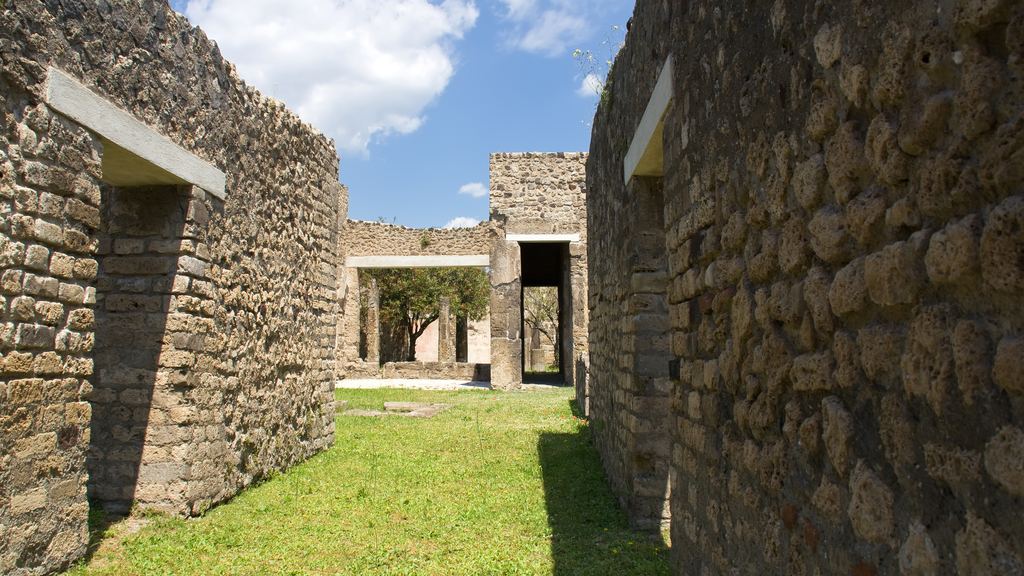
| opus incertum | Facing of irregular, unworked stones over a concrete core; used from the 2nd century to the mid 1st century BC. |
| opus quasi reticulatum | A transitional facing with very little mortar between more regular stones. |
| opus reticulatum | Facing of small pyramid-shaped tufa blocks set in a net pattern, from the 1st century BC to the early 1st century AD. |
| opus latericium (testaceum) | Brick facing laid in regular courses over a concrete core. |
| opus signinum (cocciopesto) | A waterproof mortar with crushed terracotta, used for tanks, baths, cisterns and floors. |
| opus sectile | Inlay of marble pieces cut to a design, as on the threshold of the House of the Faun. |
| opus vermiculatum | Mosaic made of tiny tesserae that follow the outlines of the figures. It is the technique of the Alexander mosaic, which the Naples museum says has over a million tesserae. |
| opus craticium | Light construction on a timber frame filled with rubble or wattle, mortar or clay. |
| tessera | A single piece of stone, marble, brick or glass in a mosaic. |
| emblema | A small central decorative panel inside a larger design, in a mosaic or a fresco (Binns). |
Wall painting
The four styles are a modern classification by the German scholar August Mau (1882); the dates below follow Binns. The full tour, with examples, is on our wall painting page.
| Term | Meaning |
|---|---|
| First Style | The "incrustation" style: it imitates walls of blocks or marble slabs, often in colored relief stucco. Roughly the 3rd century to the early 1st century BC. |
| Second Style | The "architectural" style: false architecture in perspective, until about 20 BC. The Park gives the Villa of the Mysteries and the Villa at Oplontis as examples. |
| Third Style | The "ornamental" style: walls divided into fields with small pictures on a plain ground, about 20 BC to AD 50. |
| Fourth Style | The "fantastic" style: more elaborate architecture and mythological pictures, in the second half of the 1st century AD. Binns places its appearance at Pompeii after the earthquake of 62. |
| megalography | A large-scale painted picture; the figures are life-size or larger. The Frieze of the Mysteries is the Pompeian example, and the Naples museum uses the word for the Boscoreale paintings. |
| trompe-l'oeil | A painted illusion of real space or objects on a flat surface; the Second Style uses it heavily. |
| fresco | Painting on lime plaster that is still wet, so the pigment becomes part of the wall. |
| sinopia | A preparatory drawing in red on the plaster. The Naples museum shows some among the painters' tools. |
| pinax (quadretto) | A picture on a panel or in a frame; on walls, the central pictures in the fields. |
Inscriptions and writing on the walls
Pompeii's walls carry a great deal of writing. Election notices and shop signs are part of the picture of a working town; the scenes are in our daily life page.
| Term | Meaning |
|---|---|
| programma | A painted election notice. |
| dipinto (dipinti) | Text painted on a wall, usually a public one. Binns notes that most of the so-called graffiti are really painted. |
| graffito (graffiti) | Text or a drawing scratched into a wall. |
| Oscan | An extinct Italic language spoken by the Samnites and others. The Park says the red-painted inscription with military instructions at the House of Pansa is one of seven in Oscan found in the city. |
| tabulae ceratae | Wooden tablets coated with wax for writing. Some were recovered from houses at Herculaneum. |
| cave canem | "Beware of the dog": a warning, in mosaic, at the entrance of the House of the Tragic Poet. |

The volcano and its deposits
The words below describe what came out of Vesuvius in AD 79. For the sequence of events, with the evidence, read the eruption page. Most of these definitions come from the US Geological Survey.
| Term | Meaning |
|---|---|
| Plinian eruption | An explosive eruption that sends a column of gas and fragments more than 11 km into the stratosphere. The name comes from Pliny the Younger, who described the eruption of AD 79. |
| eruptive column | The vertical mass of gas and debris rising above the vent, spreading into a cloud at the top. |
| tephra | Any rock fragment thrown out of a volcano and carried through the air: ash, bombs, cinders. |
| ash | Tephra fragments smaller than 2 mm. |
| lapilli | Tephra fragments from 2 to 64 mm. The word is Latin for "little stones". |
| pumice | A light volcanic rock full of bubbles, made when gas froths the magma before it hardens. |
| pyroclastic flow | A chaotic hot mixture of gas, ash and fragments, that runs down a volcano's slopes at tens of meters per second; temperatures can exceed 800 °C, but the deposits at Pompeii record 180 to 380 °C. |
| pyroclastic surge | A ground-hugging cloud of ash, rock and gas moving at hurricane speed, at hundreds of degrees. |
| nuée ardente | An older French term for pyroclastic currents. Current usage is pyroclastic flow or current. |
Archaeology and the dig
The last group covers how Pompeii has been dug and kept. The long version is on the excavation history page, and the casts have their own page, the body casts.
| Term | Meaning |
|---|---|
| cast (calco) | A plaster copy of the void that a decayed body left in the hardened ash. Fiorelli devised the method. |
| Regio V | One of the nine regions of Pompeii and still partly unexcavated; recent finds there include the decorated snack bar. (The hall with Helen and Paris is in Regio IX, on Via di Nola.) |
| stratigraphic excavation | Digging layer by layer and recording the context of every find; the basis of modern archaeology. |
| tunnel excavation | The 18th-century method of digging shafts and underground galleries to remove objects. The Park describes it at Herculaneum (excavations from 1738) and at Stabiae, where digging began in 1749 and small tunnels were reburied. |
| Great Pompeii Project | A ten-year programme of excavation and restoration at Pompeii that began in 2012. |
| Antiquarium | A collection of finds kept at the excavation site. The Park mentions one at Boscoreale (set up in 1991) and one at Stabiae (opened in 1957), where detached frescoes were collected. |

Where these words are used
Each of these pages leans on terms from the glossary.
Data verified on . Definitions paraphrased from Binns (Durham, 2007), Wikipedia, USGS, the Park and the Naples museum. Checked 5 Nov 2026. Editorial Policy