
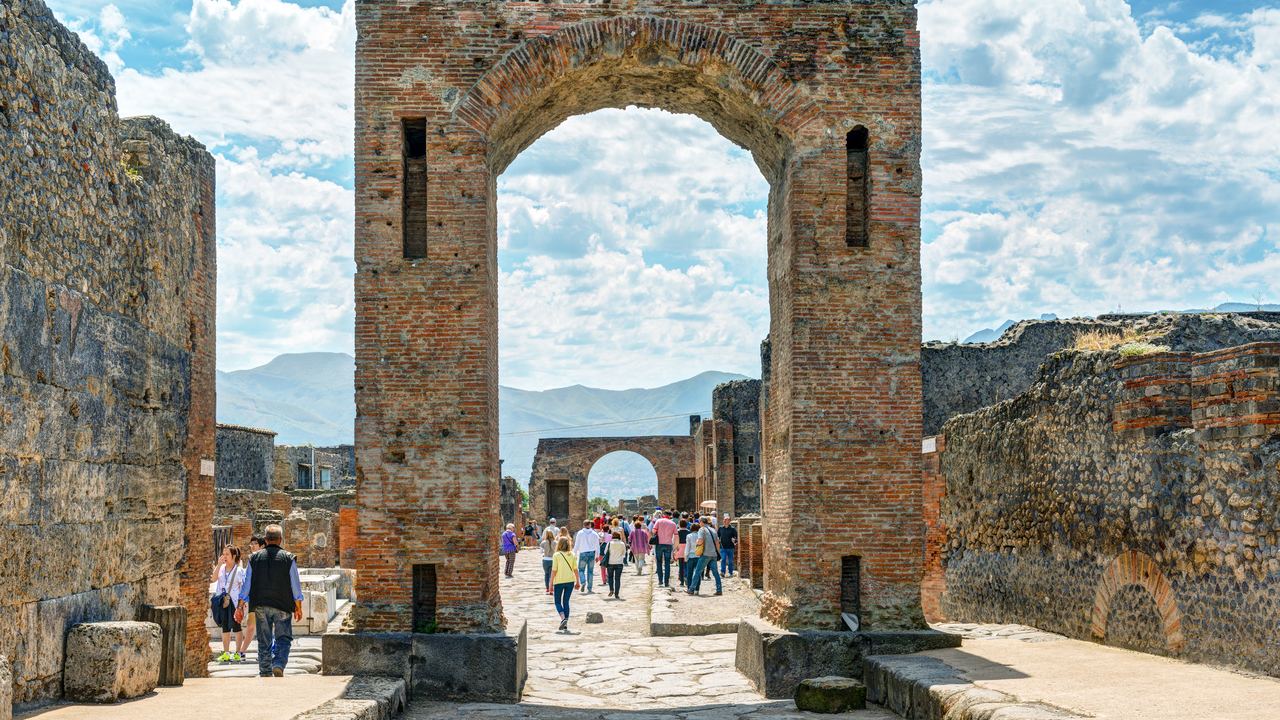
Yes, Pompeii works with children, provided they can walk for a few hours on stone and enjoy being outdoors. It suits school-age kids best; toddlers are possible with a carrier and a plan. Entry is free under 18 under the national rule for state museums and archaeological areas, and children under 12 must be accompanied. The ground is uneven, shade is thin, and the plaster body casts need a conversation before you get there.
That is our judgment, not the Park's: the Archaeological Park of Pompeii publishes no research on what children like, and we found none from a serious source either. So this page sticks to things a child can check with their own eyes, and to rules you can verify. We are independent and not affiliated with the Park; we read its pages on 5 November 2026.
Our advice: plan for two hours of real attention, not a full day. A child who has spotted ten things and had a snack in the shade remembers Pompeii better than one dragged past forty houses.
What age is right for Pompeii?
There is no age limit and no official recommendation. What the Park does say is that the visit "requires significant physical effort" (regulation, article 9), and that the ground has drops and irregularities. The table is our judgment, drawn from those facts.
| Age | What tends to work | What to watch |
|---|---|---|
| Under 2 | A soft carrier on the ancient streets; a light stroller on the accessible route | Stones, ruts and gaps make wheels hard; shade is limited in summer |
| 2 to 5 | Short stretches, a stroller for naps, snack breaks in designated areas | Little patience for long explanations; keep them away from fenced areas and drops |
| 6 to 11 | Streets, the amphitheatre, snack counters, graffiti: concrete things to find | Heat and boredom are the problem, not difficulty; the casts need a talk first |
| 12 to 17 | Longer routes, an audio guide or a guided tour, the story of the eruption | Teenagers ask the hard questions about the casts; have the answers ready |
Is the site "too much" for a young child? The ruins are not frightening, the casts can be, and the physical demand is the real limit. For the very youngest, Herculaneum (below) is easier. For when to go, the crowd calendar shows that winter days are far quieter than April or May.
What do children actually enjoy at Pompeii?
Each of these has the Park or a reference text behind it:
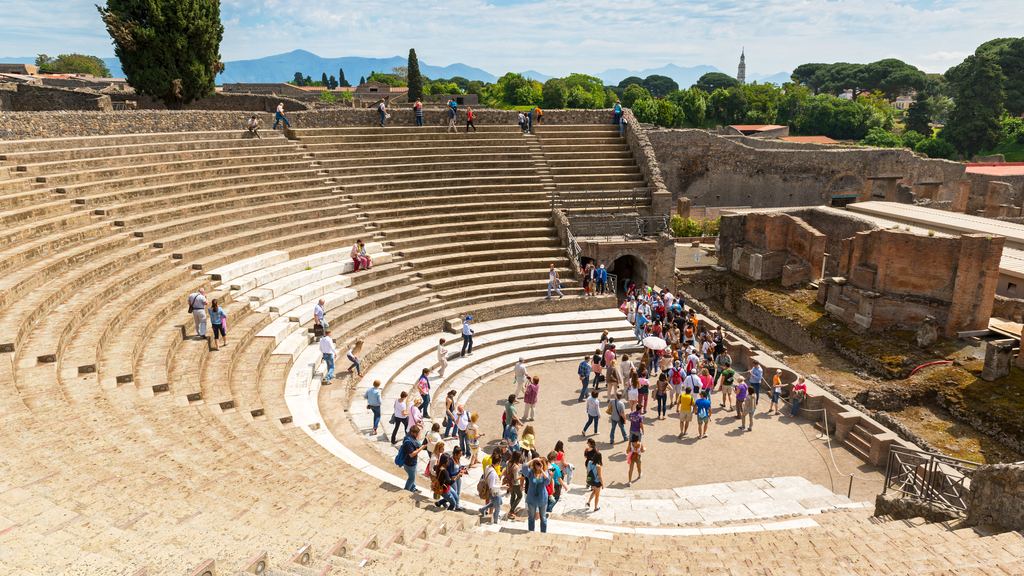
- The amphitheatre. It was built around 70 BC for shows, and a child can see where the crowd sat and where the arena was. Check the Park's notices first, because access to it has been restricted at times.
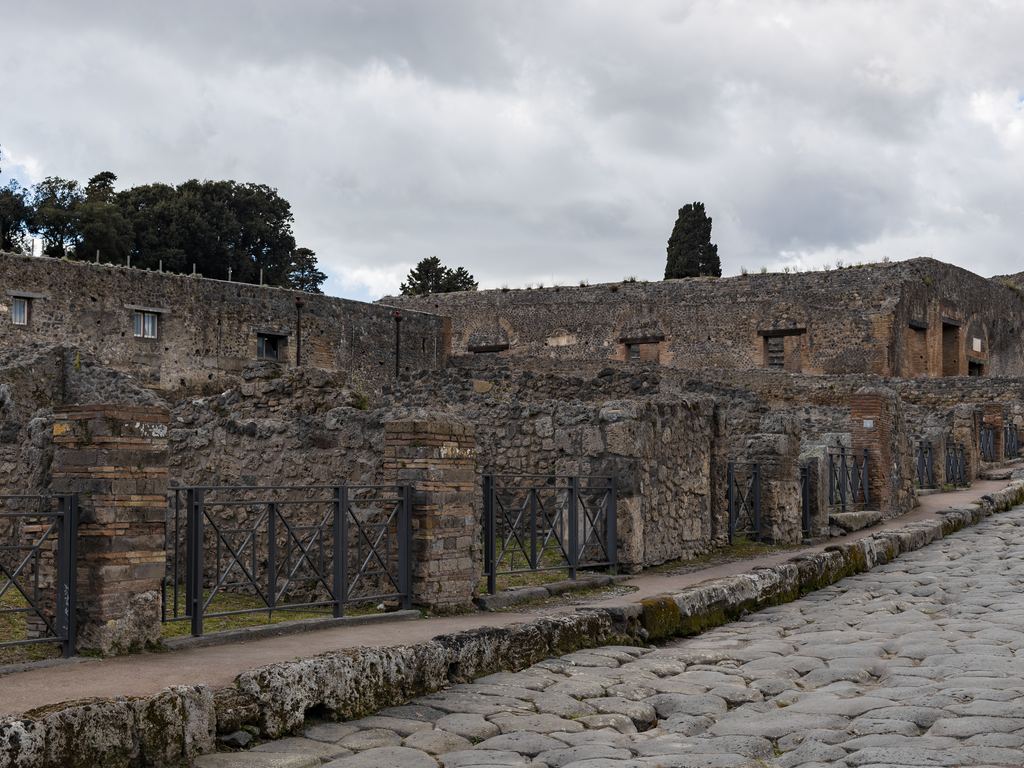
- The streets themselves. The Park describes the roads as "crowned", higher in the middle so water ran off, and the raised stepping stones let people cross without wetting their feet. A scavenger hunt writes itself: find the ruts, find the crossing stones.
- Snack counters. The Park speaks of at least eighty thermopolia, the street-food counters of Roman towns. Look for the counter with round holes where large jars were set.
- Graffiti. Roman residents scratched messages into plaster, and some survive. They are the closest thing to reading a stranger's note.
- Fountains. The Park describes a travertine fountain on Via dell'Abbondanza; street fountains with stone basins appear all over the city.
- The dog mosaic. The Park places the "Cave canem" mosaic at the entrance of the House of the Tragic Poet, protected by glass. Open houses change weekly, so check the Park's list before you plan around any single house.
A list of eight things to spot (ours): a rut, a crossing stone, a counter, a fountain, a wall painting, a message on a wall, an amphitheatre tier, a doorway taller than your child. It turns a walk into a game, and it ends before attention does.
Pace
How long should a visit with children last?
The Park's FAQ speaks of a minimum of two to three hours, but it is an old page and written for adults. With children we would stop at two hours of walking and add breaks. The Park's own themed routes help: "Civic Pompeii" ("Pompei civica") and "Daily Pompeii" ("Pompei quotidiana") last about 1.5 hours, run in groups of 20 to 25 with radio headsets, and are free for children under 10 (the route itself has a separate fee). The civic route starts at Porta Marina Superiore and the daily one at Piazza Anfiteatro, at fixed times that the Park publishes on its pages (as of November 2026). Ticket costs are on our tickets page.
How do you talk to children about the body casts?
The casts worry parents most. They are not bodies. They are plaster poured into the hollows that bodies left in the hardened ash, a method perfected by Giuseppe Fiorelli, who made the first casts in 1863. The Park counts over a thousand victims found and a little over a hundred casts (104 in the 2024 DNA study by Elena Pilli and colleagues). A 2015 scan of 26 casts, reported in that study, found no complete skeleton inside any. Since 12 March 2026 the Park has displayed 22 casts in the porticoes of the Great Palaestra; others are in different places, including the Macellum.
Our suggestions, which are advice and not Park guidance:
- Say beforehand what they will see: "statues made from the shapes people left in the ash".
- Tell the truth in short sentences. People died, and the Park's work is to look after what remains.
- Let the child choose whether to look. Walking past is fine.
- Save the debates for later. Whether the victims died of heat or suffocation is still argued by scholars.
The full story, including what DNA analysis in 2024 revealed about the casts, is on The Pompeii body casts. The eruption itself, hour by hour, is in The Eruption of AD 79.
Can you bring a stroller to Pompeii?
Yes, with limits. The regulation bans bicycles, scooters, motor vehicles and "unauthorised vehicles of any type" but does not name strollers, and the Park itself cites parents with strollers as users of its accessible route. That route, "Pompei per tutti", runs over 3.5 km from Piazza Anfiteatro; it has ramps sometimes steeper than 8% and level changes under 5 cm. Everywhere else, the ancient paving is a hard ride. A light, compact stroller with large wheels is our pick; a carrier is better for children who walk badly.
Three baby changing points sit on Via dell'Abbondanza, Via di Nola, and the corner of Via Stabiana and Via della Fortuna. You collect the key at the entrance and hand it back when you leave, according to the Park. Toilets are at the entrances, the Casina dell'Aquila and several other points. For step-free routes in detail, see Pompeii accessibility.
On the way there, folded strollers travel free on the Circumvesuviana under the 2015 regional fare rules, and so do children under six (one per adult, without a seat).
Is Pompeii free for children?
The national rule, on the Culture Ministry's concessions page, is free entry for visitors under 18 in state museums, monuments, galleries and archaeological areas, and children under 12 must be accompanied. The Park repeated it in a communiqué on 3 November 2025. Some resellers quote "free under 6"; that is not the Park's rule. One thing we could not confirm: whether a named zero-price ticket must be booked online for a minor, since the regulation asks for a named ticket from everyone except on free days. Check the Park's ticket page when you book, and see our tickets guide for all prices and free days.
Is Herculaneum easier with young children?
Often, yes. The Park describes the excavated part as more than four hectares visible out of an estimated twenty, and its FAQ gives about two hours for a visit. There is a free luggage deposit. The rules are strict about one thing: children must be constantly watched and held by the hand, and those under 12 must be accompanied. Wooden beams, doors and furniture carbonized in the eruption are on display, which children tend to notice. The two sites need separate tickets: the FAQ says there is no combined one.
Herculaneum also has a browser game, "Lost in Herculaneum", in which a girl named Giulia follows a riddle at the ancient theater, plus an app with five itineraries in nine languages. Compare the two sites on Pompeii or Herculaneum?, or browse Herculaneum tours.

Herculaneum
A snack counter you can see from the street
The thermopolium at Herculaneum is one of the easiest ancient shops for a child to understand: a counter facing the street, with sunken jars for food. Pair it with the one in Pompeii and a child sees the same Roman habit in two towns.
What are the Park's own materials for families?
The Park offers a free app, MyPompeii, with a map and points of interest (extra content comes with a ticket; its store description is in English only). Maps and a mini-guide are available as PDFs in nine languages, though the map is the 2019 edition and does not reflect recent closures. The Park's pages also present the Pompeii Children's Museum, run as a public-private partnership and housed in the Casina Rosellino on Via dell'Abbondanza; its own site, pompeiichildrensmuseum.it, lists school programs. We make no claim here about whether the space is open to families, so check with the operator before building a plan on it. Audio guides have a separate children's rate; prices are on the tickets page.
For the heat, the Park's notice of 27 June 2025 advises avoiding the hottest hours, especially with children and older people, bringing bottles and drinking without waiting for thirst. We cover clothing and bags on What to wear and bring, and the summer calendar on Pompeii in summer. If a guide would help, see guided tours at the site.
Planning the rest of the trip
Time, tickets and transport are covered in our planning hub.
Questions parents ask
Is Pompeii suitable for kids?
For most school-age children, yes. It is outdoors, has plenty to spot, and the physical effort is the main limit. For toddlers, use a carrier or the accessible route.
Is Pompeii too disturbing for children?
The ruins are not. The plaster casts of victims can be. Prepare the child beforehand and let them choose whether to look. See our guide to the casts.
Are strollers allowed?
The regulation does not forbid them, and the Park cites parents with strollers as users of its accessible route. Ancient paving is hard for wheels. Choose a light stroller with large wheels, or a carrier.
Is Pompeii free for children under 18?
Under the national rule for state museums and archaeological areas, yes, and children under 12 must be accompanied. Check the Park's ticket page about a named ticket when booking online.
Are there baby changing facilities?
Three baby points: on Via dell'Abbondanza, Via di Nola, and the corner of Via Stabiana and Via della Fortuna. Ask for the key at the entrance and return it at the end.
How long should we stay with children?
Two hours of walking is a sensible target, with breaks. The Park's themed routes last about 1.5 hours and are free for children under 10.
Can children eat inside Pompeii?
Only in designated places; the regulation forbids eating elsewhere. The Park runs a self-service restaurant and a café-wine bar at the Casina dell'Aquila.
Is Herculaneum better for small children?
Often, because it is smaller and a visit takes about two hours. Children must be held by the hand and watched at all times.
Data verified on . Rules and facts read on the Park's pages and in the Culture Ministry's concessions page. Age guidance is our judgment, not the Park's. Editorial Policy