
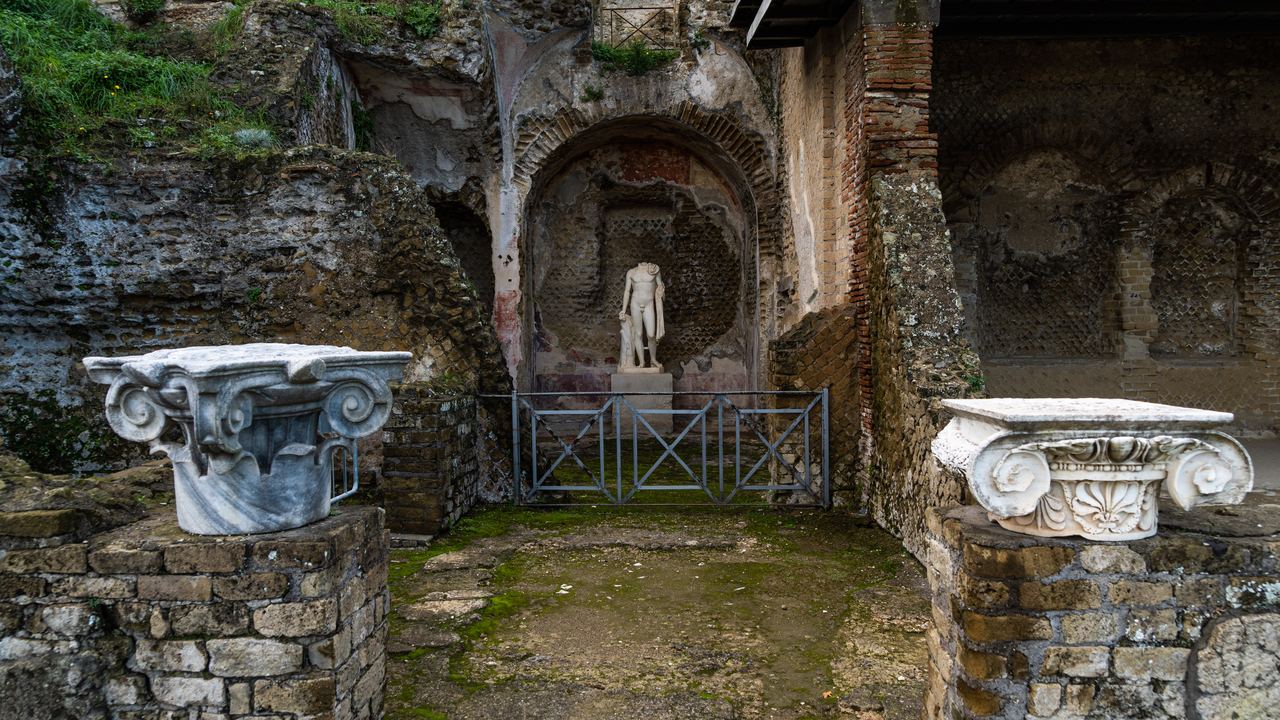
The Phlegraean Fields (Campi Flegrei) are a volcanic area west of Naples where you can see a Greek colony's acropolis at Cumae, Roman baths and a drowned town at Baia, and a huge amphitheatre at Pozzuoli. All of it is reachable from Naples on the Cumana railway or by car, and two days cover it comfortably. The Park runs four ticketed sites, and Cumae and the amphitheatre close on Tuesday, Baia on Monday, so the one clean rule is to go from Wednesday to Sunday.
The ground here is alive, and that is the point of the place: the same movement that raised and sank the Roman coast is why the Macellum columns are drilled by sea creatures and why part of Baia lies under the water. We give the facts from the scientific bodies and the Park, and nothing that looks like a forecast.
What are the Phlegraean Fields, and what is the risk?
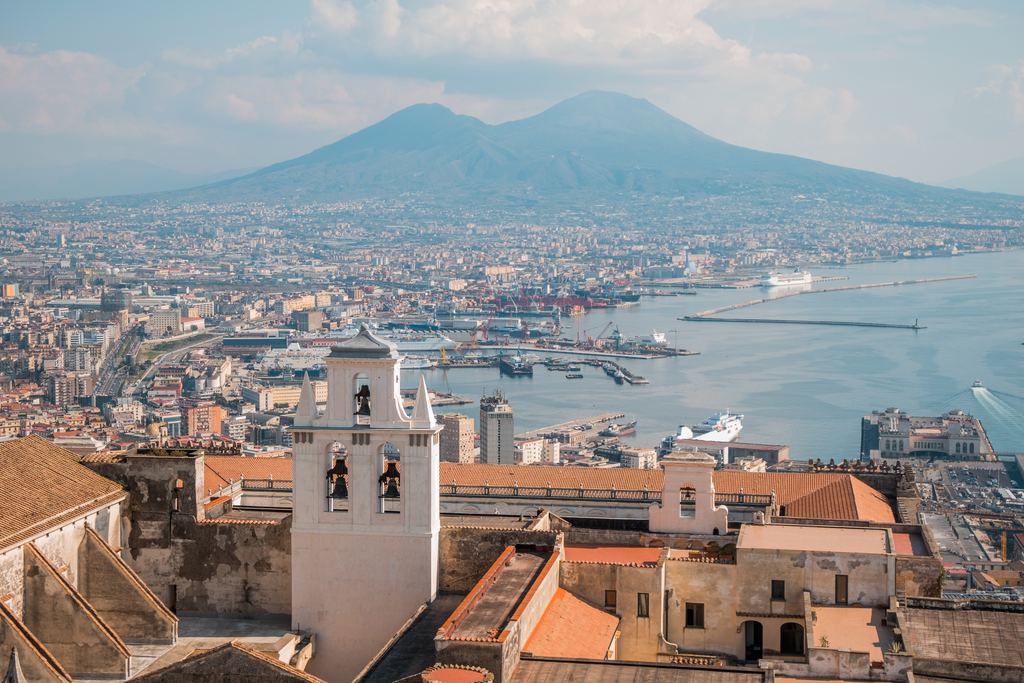
The name comes from a Greek word for burning. The Fields are a caldera, a low circular basin formed by large explosive eruptions, that stretches from Monte di Procida to Posillipo and extends under the Gulf of Pozzuoli. The Civil Protection Department says the last eruption took place in 1538, after about 3,000 quiet years, and in a matter of days built the cone of Monte Nuovo, roughly 130 meters high, on the east shore of Lake Avernus. Since then the volcano has been quiescent, with steam vents and a ground movement called bradyseism.
Bradyseism is a slow rise and fall of the ground. Rapid uplift comes with earthquakes, usually of modest magnitude but shallow enough to be felt and to damage buildings. The Department lists the major recent crises as 1970 to 1972 and 1982 to 1984, when the historic center of Pozzuoli was evacuated. A new phase of uplift has run since 2005, and its page records a total of more than 150 centimeters. The strongest shock in the instrumental record so far was a magnitude Md 4.7 earthquake on 31 July 2026, located by INGV about 3 km deep, followed by a swarm of smaller events, according to INGV's Osservatorio Vesuviano weekly bulletin.
The alert level for the Phlegraean Fields has been yellow since 2012, and after a decree of 30 October 2025 updated the alert levels, the Department declared yellow again with the operational phase "attention" (phase 2), which as the Department describes it means stronger monitoring and planning, not evacuation (page read 5 November 2026). We are not volcanologists and this page makes no prediction. For anything on the day, the Park and the Civil Protection Department are the authorities to check.
What is there to see at Cumae?
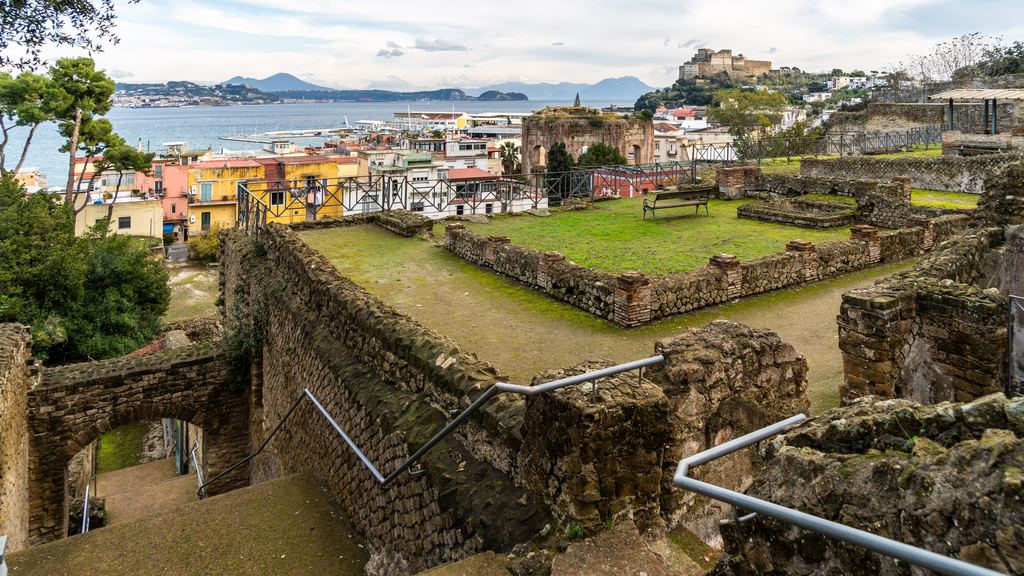
Cumae was among the early Greek colonies in the West, traditionally founded by settlers from Euboea in the 8th century BC. The Park's archaeological area covers about 50 hectares, but the part you can enter is the acropolis: the Sibyl's Cave at the foot of the hill, then the Byzantine Tower and a belvedere over Ischia and Procida, and two terraces with the remains of large temples. The lower city, with the forum, baths and the Roman crypt, is under enhancement works and, on the Park's page read on 5 November 2026, open only on special occasions and events.
The Sibyl's Cave: what is certain and what is not
The cave is a long gallery cut into tufa, with side openings that let light in. The Park's reading is that archaeologists see a military gallery from the Samnite period, between the late 4th and early 3rd century BC, with cisterns along side arms. The "Sibyl" name comes from Amedeo Maiuri, who excavated it in 1932 while looking for the places Virgil describes, with their hundred mouths and oracle rooms. The Park says outright that it cannot be the celebrated cave of the poem, and adds that it has drawn visitors from everywhere for its light and shape. Go for the gallery, not for a proven oracle.
The terraces
The lower terrace is called the Temple of Apollo, with a main temple built at the end of the 6th century BC, rebuilt in the Augustan age and turned into a church from the 4th century AD. The upper terrace, on the summit, holds the large temple that guidebooks long gave to Jupiter. The Park now attributes it to Apollo, which fits Virgil's story of Daedalus landing at Cumae and dedicating his wings to the god. It dates at least to the 6th century BC and also became a church. The Park adds that recent research is revising earlier identifications, so treat any label as provisional.
What do you see at Baia, above and below the water?
Baia was the Roman resort town of the Bay of Naples. The Park's baths complex climbs the inner wall of an old volcanic crater, in a thicket of masonry whose three big domed halls were long labeled temples of Mercury, Venus and Diana. They were never temples; they are the main rooms of three thermal establishments built about a century apart to use the hot water and steam below ground. The Park calls the "Temple of Mercury" the earliest known large hemispherical concrete dome, dated to the age of Augustus and made possible by the local volcanic ash, pozzolana.
Above the town stands the Castle of Baia, built by the Aragonese between 1490 and 1493, which houses the Archaeological Museum of the Phlegraean Fields in its current form since 2010. The museum is arranged in sections for Cumae and Pozzuoli, among others, with statues, tombs and marbles from across the area. Its walls enclose the remains of a Roman villa that climbs almost 100 meters from the sea to the summit, and from the parade ground you look over the whole gulf. As of November 2026 the Park lists the museum as open 9:00 to 18:30, with the last entry at 17:30, and closed on Mondays.
How do you visit the sunken city of Baia?
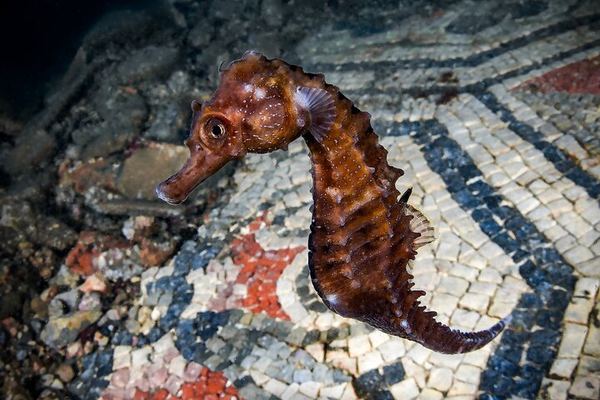
Bradyseism has put a large strip of the ancient coast under the sea. The Underwater Archaeological Park of Baia was set up as a marine protected area by an interministerial decree of 7 August 2002. It protects villas, shops, spas and roads. The Nymphaeum of Claudius, a banquet hall once reached by boat, lies off Punta dell'Epitaffio; many of its statues were found in the sea, and copies now stand where they were. The originals are in the castle museum. Another route follows the Villa with a protiro, a bath and a row of identical shops, and the Villa of the Pisones, tied by a lead pipe to the name of Lucius Calpurnius Piso. The Park also lists a Portus Julius route, the naval harbor Agrippa built in the late 30s BC.
You visit it on the water, not on a path. The Park's dedicated site lists authorized operators for scuba diving, snorkeling, boat trips and canoes, and takes bookings and information through that site. Choose by what you want: a boat keeps you dry, snorkeling suits the shallow parts, diving the deeper ones. Ask the operator which route fits your level.
What is in Pozzuoli?
Ancient Puteoli was the main port of Rome before Ostia, according to the Park's museum, and the traces of that trade are scattered through a lively modern town. The two stops that matter are close to the Cumana line.
The Flavian Amphitheatre
The Park calls it the third arena in Italy by size, after the Colosseum and the amphitheatre of Capua. It measures 149 by 116 meters, the arena itself 75 by 42, and held up to 40,000 spectators. Inscriptions at the four entrances show the Flavian colony paid for it, and brick stamps suggest work began between the end of Nero's reign and the start of the Flavian age. What visitors come for is the underground level: the corridors, the cells, the trapdoors in the arena and the mechanism that lifted cages of wild animals to the sand. Restoration after the bradyseism crisis of 1983 and 1984 recovered the lower tiers of seating.
A small chapel inside the ambulatory recalls the local tradition that Saint Januarius and his companions were condemned to the beasts here. The legend says the lions grew tame; the Park presents it as tradition, not as history.
The Macellum and the columns that measure the ground
Near the port stands a ruin that was long called the Temple of Serapis. In the mid-1700s Charles of Bourbon had it dug out after marble columns surfaced from a vineyard, and a statue of Serapis found inside gave the building its name. It was never a temple. The Park identifies it as the Macellum, the city's public food market, dated by the Park to the late Flavian age (second century AD), with a courtyard of 58 by 75 meters, a round tholos of 16 pink columns in the middle and a great apsed hall at the back. The Park's page for each site carries an open or "temporarily closed" label, and on 5 November 2026 the Macellum's read "temporarily closed", so check it before you plan around the columns.
Its standing columns are the reason geologists visit. They are monolithic cipollino marble, 40 Roman feet tall, and their lower halves are pitted by marine mollusks. Radiometric dating of the shells left inside the holes shows the ground began to sink around the end of the 4th century AD, when the building was abandoned. Charles Babbage and Charles Lyell came to study them, and the medal created in Lyell's memory shows the building. You can stand in front of the columns and read the history of the ground in the stone.
Where does Lake Avernus fit in?
Lake Avernus is a volcanic crater lake close to Baia and Cumae, formed like the other craters of the Fields. It matters here as context rather than as a stop. In 37 or 36 BC, depending on the source, Agrippa dug a canal about 400 meters long linking the sea to Lake Lucrino, and another from Lucrino to Avernus, to create the naval base of the Portus Julius. The 1538 eruption and the bradyseism changed this coastline so much that part of the Lucrino lake became open sea. The Park's page for Avernus lists a "Temple of Apollo" and gives no visiting hours, so ask the Park before planning a visit.
What about the Solfatara?
The Solfatara, the crater with steam vents above Pozzuoli, has been closed to visitors since September 2017, when three members of a family died in the crater. A court seizure of the site was lifted in 2025, but we found no announced reopening to the public, and it is not a Park site. Ask the Campi Flegrei Regional Park or the municipality of Pozzuoli before building a day around it.
Which sites are ticketed, and when are they closed?
| Site | What you see | Weekly closing day | Ticketed | Nearest rail stop |
|---|---|---|---|---|
| Cumae archaeological park | Acropolis, Sibyl's Cave, terraces; lower city only for events (Park, 5 Nov 2026) | Tuesday | Yes | None at the gate; Fusaro, then road transport |
| Flavian Amphitheatre, Pozzuoli | Arena, underground corridors, tiers of seating | Tuesday | Yes | Pozzuoli (Cumana) |
| Macellum ("Temple of Serapis") | Market courtyard, columns, tholos | Not listed by the Park; page labeled "temporarily closed" on 5 Nov 2026 | Not on the ticket list | Pozzuoli (Cumana) |
| Baia baths (Terme di Baia) | Domed halls on the crater slope | Monday | Yes | Lucrino or Fusaro, then a bus or about 1 km |
| Castle of Baia and museum | Museum sections, Roman villa, view | Monday | Yes | Same as the baths |
| Underwater park of Baia | Villas, spas, nymphaeum, Portus Julius | By operator | Via authorized centers | Baia area; ask the operator |
The four ticketed sites share a cumulative Circuito Flegreo ticket valid for three consecutive days, one entry per site, with entry by reservation, the Park says. Amounts, reductions and the annual cards are on the Park's own tariff page, which we link in the sources. The Park lists free admission for anyone under 18.
How do you get around the Phlegraean Fields?
The backbone is the Cumana railway (EAV) from Napoli Montesanto to Torregaveta. A train takes roughly half an hour from Montesanto to Pozzuoli and a little longer to Baia, Fusaro and the terminus. In the daytime trains run every 15 minutes or so, and not every train calls at every stop, so check the EAV timetable for your date. Fares are on the EAV site.
Two cautions. First, no rail stop is at Cumae's gate, and the Park's pages give no public transport route for it, so plan a taxi or local bus from Fusaro or go by car. Second, the Baia stations are not at the baths: the Park's own directions name Lucrino or Fusaro on the Cumana, then a bus or about 1 km on foot. By car, the Park suggests the Naples ring road, exit Pozzuoli/Arco Felice, then follow the signs for Pozzuoli or Bacoli. The Park also mentions Metro Line 2 to Pozzuoli for the amphitheatre; press reports of works on that line in 2026 are unconfirmed by the Park, so check the operator.

Two days
A plan that respects the closing days
Day one, Wednesday to Sunday: Cumae in the morning, with a taxi or a car, then the amphitheatre in Pozzuoli after lunch, reached by the Cumana, and the Macellum columns if the Park's page shows it open. Day two, also Wednesday to Sunday: the baths and the castle museum at Baia, then a boat or snorkeling trip over the sunken town. If you have one day, choose Pozzuoli and Cumae, or Baia and the water. They are different parts of the coast and trying to do all of it from Naples in a day means more time in transit than at the ruins.
Should you book a tour?
The Fields are easier on your own than Paestum if you stay near the Cumana line, and harder if you want Cumae, which needs road transport. A guided visit helps most at Cumae and underwater at Baia, where the context lives in what the guide tells you. Our More of Campania page covers the group and private formats and what they cost, so we do not repeat them. For the Vesuvian side of the volcanic story, Vesuvius and Pompeii picks up from here, and the Beyond Pompeii hub places the Fields among the other sites.
If you would rather not manage the transport
Day trips to the Phlegraean Fields, Paestum and Caserta from our More of Campania collection.
Baia Double Dive for Certified Divers among Sunken Roman Mosaics and Villas
Two dives from the Subaia hub at the Port of Baia, five minutes by boat from the site, among the mosaics, columns and statues of the underwater Roman park.
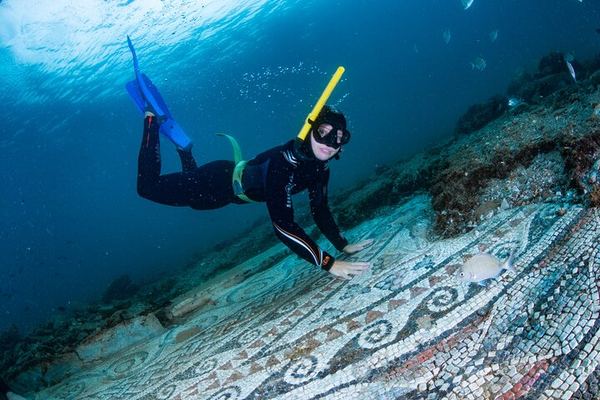
Baia Snorkeling Tour with Expert Guide, Two Sites among Submerged Roman Remains
Snorkelers follow an expert guide over Roman domus and architecture about 5 meters down in the Baia archaeological park, with two stops at different spots.
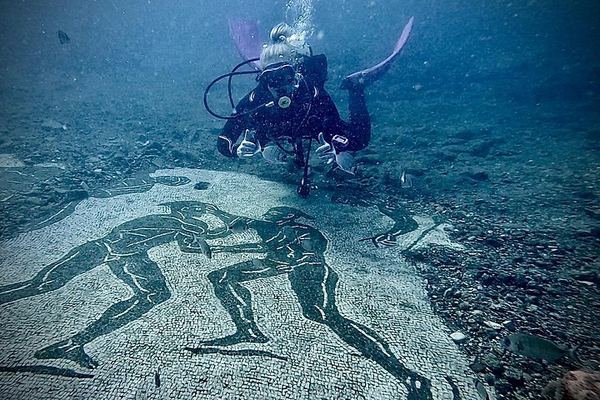
Baia Submerged Park Guided Dive for Certified Divers from Bacoli by RIB Boat
A dive of about an hour at the sunken Roman city of Baia, under five minutes by boat from a dive center in Bacoli, with equipment and park ticket included.
Ratings collected by Viator and Tripadvisor
Phlegraean Fields: common questions
Can you see the Phlegraean Fields in one day?
You can see part of them. Cumae plus the Pozzuoli amphitheatre, or Baia plus a boat trip, is a realistic day. All of it takes about two days, because Cumae needs road transport and the sites close on different days.
Is it safe to visit given the earthquakes?
The Civil Protection Department sets the alert level at yellow, which as it describes it means stronger monitoring, not evacuation. We make no forecast; check the Park and the Department before you go.
Is the Solfatara open?
No. The Solfatara crater at Pozzuoli has been closed to visitors since September 2017, and we found no announced reopening date.
Which days are the sites closed?
Cumae and the Pozzuoli amphitheatre close on Tuesday. The Baia baths and the castle museum close on Monday. Wednesday to Sunday is open for all four. Confirm on the Park's site the week you travel.
Do I need to book Cumae or Baia?
The Park's tariff page says entry with the cumulative ticket and the annual cards is by reservation. Book through the Park's channels rather than turning up and hoping.
How do I get from Naples to Pozzuoli and Baia?
By the Cumana railway from Napoli Montesanto: roughly half an hour to Pozzuoli and a little more to Baia. Cumae has no rail stop at its gate.
Is the Sibyl's Cave really the cave of the Sibyl?
The Park's reading is that it is a Samnite military gallery of about 300 BC, named for the Sibyl by Amedeo Maiuri in 1932 and not matching the cave Virgil describes.
Is the Temple of Serapis in Pozzuoli a temple?
No. The Park identifies the building as the Macellum, the public food market, of the second century AD. The name comes from a statue of Serapis found there in the 18th century.
Can you swim or dive over the sunken ruins of Baia?
Yes, through authorized operators listed on the Underwater Park's website. The Park does not suggest going on your own; ask the operator about the rules.
Data verified on . Park of the Phlegraean Fields (sites, tariffs), Underwater Park of Baia, Civil Protection Department, INGV, EAV timetable. Independent of all of them. Editorial Policy