
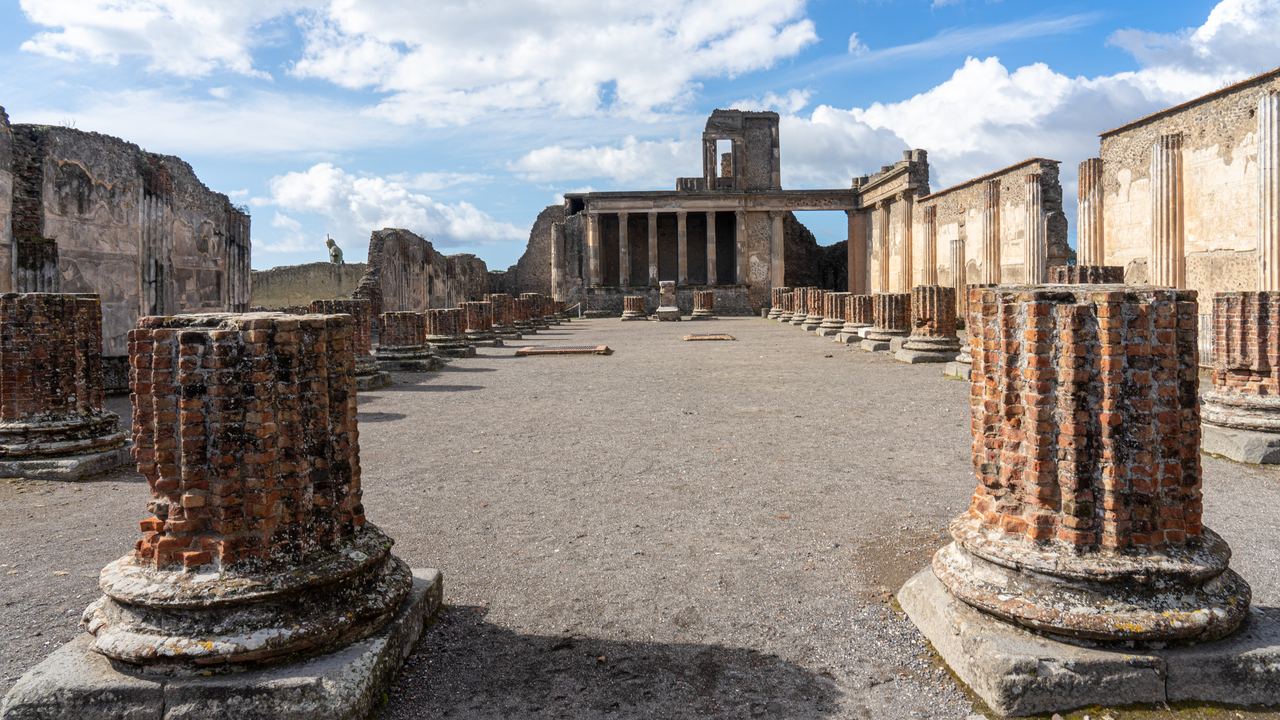
Pompeii is quietest and cheapest in effort from November to March, but the days are short: the Park closes at 17:00 and takes its last entry at 15:30. Highs run 13 to 15 °C from December to February, the average day brings only 3,900 visitors in January against 14,000 to 16,000 from April to October, and November is the wettest month. The winter timetable runs from October 15 to March 15 (as of November 2026). You give up daylight and some comfort, and in return you can actually look at the site.
What are the winter opening hours, and how much daylight do you get?
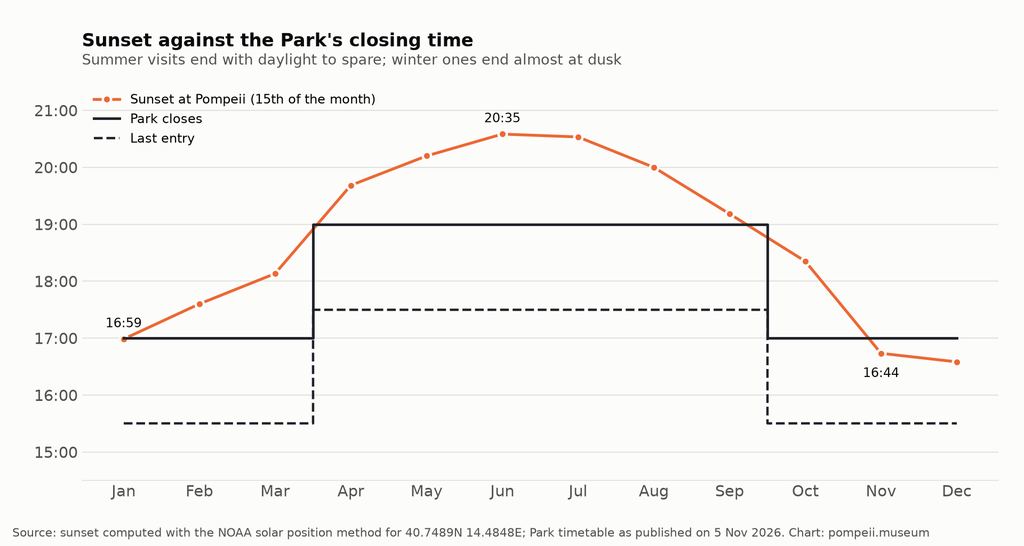
From October 15 to March 15 the Park of Pompeii opens at 9:00, takes its last entry at 15:30 and closes at 17:00. The regulation's Annex A sets two entry windows for the winter day, 9:00 to 13:00 and 13:00 to 15:30, within a daily cap of 20,000 entries (15,000 in the first window, 5,000 in the second). From March 16 the summer timetable starts, with a 19:00 closing. Herculaneum follows the same dates with its own hours: 8:30 to 17:00, last entry 15:30, and visitors are asked to be out by 16:40. All of this is dated November 2026, and the changeover days are the ones to recheck.
We calculated sunrise and sunset for the 15th of each month at Pompeii's coordinates, using the NOAA solar position method. In mid-November the sun sets at 16:44, in mid-December at 16:35 and in mid-January at 16:59. The Park closes after sunset from the start of November to mid-January, and for short windows from 16 to 28 March and from 23 September to 14 October. From mid-January to mid-March it closes before sunset. The number that matters is the gap between the last entry and the end of the light: 1 hour 14 minutes in November, 1 hour 5 minutes in December and 1 hour 29 minutes in January, rising to 2 hours 6 minutes in February and 2 hours 38 minutes in mid-March. Entering at 15:30 is possible but sensible only for a short look.
The sun is also low. On December 15 it stands 14° above the horizon at 9:00, reaches 26° at about 11:57 and is back to 13° at 15:00 and under 10° by the last entry (our calculation). Walls throw long shadows at midday. In January the midday sun reaches 28°. A morning arrival in winter has nothing to do with heat. It is about using the light you have.
How much quieter is Pompeii from November to March?
Much quieter. Averaging the Park's monthly counts across eight years, November to March hold about 20 percent of the annual total; April to October hold the other 80 percent. For daily figures we use 2023-2025. January averages about 3,860 visitors a day, February 4,920, December 4,490, November 6,100 and March 8,480. The summer plateau is 14,000 to 16,000, and the cap is 20,000. In January the average day is about a quarter of a spring one. The whole series, with minimum and maximum by month, is in the crowd calendar.
Averages are not your Tuesday. The Park publishes no counts by weekday or by hour, so a busy morning in November can still feel full around the Forum. Winter is also shifting: January 2025 was 15.4 percent above January 2024 in the Park's four-site series (133,788 against 115,914). We do not know why, and the source does not say. Winter quiet is a pattern, not a promise.
Month by month, November to March
| Month | Highs, °C | Lows, °C | Rain, mm | Rain days | Visitors a day | Sunrise / sunset |
|---|---|---|---|---|---|---|
| November | 18.3 / 18.1 | 12.9 / 8.3 | 96 / 152 | 9.4 / 11.3 | 6,097 | 06:48 / 16:44 |
| December | 14.6 / 14.1 | 9.9 / 4.6 | 85 / 98 | 8.9 / 9.6 | 4,485 | 07:18 / 16:35 |
| January | 13.7 / 13.1 | 8.7 / 3.4 | 71 / 89 | 8.3 / 8.7 | 3,860 | 07:24 / 16:59 |
| February | 14.3 / 13.8 | 8.2 / 3.2 | 58 / 71 | 6.8 / 8.3 | 4,921 | 06:56 / 17:36 |
| March | 16.8 / 16.2 | 9.8 / 5.4 | 53 / 83 | 6.7 / 7.5 | 8,476 | 06:13 / 18:08 |
Read the two stations as a range: Pompeii falls between a coastal rock and an inland plain. The nights show the difference most. January lows average 8.7 °C at Capri and 3.4 °C on the plain, so cold mornings at Pompeii are likelier to feel like the plain's. Rain days count days with 1 mm or more. March is the first month the numbers turn: visitors rise by about 70 percent on February, and the Park's 17:00 closing ends on the 15th.
How much does it rain, and does the wind matter?
November is the wettest month of the year: 96 mm at Capri and 152 mm at Grazzanise, with rain on 9 to 11 days. December brings 85 to 98 mm. Heavy days, with 10 mm or more, peak in November at 3.3 (Capri) and 5.2 (Grazzanise). Thunderstorms follow the same pattern; Grazzanise counts 5.6 thunder days in November, more than in any summer month. From January the totals fall to 71 to 89 mm, 58 to 71 mm in February and 53 to 83 mm in March. Our weather and climate page has the rain chart.
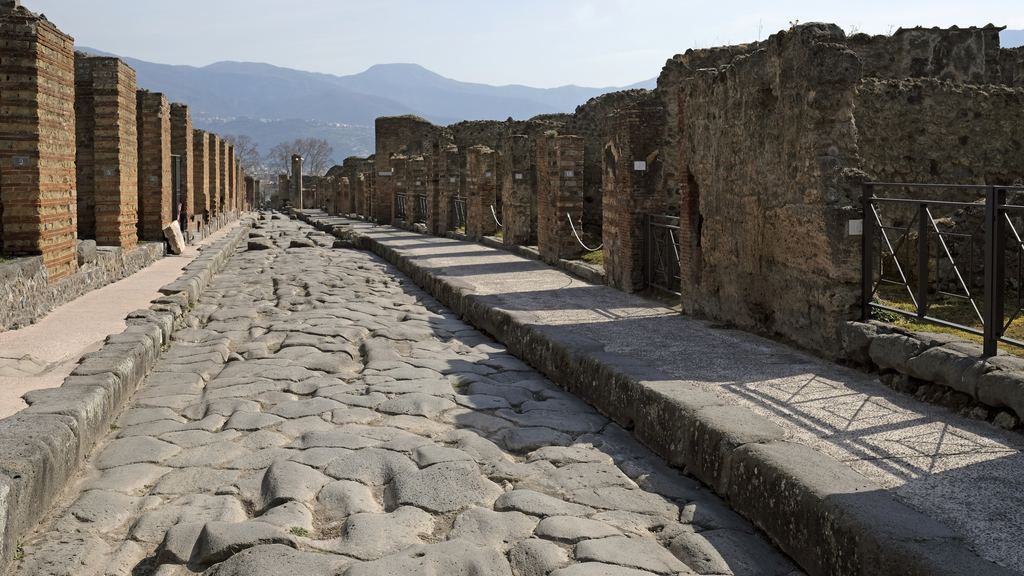
Wind is a sea story more than a ruin story. Capri counts days with wind at 10 m/s or more (about 36 km/h) at 10.0 in November, 10.6 in December, 8.6 in January and February and 7.7 in March, against 2.1 in August. On the site, the issue is trees. In October 2023 the Park issued a notice about wind and rough seas that told visitors not to shelter under the trees in the park. The ancient paving is uneven, and the Park's regulation says so itself, in its own words about drops, irregularities and gaps. In rain it is slick. Wear shoes with grip.
A rain jacket with a hood is a better answer than an umbrella. The 2025 regulation does not list umbrellas, while the Park's 2024 guide says to leave them out, and Herculaneum's rules name umbrellas among the bulky items for its deposit. There is little roof on the site, so the layer you carry is the shelter you have. Our guide to what to wear and bring has the winter list.
What works better in winter?
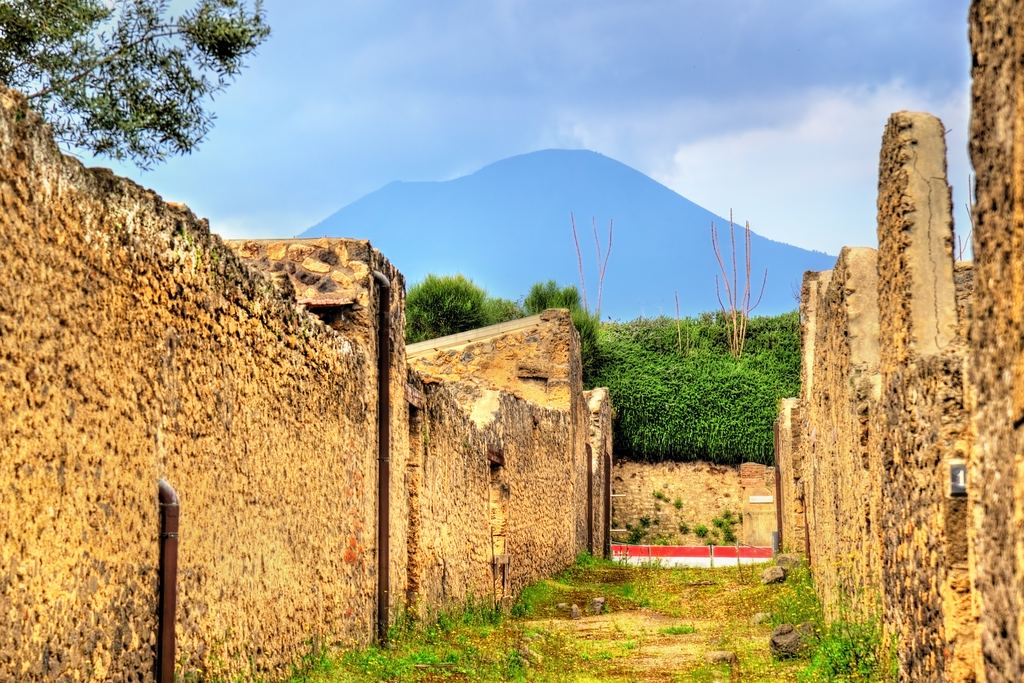
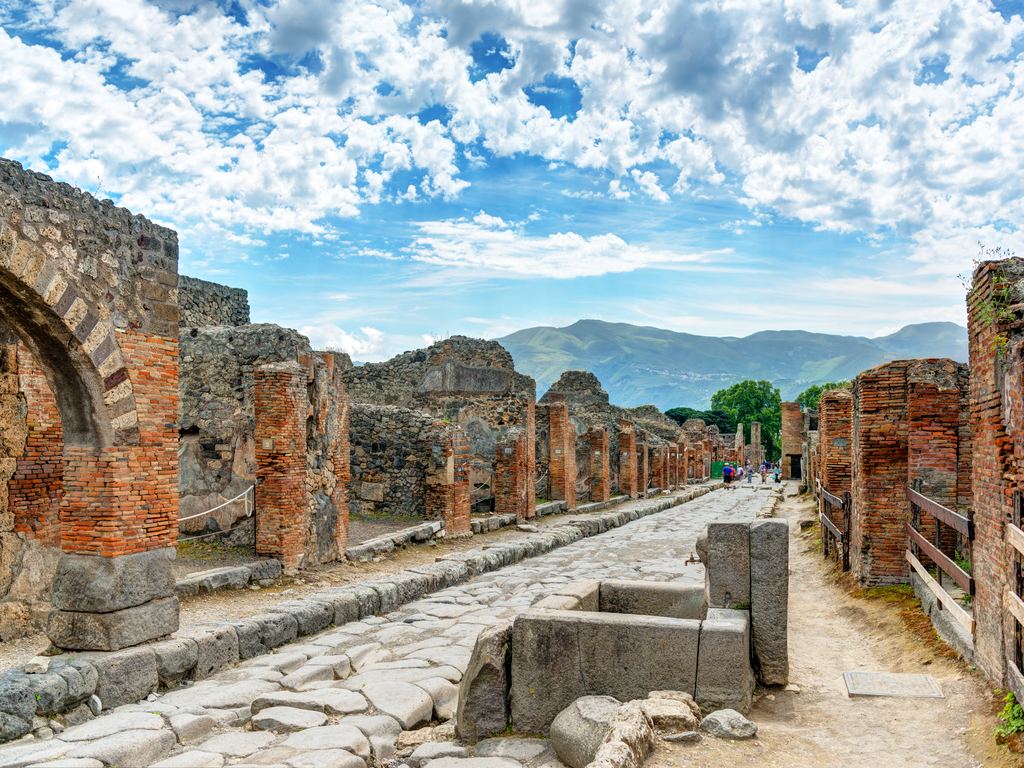
Crowds are the first gain, and the one with a number: a January day at the Scavi averages roughly a quarter of a spring day. Reading the place is the second. With fewer people, you can stand in a doorway and look at where the walls, the thresholds and the street ruts line up, which is hard when a group of thirty is behind you.
Planning is simpler too. The entry windows still exist, but the afternoon one ends at 15:30, and the heat problem described in our summer guide does not exist. Walking all day is comfortable at 13 to 18 °C if it is dry.
Other sites gain as well. Paestum has a lower winter ticket tier from December to February, as of November 2026 (see the ticket guide for amounts). Herculaneum, a smaller site, is easy to add to a short day.
What gets harder in winter?
Time. The Park is open eight hours in winter against ten in June, and entry stops at 15:30, so a late start leaves you ninety minutes. If you want a long tour of the site, see our itineraries, which show what fits in two hours, half a day and a full day. Warmth. Winter mornings feel colder on open ground than the numbers suggest, especially with wind, and the plain averages lows of 3 to 5 °C from December to February. Dress in layers. Closures. Parts of the site close for works at any time of year, and winter is when some of the work happens. The Park posts these temporary closures in its service notices. Its list of open houses changes weekly and is on its houses page; we do not tell you which are open.
Rain on the ground. A wet day affects the stepping stones and the drains more than the rooms. The Park's accessibility route has ramps that the Park says are at times steeper than 8 percent, which is a harder climb on wet paving. See Pompeii accessibility.
What about boats, Vesuvius and other day trips in winter?
Boats are where winter bites. At Capri the wind figures above mean roughly one day in three in November and December has strong wind, and sea crossings are what that wind cancels. Travelmar, the operator between Salerno, Amalfi and Positano, says its service runs all year, and that it can be delayed or changed by bad sea and weather. We could not verify the winter schedules of the Capri lines, whose websites load their times in a script, so we do not publish them. Check on the day and keep a plan B inland.
The Park of Vesuvius shortens its hours in the cold months and closes the ticket office and the path automatically from an orange weather alert issued by the regional civil protection, with a refund. Details, with what you can and cannot reach, are in Vesuvius and Pompeii. For a wet day the sensible alternative is indoors in Naples; the Archaeological Museum is closed on Tuesdays (as of November 2026), and its rooms change, so read our museum page first. The Reggia di Caserta is closed on Tuesdays, December 25 and January 1, and its park and garden hours change from month to month, so read its hours page before you go.
Which days are closed, free or different?
As of November 2026 the Park's timetable page says Pompeii is closed on December 25 and January 1 unless the Park announces otherwise. Other dates in the window are Italian public holidays: December 8, December 26 and January 6. We found no visitor counts for those specific days, and we will not guess. On the first Sunday of each month state sites are free. The Park's notice of May 23, 2025 says that on free days there is no online booking and entry is through the turnstiles, while the Ministry's own calendar can say otherwise, so check the day. Our crowd calendar covers the free-Sunday rule.
Is winter worth it?
Go in winter if you value space more than daylight, and plan one site per day. For the emptiest visit choose January or February. For the best balance of weather and crowds choose March, or November before the rain sets in.
November has the warmest air of the five months, 18 °C, and a sea warmer than May, but it is also the wettest and the one with the most thunder. March is quiet by summer standards at 8,500 visitors a day and has nearly 12 hours of daylight on the 15th. The comparison for every month is in our best-time guide.
Winter questions
What are Pompeii's opening hours in winter?
From October 15 to March 15 the Park opens at 9:00, takes its last entry at 15:30 and closes at 17:00 (as of November 2026). The summer timetable starts on March 16.
Is Pompeii worth visiting in winter?
Yes, if you accept short days. The site is quiet, with about 3,860 visitors on an average January day, and highs of 13 to 14 °C suit a long walk.
What is the weather like in Pompeii in December?
Highs of 14 °C, lows from about 5 °C on the plain to 10 °C on the coast, and rain on 9 to 10 days with 85 to 98 mm. Sunset is at about 16:35 mid-month.
Is Pompeii open on Christmas Day and New Year's Day?
According to the Park's timetable page as of November 2026, it is closed on December 25 and January 1 unless there is a notice. Check before you travel.
Does it rain a lot in Pompeii in November?
It is the wettest month, with 96 mm at Capri and 152 mm at Grazzanise on 9 to 11 days. Heavy rain days are most frequent then too.
Do boats to Capri and the Amalfi Coast run in winter?
Some do. Travelmar says its service runs year-round but can change with sea conditions. We could not verify the Capri lines, so check them close to the day.
Is it too cold to visit Pompeii in January?
Daytime highs of 13 to 14 °C are cool, not cold, but nights on the plain average lows of 3 to 4 °C. Wear layers and shoes with grip.
Should I bring an umbrella to Pompeii?
The Park's 2025 regulation does not list umbrellas, but its 2024 guide says to leave them out. A hooded rain jacket avoids the question.
Short days, so plan the hours
Four routes from 2 hours to 2 days, with the order of places.
Guided visits in the quiet season
A guide helps fit the best of the site into a short winter day.
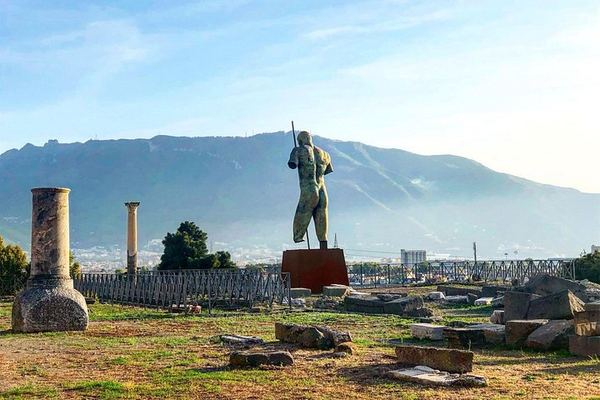
Pompeii 2.5-Hour Small Group Tour with Archaeologist and Skip-the-Line Entry
A site-only visit: 2.5 hours in Pompeii with an archaeologist, skip-the-line entry and tickets included, in a small group that ends at sunset over the ruins.
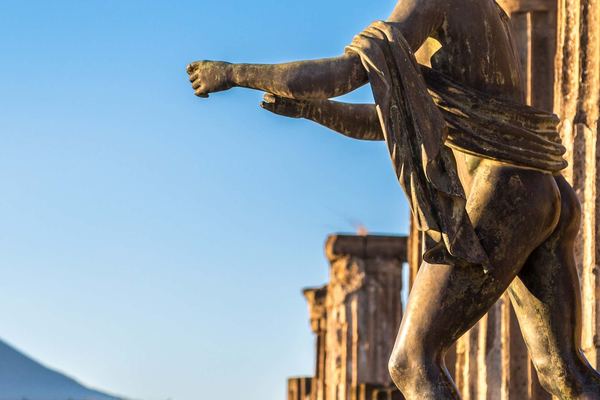
Pompeii 2-Hour Guided Tour with Entrance Ticket and English-Speaking Guide
Entrance to the archaeological site is covered on this English-speaking walk past the House of the Faun, the thermal baths, the Lupanar and the Basilica.

Pompeii 2-Hour Guided Tour with Licensed Archaeologist, Ticket and Cameo Workshop Stop
A licensed archaeology guide leads the two hours inside the ruins after a stop at a traditional cameo workshop, and the entrance fee is included in the booking.
Ratings collected by Viator, Tripadvisor and Civitatis
Data verified on . WMO normals 1991-2020; Park of Pompeii timetable and visitor data; our solar calculation; Travelmar and Park of Vesuvius pages. Independent of the Park. Editorial Policy