
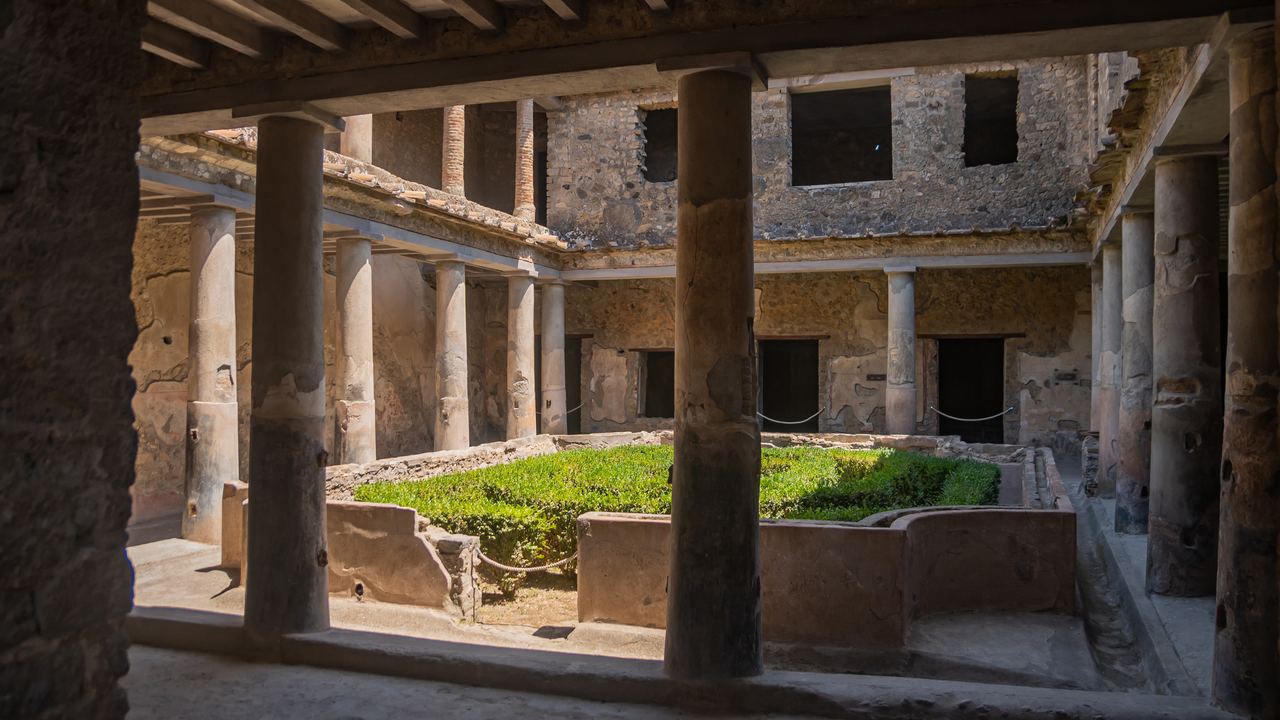
The three sites are Roman country houses buried by the same eruption as Pompeii, spread across three towns within about 7 km of its main entrance, measured in a straight line. Oplontis, in Torre Annunziata, has the seaside villa often called Poppaea's, with a 61 by 17 meter swimming pool and, by the Park's count, more than 90 rooms. Stabiae, in Castellammare di Stabia, has two big hillside villas and a small museum. Boscoreale has Villa Regina, a working farm with its wine cellar still in place. Pick by what you want to see: painted rooms and gardens, a view over the bay, or how Romans made wine.
If you add only one villa to a Pompeii trip, make it Oplontis. The Park runs a shuttle to it from Piazza Esedra, its rooms keep Second Style paintings, and it shows a kind of house the walled town does not have: a luxury residence built for the sea view.
Why are there villas outside Pompeii at all?
Pompeii was a town, and the Romans who could afford it kept a second house outside it. The Park sorts the ones around Vesuvius into two kinds. Residential villas were built for leisure and views: at Stabiae, according to the Park, many were put up along the northern edge of the Varano hill to take advantage of the panorama, with large decorated apartments, baths, porticoes and fountain rooms. Farm villas (villae rusticae) were the working end of the countryside. Around Boscoreale, private digs in the late 19th and early 20th centuries brought out about thirty of them, part of a dense network of family-run or slave-run farms on the slopes of the volcano and across the Sarno plain. The Park says they made wine for export and oil mostly for the local market.
That split is the quickest way to choose. Oplontis and Stabiae answer the question "how did the rich live?" Boscoreale answers "who made the wine in the amphorae you saw in Pompeii?" For the town houses inside Pompeii itself, our address book of Pompeii's houses covers the main ones.
Which villa is worth the trip?
| Site | Town | What you walk through | From Piazza Esedra | Best for |
|---|---|---|---|---|
| Oplontis, Villa A ("Poppaea") | Torre Annunziata | Seaside villa with a Tuscan atrium, Second Style paintings, private baths and a 61 x 17 m pool | about 2.9 km | Painted rooms and a villa plan you can read |
| Oplontis, Villa B | Torre Annunziata | A wine and goods warehouse around a columned courtyard, found in 1974 | about 300 m east of Villa A | Context only; see the Villa B section |
| Stabiae, Villa San Marco | Castellammare di Stabia | Residential villa of 11,000 square meters on the hill edge | about 5.1 km | Scale, and the view the owners paid for |
| Stabiae, Villa Arianna | Castellammare di Stabia | Villa named for a mythological fresco in its dining room | about 5.3 km | The dig history behind the Naples frescoes |
| Stabia museum (Reggia di Quisisana) | Castellammare di Stabia | 507 finds from the area's villas in a royal palace | about 6.9 km | What came off the walls and stayed in the region |
| Boscoreale, Villa Regina | Boscoreale | Farm with a wine cellar of 18 dolia, a press room and a granary | about 1.6 km | Daily work and wine |
Is Oplontis worth visiting?
Yes, if you have already seen Pompeii's town houses and want a different building type. The Park calls Villa A, also known as the Villa of Poppaea, the only part of ancient Oplontis open to visitors. It dates to the mid-1st century BC and was enlarged in the early Imperial age. The earliest part surrounds a Tuscan atrium with Second Style paintings. Around it are resting, dining and living rooms lit by windows onto a garden that once ran down to the sea. The private baths were heated from the kitchen and were later converted into a living room.
Around the middle of the 1st century AD the villa was extended eastward with a 61 by 17 meter pool, lined by dining rooms, guest apartments and small winter gardens decorated with paintings. Paleobotanical work let the Park replant what grew there: box hedges, oleanders, lemons, plane trees, olives, cypresses, roses and ivy. The slave quarters on the east side are arranged around a peristyle with a central fountain, and a tunnel once ran from its south-west corner under the 16th-century Sarno canal to a cryptoporticus facing the sea.
One thing to expect: the villa was probably mostly empty when the volcano erupted. The Park says repairs after earthquake damage had already stripped out many architectural and decorative elements. You see a big house between jobs, not a home frozen mid-dinner, and the walls carry more of the interest than the objects.

Did Poppaea really own the villa?
Nobody knows. The Park writes only that the villa could have belonged to Poppaea Sabina, Nero's second wife, or to her family, because an amphora carries a painted inscription naming Sucundus, one of Poppaea's slaves or freedmen. That is a thread, not a deed. We call the building Villa A and mention the Poppaea name the way the Park does.
Figures vary online. Some sources give the pool as 60 meters and the villa as having over 100 rooms. We use the Park's numbers: 61 x 17 m and over 90 rooms. Systematic excavation began in 1964, and the Park says it took about twenty years to uncover the complex, still not in full. The site came to light much earlier by accident, at the end of the 16th century, when the Conte di Sarno canal was dug along its southern edge.
What about Villa B at Oplontis?
Villa B turned up in 1974, about 300 meters east of Villa A, when a gym was being built at a junior high school. It was built toward the end of the 2nd century BC around a courtyard with a double-order colonnade in grey tuff, which the Park rebuilt from the original column drums. The finds point to a warehouse (horreum) for local farm produce and wine: wine amphorae were stacked upside down along the walls of the courtyard. In one of the vaulted storerooms on the south side, 54 people died while sheltering from the eruption. They carried gold and silver coins and jewelry, and a wooden strongbox decorated with iron and bronze fittings had fallen from the upper floor.
The Park's page describes Villa B as not open to visitors, and mentions guided summer visits on Friday afternoons under an agreement with a local archaeological association. The page carries a 2018 date, so treat that as history and ask before you plan around it. Also note the name: the same Park page spells it Lucius Crassius Tertius in the title and Lucius Cassius Tertius in the text, taken from a bronze seal. We avoid the personal name and just say Villa B.
What do you see at Stabiae?
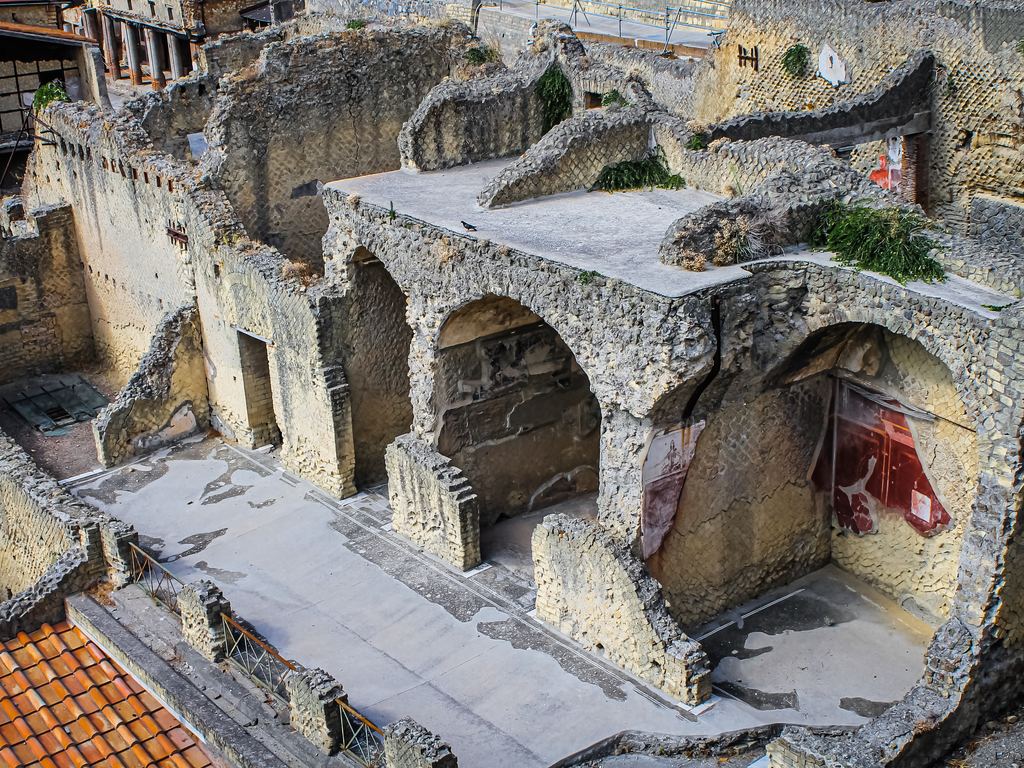
Stabiae was an important town in the 8th century BC and was destroyed by Sulla in 89 BC. In the decades before 79 AD its hill filled up with villas. The Park says that only some of them can be visited, and none has been dug in full. There are three on the ticket list.
Villa San Marco covers 11,000 square meters and is one of the big Roman residential villas. It is named after an 18th-century chapel of St. Mark on the site. The Bourbons dug it from 1749 to 1754, and it was re-excavated systematically between 1950 and 1962. The original villa, from the Augustan age, was built around an Ionic atrium and extended under Claudius.
Villa Arianna takes its name from a large mythological fresco on the far wall of the dining room. The Swiss engineer Karl Weber almost completely uncovered it between 1757 and 1762, using underground tunnels to recover objects rather than recording the whole building. The better frescoes were detached and taken to Naples, so the walls you see are what was left. The Second Complex, about 1,000 square meters, is separated from Villa Arianna by a narrow lane.
The finds from these digs went to Naples and to Castellammare. The Libero D'Orsi archaeological museum sits in the Reggia di Quisisana, an Angevin summer residence from the 13th century that Charles III of Bourbon remodeled between 1765 and 1790. The Park says the museum reopened on 6 March 2024 and shows 507 finds from the area's villas: wall paintings, marble furnishings, ceramics and bronzes. For the famous Stabiae frescoes, including the "Flora" panel from Villa Arianna, you need the Naples museum; see Pompeii at the Naples Archaeological Museum.
What is Villa Regina at Boscoreale?
Villa Regina is a farm. The Park puts it about a kilometer north of Pompeii's excavations, and our straight-line count from Piazza Esedra gives 1.6 km. It was excavated in 1977 after building works nearby, and it was buried by the same eruption: you can read the layers of volcanic deposits in the stratigraphy along its walls. Its rooms open onto a courtyard with the wine cellar holding 18 dolia, the big buried jars used for fermenting. Next to them stand the press room with the remains of the wooden press, a kitchen that was not in use at the eruption, a granary for hay, cereals and beans, and a dining room with paintings from the transition between the Third and Fourth Styles.
Two details make it feel like a real farm. A cart (plaustrum) was found in the arcade, and the wheel ruts are still visible in a street nearby. And the ground around the villa is the agricultural land of 79 AD: the Park made casts of the vine roots and replanted the vines on the same plots as a demonstration vineyard. The villa sits eight to nine meters below the modern street, which is why damp and salts are a constant conservation problem there.
Boscoreale's most famous finds are not there. Private diggers a century ago sent objects to the Naples museum, the Louvre and the Metropolitan Museum of Art in New York. Villa della Pisanella, dug in 1895-1899, was reburied; its treasure of 1,037 gold coins and 108 pieces of silverware is split between the Louvre and the Rothschild Collection. The best wall paintings of the villa of Publius Fannius Synistor, dug in 1900, were split among museums in Naples, New York, Brussels, Paris and elsewhere, according to the Park.
Is there anything else out here, like Longola?
Longola is a different story. It is a prehistoric village in Poggiomarino, in the upper Sarno valley, which the Park places about 10 km east of Pompeii. Found by accident in 2000, it was inhabited from the Middle Bronze Age to the 6th century BC: huts on artificial islets separated by canals, a wet dock and three dugout canoes. The Park compares its layout with the Marsh Arabs of Iraq and with Ganvie in Benin. Nothing there is Roman. As of November 2026 the Park's ticket page says a valid Pompeii ticket (valid 30 days from issue) gets you in free; we found no opening hours in the Park's hours table, so check the site's own pages before going.
How do you get to Oplontis, Boscoreale and Stabiae?
| Site | Train (Circumvesuviana) | Park shuttle (Pompeii Artebus) |
|---|---|---|
| Oplontis, Villa A | Stop Torre Annunziata (the Park lists both the Naples-Sorrento and Naples-Poggiomarino lines) | Shuttle 2, from Pompeii's Piazza Esedra |
| Boscoreale, Villa Regina and Antiquarium | Naples-Sorrento line, stop Villa Regina | Shuttle 1, from Piazza Esedra; the Villa dei Misteri stop on this route is for boarding only |
| Stabiae, villas and museum | Naples-Sorrento line, stop Castellammare di Stabia. For the villas, then EAV bus line 2; for the museum, the Park lists city bus lines 5 or 7 from Piazza Giovanni XXIII | Shuttle 3, which starts in Castellammare, not in Pompeii |
The last row is where itineraries go wrong. No shuttle runs from Pompeii to Stabiae. The Park says to take the Circumvesuviana to Castellammare di Stabia and pick up Shuttle 3 there, at Piazza Unità d'Italia or at the Piazza Giovanni XXIII terminus. Shuttle 3 then calls at the museum, Villa Arianna and Villa San Marco. The villas are about 5 km from Piazza Esedra in a straight line, but by train and bus it is a separate trip, not an add-on.
The Park runs three Artebus shuttles between its sites, and says they are free for visitors of its sites and "subject to availability for each ride". Each has a winter and a summer timetable (winter runs 15 October to 15 March, summer 16 March to 14 October), and the Park notes that travel times can vary with traffic. Shuttles 2 and 3 do not run on Tuesdays, when Oplontis and the Stabiae sites are closed. The vehicles have room for large luggage but no access for disabled passengers. Shuttle 2 leaves from Piazza Esedra in Pompeii and takes about half an hour to Oplontis; Shuttle 1 runs from Piazza Esedra to Boscoreale and Villa Regina; Shuttle 3 makes only a few runs a day from Castellammare. Because the runs are spaced out, work backward from the last entry at the villa and from the return pick-up, and check the timetable on the Park's shuttle page before you go.

Which ticket includes the villas?
| Ticket | Pompeii | Villa dei Misteri and Villa di Diomede | Villa Regina and Antiquarium (Boscoreale) | Oplontis | Stabiae villas and museum |
|---|---|---|---|---|---|
| Pompeii Express | Yes | Add-on at the start of that route | Add-on | No | No |
| Pompei+ | Yes | Yes | Yes | No | No |
| Three-day ticket | Yes | Yes | Yes | Yes | Yes |
| MyPompeii annual card | Yes | Yes | Yes | Yes | Yes |
Two points are easy to miss. The three-day ticket allows one entry to each site, within three days and only on each site's opening days. And Pompei+ does not include Oplontis or Stabiae: it stops at Boscoreale. Each of Boscoreale, Oplontis and the Stabia museum also has its own single-site ticket, while the Park's table shows entry to the two Stabiae villas (Villa Arianna and Villa San Marco) as free ("gratuito") in November 2026. We keep every price on one page: Pompeii tickets explained.
Opening days differ by site. In the Park's table read on 5 November 2026, Oplontis, the two Stabiae villas and the Stabia museum are closed on Tuesdays, while Villa Regina and the Antiquarium open every day, like Pompeii, except 25 December and 1 January unless the Park announces otherwise. For these villas the last entry is one hour before closing, and the hours shift with the season, so check the Park's timetable page before you set out.
How do you fit the villas into a Pompeii trip?
Treat Oplontis and Boscoreale as satellites of a Pompeii day and Stabiae as its own half day. The Park shuttles leave from Piazza Esedra, so a morning at Pompeii followed by a shuttle to Oplontis, or the reverse, works on paper; the shuttle schedule is the limit, because the last entry to these sites comes an hour before closing. Stabiae sits on the Naples-Sorrento line, which makes it a natural stop for anyone based in Sorrento or Castellammare. For a longer plan across several days, our Pompeii itineraries page lays out the sequences.
The order matters less than you would think, but one rule helps: see at least one Pompeii town house first. The villas then read as variations on a theme you already know, rather than as ruins with no scale.
Questions about the villas around Pompeii
Is Oplontis worth visiting?
Yes, if you want a different kind of building from Pompeii's town houses. Villa A is a seaside luxury villa with Second Style paintings, a Tuscan atrium and a 61 x 17 m pool. Expect a big house that was probably half empty in 79 AD because of repair work.
Is the Villa of Poppaea really Poppaea's?
Unproven. The Park says it could have belonged to Poppaea Sabina or her family, based on an inscription naming Sucundus, a slave or freedman of Poppaea, on an amphora.
Can I visit Villa B at Oplontis?
The Park's page says it cannot be visited, and mentions occasional guided access on summer Friday afternoons with a local association. The page is undated, so confirm before you go.
Is Stabiae a UNESCO World Heritage Site?
We could not confirm it. The Park's page ties the 1997 listing to the excavations at Oplontis. We found no Park statement saying the same of Stabiae, so we do not claim it.
Is there a shuttle from Pompeii to Stabiae?
No. Shuttle 3 starts in Castellammare di Stabia. From Pompeii, take the Circumvesuviana toward Sorrento to the Castellammare di Stabia stop.
Does the Pompei+ ticket include Oplontis or Stabiae?
No. Pompei+ adds the Villa dei Misteri, the Villa di Diomede and Villa Regina in Boscoreale. Oplontis and Stabiae come with the three-day ticket, the MyPompeii card or their own tickets.
What are the Villa dei Misteri and Villa di Diomede?
Two suburban villas just outside Pompeii's walls, beyond the Herculaneum Gate. They belong to Pompeii's own ticket route rather than to the three sites on this page.
Where did the Boscoreale treasure go?
The silver and gold from Villa della Pisanella (1,037 gold coins and 108 silver pieces) is divided between the Louvre and the Rothschild Collection. The villa itself was reburied.
Check the ticket before you go
The villas are covered by some Park tickets and not others. Our tickets page lays out which, with prices.
Data verified on . Site details, shuttles and ticket coverage: the Park's pages. Distances: our calculation from map coordinates. Hours and timetables change. Editorial Policy