
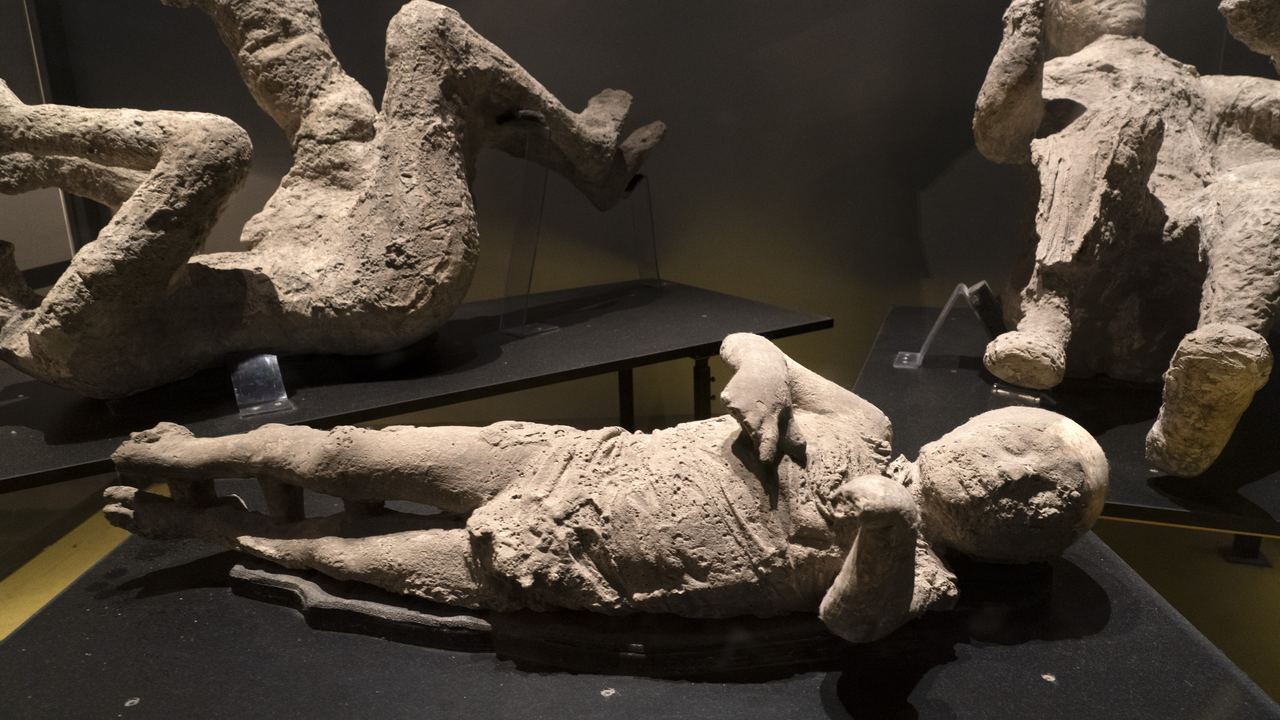
The Pompeii body casts are made of plaster poured into the hollows that victims of the eruption left in hardened ash. The method dates to 1863, when the archaeologist Giuseppe Fiorelli first used it, and it has produced about a hundred casts (104 in the latest count). They are not the bodies: inside many of them are fragments of bone, wrapped in plaster that earlier restorers shaped and sometimes reinforced with metal rods. In November 2024 a team led by Elena Pilli published DNA from five of them, and two famous stories fell apart: the "mother and child" and the "two sisters" were not what we were told. The study also left plenty unsaid, and this page keeps to what it did say.
How does a body leave a hollow in ash?
A cast needs two things that did not happen everywhere. The victim has to be buried in fine ash, not in pumice, and the ash has to harden around the body before the soft tissue rots away. When it does, the hollow keeps the outline of the person: the folds of cloth, the position of the limbs, the curl of a body. Where bodies lay in coarse pumice, the impressions "were generally lost," as Giacomelli and Scandone put it in 2026.
That explains a fact visitors rarely hear. The people who died during the long fall of pumice have left bones, and the Park of Pompeii says so on its page about the casts. The casts come from the victims of the later pyroclastic surges, whose fine ash set around them. Our page on the eruption hour by hour explains why the two groups died differently.
How did Fiorelli make the first cast in 1863?
Excavators had run into these hollows for decades, and the Park notes that earlier attempts to recover the forms are known. None worked until 1863. Giuseppe Fiorelli, who ran the excavations in the 1860s (sources give 1860, 1861 or 1863 for when he took charge), changed that. The method is simple to describe: pour liquid plaster into the void, let it set, then remove the ash around it. The bones stay inside the plaster.
Fiorelli changed more than the technique. He dug from the top of the deposit downward, which let him spot a hollow before a spade went through it. He divided the city into regions, blocks and numbered doors, the address system still in use and the subject of our address book of houses. He founded an archaeological school in 1866, and the first Pompeii museum, which he opened in 1873 to 1874, showed casts in metal and glass cases.
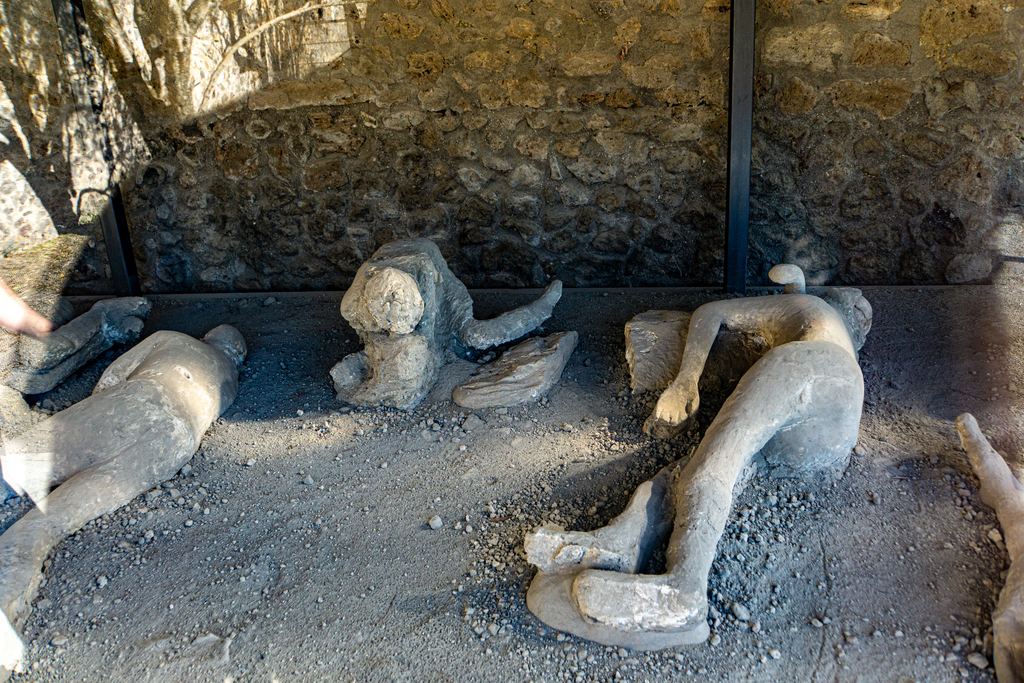
In the twentieth century the casts were instead kept where they were found, in cases or under canopies. In the Garden of the Fugitives (I 21,2) thirteen bodies, according to the Park, remain in their original position.
| Year | What happened | Why it matters |
|---|---|---|
| Before 1863 | Earlier attempts to recover the shapes of the victims are known, but none succeeds. | The Park of Pompeii records them but gives no details. |
| 1863 | Fiorelli pours plaster into the ash hollows. | First cast; the method becomes standard. |
| 1914 | In the garden of the House of the Cryptoporticus, nine victims are found and four casts are made. | The pair later nicknamed the sisters comes from here. |
| 1943 | Bombing damages or destroys many casts on display. | Maiuri and his team restore some; the survivors were not housed in the Antiquarium that opened in 1948. |
| 2015 | During restoration of 86 casts, 26 are CT scanned or X-rayed. | None holds a complete skeleton; earlier restorers had reshaped them. |
| 2024 | Pilli and colleagues publish DNA from 14 sampled casts. | Two family stories are overturned. |
| 2026 | The Park opens its first permanent exhibition on the casts in the Great Palaestra (12 March 2026), with 22 casts on show. | Casts return to public view in a dedicated display. |
How many casts are there, and why does the number get confused?
There are 104 casts of people, according to Pilli and colleagues. The Park says "a little over a hundred" have been made since 1863. The number that gets mixed up with it is 1,044, the count of victims recovered at Pompeii, in the roughly two thirds of the city excavated. One website after another has printed 1,044 as the number of casts. It is the number of bodies, and the casts are one in ten of them.
What did the CT scans of 2015 show?
During the restoration, specialists scanned 26 of the 86 casts under work. The result was less romantic than the display cases suggested: none contained a complete skeleton. Bones had been removed before casting in many cases, metal rods had been added to strengthen the plaster, and the casts had been "considerably manipulated and likely creatively restored" over the years, in the words of Pilli's team. So the shape of a cast partly reflects the taste of whoever restored it.
One example was widely repeated: the cast of a "pregnant woman" with a swollen belly. The researchers say the abdomen was probably bunched-up fabric, not a pregnancy.
What is inside: bones, teeth and a lot of plaster
The DNA team took samples from fragments of bone and teeth, reached through damaged parts of the casts. They sampled 14 casts, screened them, and enriched seven libraries for about 1.2 million genetic markers. Five individuals gave enough data for genome-wide analysis, and four were dated by radiocarbon. One person, from the Villa of the Mysteries, had a strontium signature compatible with Campania.
Five out of 104 is a small share. Treat the result as a set of case studies, not a census of Pompeii.
What did the 2024 DNA study find, and what did it overturn?
The paper is Pilli et al., Current Biology 34(22), published 7 November 2024. Its authors include Elena Pilli, David Reich, and the Park's director Gabriel Zuchtriegel. All five individuals with genome-wide data were genetically male. Most of their ancestry came from recent immigrants from the eastern Mediterranean, like that of contemporary people in Rome. The authors take it as a sign of how mixed the Roman Empire was.
| Cast and address | The story told for years | What the DNA showed |
|---|---|---|
| House of the Golden Bracelet (VI 17,42): an adult wearing a gold bracelet, with a child on the lap | A mother and her child. | The adult is a male, biologically unrelated to the child. |
| House of the Cryptoporticus (I 6,2): two victims found close together, read as an embrace | Two sisters, a mother and daughter, or lovers. | At least one is genetically male (Individual 22). Individual 21 gave no usable data. |
What the study does not say. It does not say the casts are fakes; they are casts of real people. It says nothing about how the two people in the Cryptoporticus felt about each other, and it covers five casts. The authors' own conclusion is that modern assumptions about gendered behavior "may not be reliable lenses" for reading the past.
The three readings that excavators had floated for the Cryptoporticus pair were sisters, mother and daughter, or lovers. A male in the pair rules out the first two. The paper neither proves nor excludes the third. The old caption, which settled the matter, was never evidence.
Are the casts the people themselves?
Partly. The outline is real: it is the space the body left in the ash. The plaster is a nineteenth or twentieth century addition, the bones inside are real and sometimes incomplete, and the pose has been adjusted in places. This is why the question of the final moments is hard. Mastrolorenzo and colleagues read the twisted limbs as cadaveric spasm from sudden heat. Others see the sign of a slower death. The casts do not settle it, because the casts themselves have been reworked.
The Park also says that casts which were thought lost after the 1943 bombing have been found again, and that the older plaster and resin casts have been laser scanned so 3D copies can travel while the originals stay in Pompeii.
Where can you see the casts?
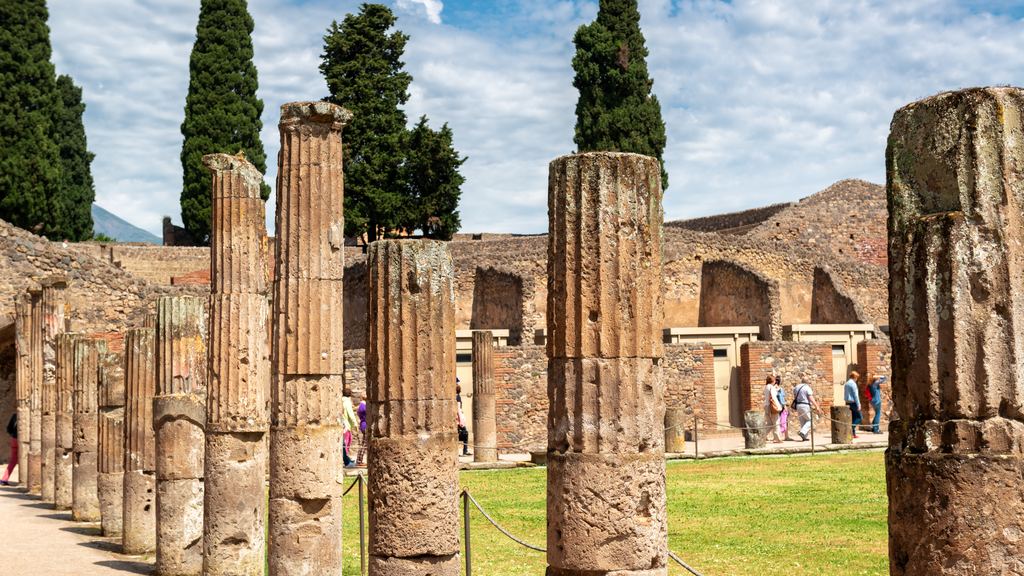
Two places matter. The Garden of the Fugitives (Orto dei Fuggiaschi, I 21,2) shows casts of the people found there, in the position where they lay. The Great Palaestra (II 7,1) hosts the Park's permanent exhibition on the casts, with 22 casts under the porticoes. Which buildings are open changes, so we leave that to the Park's list at pompeiisites.org/en/houses, and the standard ticket covers the main site (see our tickets guide).
How to look at them with respect, and with children
Each cast is a person who died in the worst hours of their life. You do not need to avoid them, only to be plain about what they are. A few habits help, with adults and with children.
Stay back and keep your voice down. People pause here, and some visitors are moved. Take photos if the Park's rules allow it, and do not use a person's cast as a backdrop for a joke.
Tell children before they see one. A short, true explanation works: these are the shapes people left in volcanic ash, made of plaster, with some of their bones inside. Let a child look away. Some children are curious and some are frightened, and neither is a failure. Our page on visiting Pompeii with kids has more on pace and age.
Say what we do not know. The 2024 study gives children a useful lesson: the story on the label may be wrong, and scientists correct it. We do not know the names of most of these people. Saying so is respectful.
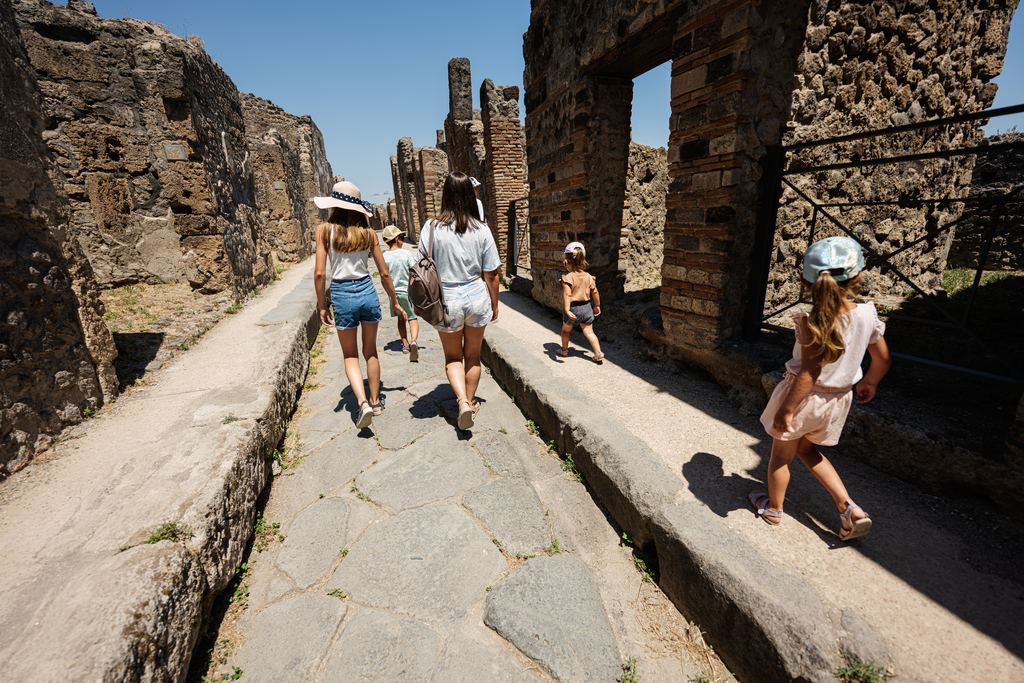
Seeing the casts with a guide
If you would rather have the context in person, our page on guided tours at the site compares formats.
Questions about the Pompeii body casts
How were the Pompeii body casts made?
Liquid plaster was poured into the hollows that decayed bodies left in hardened ash. The method was first used by Giuseppe Fiorelli in 1863. Once the plaster set, the ash around it was removed.
Are there real bones inside the casts?
Yes, fragments of bone and teeth, though not complete skeletons. A 2015 scan of 26 casts found none with a full skeleton, and some bones were removed before casting.
How many plaster casts are there?
104 casts of people, according to Pilli et al. (2024). The number 1,044 is the count of victims recovered at Pompeii, not the casts.
Is the pregnant woman cast real?
The swollen abdomen was probably bunched-up cloth, according to the 2024 study, not a pregnancy.
Were the two "sisters" actually sisters?
No. At least one of the pair in the House of the Cryptoporticus is genetically male (Pilli et al. 2024). The study does not say anything about whether they were lovers or friends.
Was the cast with the golden bracelet a mother and child?
No. The adult is a male, biologically unrelated to the child, according to the DNA analysis of the cast from the House of the Golden Bracelet.
Where can I see the casts?
The Garden of the Fugitives (I 21,2) has casts where they were found, and the Great Palaestra (II 7,1) hosts a permanent exhibition on the casts. Check the Park's list of open buildings before you go.
Are the casts suitable for children?
That depends on the child. Tell them what they are about to see, and let them skip it if they want. See our page on visiting Pompeii with kids.
Do the casts show the victims' last moments?
They show the shape the body held when the ash set, then handled by restorers. Researchers disagree on whether the poses show heat spasm or a slower death.
Data verified on . Checked against Pilli et al. 2024 (Current Biology) and the Park of Pompeii's pages, 5 November 2026. Editorial Policy