
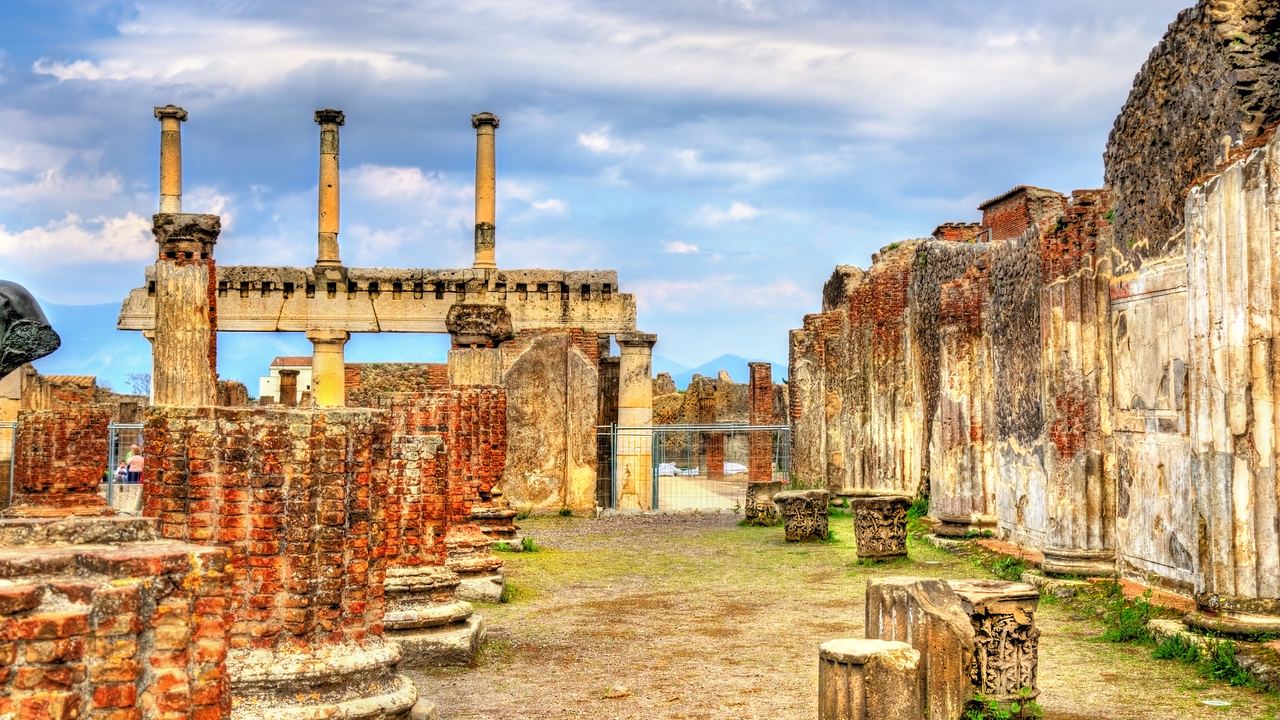
We checked 30 popular claims about Pompeii, the eruption and the plaster casts against primary sources: the Park of Pompeii, UNESCO, Italy's Civil Protection Department, the ancient texts and peer-reviewed studies. 16 are false, 6 are partly true, 6 are disputed and 2 are true. Each entry below gives the verdict, the source and, where the evidence splits, both sides. It is not a debunking page for its own sake: some old stories are right, and some of the corrections are still argued over.
The three errors we see most: Pompeii was not buried by lava, there are 104 casts by the latest count (the Park says a little over a hundred), not 1,044, and 24 August is the traditional date for the eruption, not a settled one.
How to read the verdicts
True means a primary source says it. False means a primary source or a peer-reviewed study contradicts it. Partly true means the claim holds for one part and fails for another, and we say which. Disputed means qualified researchers disagree and nobody has settled it, so we give each side and do not pick. When a number differs between sources we say so and name them. The table is the short version; the sections after it carry the evidence.
The 30 claims at a glance
| Claim | Verdict | Why |
|---|---|---|
| Pompeii was buried by lava. | False | Ash, pumice and hot surges; no lava flow in AD 79 |
| Everyone died in an instant. | Partly true | 62% died in the surges, 38% over hours of pumice |
| Vesuvius erupted on 24 August, AD 79. | Disputed | A Latin date converted by readers; a charcoal note says October |
| Pliny's letters describe the destruction of Pompeii. | False | The letters never name Pompeii or Herculaneum |
| Pliny the Elder was killed by poisonous gas. | Disputed | The cause is his nephew's guess: "as I gather" |
| Vesuvius looked then as it does now. | False | The cone you see grew after AD 79 |
| The Romans had no idea Vesuvius was a volcano. | Partly true | Strabo guessed it had burned; nobody expected this |
| The plaster casts are the bodies. | False | Plaster in ash hollows; 2015 scans found no complete skeleton |
| There are 1,044 casts. | False | 1,044 is the count of victims; there are 104 casts |
| The cast with the gold bracelet is a mother holding her child. | False | DNA: an adult male, not related to the child |
| The embracing pair in the House of the Cryptoporticus are two sisters. | False | At least one of the two is genetically male |
| One cast shows a pregnant woman. | False | The swelling reads as bunched-up cloth |
| Everyone in Pompeii died. | False | 1,044 bodies against a population of thousands |
| The man with the glass brain died at Pompeii. | False | He was found at Herculaneum |
| The twisted poses of the casts prove a slow, agonizing death. | Disputed | Heat spasm or suffocation: researchers disagree |
| The victims suffocated on ash. | Disputed | Heat, suffocation and collapse all have a study behind them |
| Pompeii was a seaside town. | Partly true | Strabo: a river port on the Sarno |
| Every Pompeian house had a Cave canem mosaic. | False | One famous mosaic, at the House of the Tragic Poet |
| Pompeii had 20,000 inhabitants. | Disputed | Published estimates run from about 10,000 to 20,000 |
| Pompeii has been completely excavated. | False | UNESCO: 44 hectares dug; about two thirds of the town |
| The red walls of Pompeii are the original paint. | Partly true | Some reds were yellow ochre baked by the surges |
| An election campaign was under way when the volcano erupted. | True | UNESCO and the 2023 Regio IX finds |
| Pompeii was forgotten for 1,700 years. | False | Survivors, looters and a 16th-century canal all knew |
| Pompeii was discovered in 1748. | Partly true | 1748 starts the digging; the name came in 1763 |
| Emperor Titus rebuilt Pompeii. | False | The Park: the sites were abandoned |
| The earthquake that damaged Pompeii happened in AD 62. | Disputed | Tacitus says 62, Seneca's consuls point to 63 |
| Everything found at Pompeii is in the Naples museum. | Partly true | Most movable art is; the Park names exceptions |
| Vesuvius is extinct. | False | Quiet since 1944, monitored around the clock |
| AD 79 was Vesuvius's only big eruption. | False | 472, 1631, 1906 and 1944 all followed |
| Spartacus hid on Vesuvius. | True | Appian, Civil Wars 1.116 |
The eruption and the people who wrote about it
The best-known story of Pompeii is also the one with most errors in it, partly because the only eyewitness wrote about a different town.
"Pompeii was buried by lava." False. UNESCO describes Pompeii as buried largely under a thick layer of ash and lapilli, and Herculaneum as buried by surges and flows of volcanic material. No lava flow reached either town. What buried Pompeii was pumice, about three meters of it according to the Park of Pompeii, followed by fast, hot clouds of gas and ash. The full sequence is on our page about the eruption hour by hour.
"Everyone died in an instant." Partly true. Giacomelli and colleagues (2003) counted 1,044 victims in the excavated part of the town. Of these, 650 (62 percent) lay in the deposits of the pyroclastic flows, where death came fast. The other 394 (38 percent) lay in the pumice fall and died over many hours, 80 to 88 percent of them indoors, as roofs and walls gave way. The Park's own page on the casts says those caught by the flow died at once of thermal shock. So the sentence is true for most of the second phase and wrong for the first.
"Vesuvius erupted on 24 August, AD 79." Disputed. Pliny's Latin gives the ninth day before the Kalends of September, which readers convert to 24 August. That is the traditional date, and the Park's director defended it in December 2024. Against it stand a charcoal inscription found in Regio V in 2018 (XVI K Nov, 17 October, no year) and a 2022 review arguing for autumn. There is no consensus, so we write "the traditional date" every time. The evidence is laid out in the hour-by-hour page.
"Pliny's letters describe the destruction of Pompeii." False. Pliny the Younger wrote two letters to Tacitus (Epistles 6.16 and 6.20). In the Latin they name Misenum, Stabiae, Capri and a woman called Rectina. They never name Pompeii or Herculaneum. Pliny was 17 and across the bay at Misenum, and he writes that the cloud came from a mountain that was only later known to be Vesuvius. The letters are the only eyewitness account, and they are about somewhere else.
"Pliny the Elder was killed by poisonous gas." Disputed. His nephew writes that the admiral collapsed, his breath blocked by thick fumes, and then adds ut ego colligo, "as I gather" (6.16.19). The cause of death is Pliny's inference, not a report. He also notes that the body, found when daylight returned, the third day counting from the last he had seen (Epistles 6.16.20), was whole and unmarked and looked more like a sleeper than a dead man.
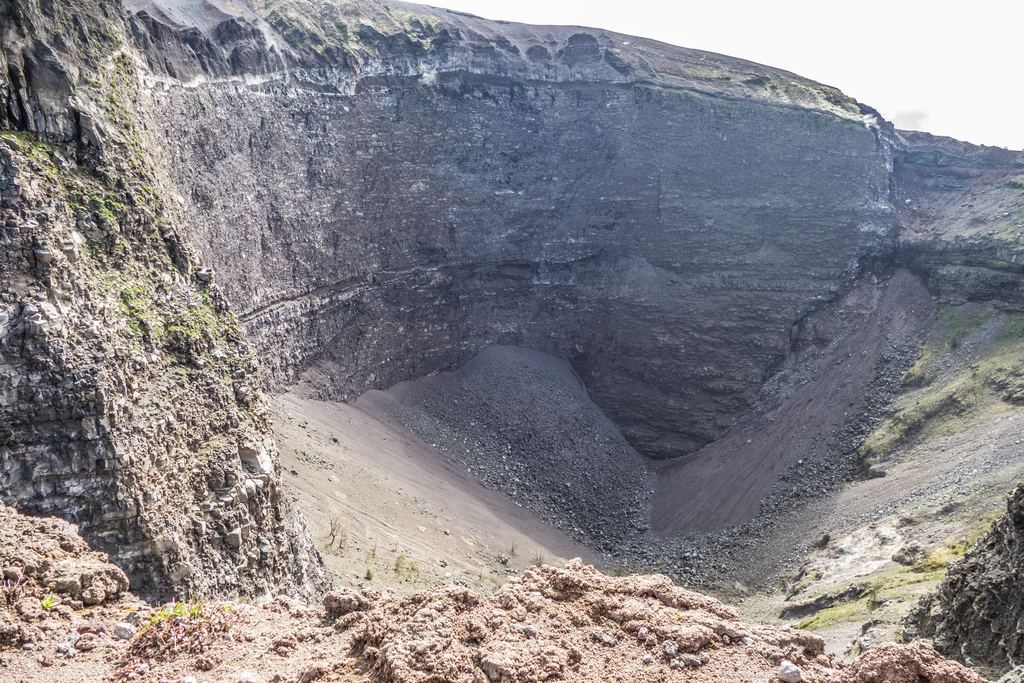
"Vesuvius looked then as it does now." False. The Civil Protection Department describes an older volcano, Monte Somma, with a caldera, and a younger cone, Vesuvius, that grew inside the caldera after the eruption of AD 79. The mountain the Romans saw had a different outline. Cassius Dio, writing later, describes it as a hunting-theater shape with a hollow center, which matches a mountain with a hollow center.
"The Romans had no idea Vesuvius was a volcano." Partly true. Strabo (Geography 5.4.8) describes an ash-colored top and rocks that look eaten by fire, and concludes the place probably burned once. Nothing in the sources we read shows that anyone acted on that guess. The Civil Protection Department puts the rest before AD 79 at about three centuries, and Pliny says the tremors of the previous days were ignored because they were normal in Campania (6.20.3). Strabo had the idea, and the town stayed where it was.
Victims and plaster casts
The casts attract more false stories than anything else on the site, and the 2024 DNA study cleared some of them. Our full page on the body casts has the method and the results.
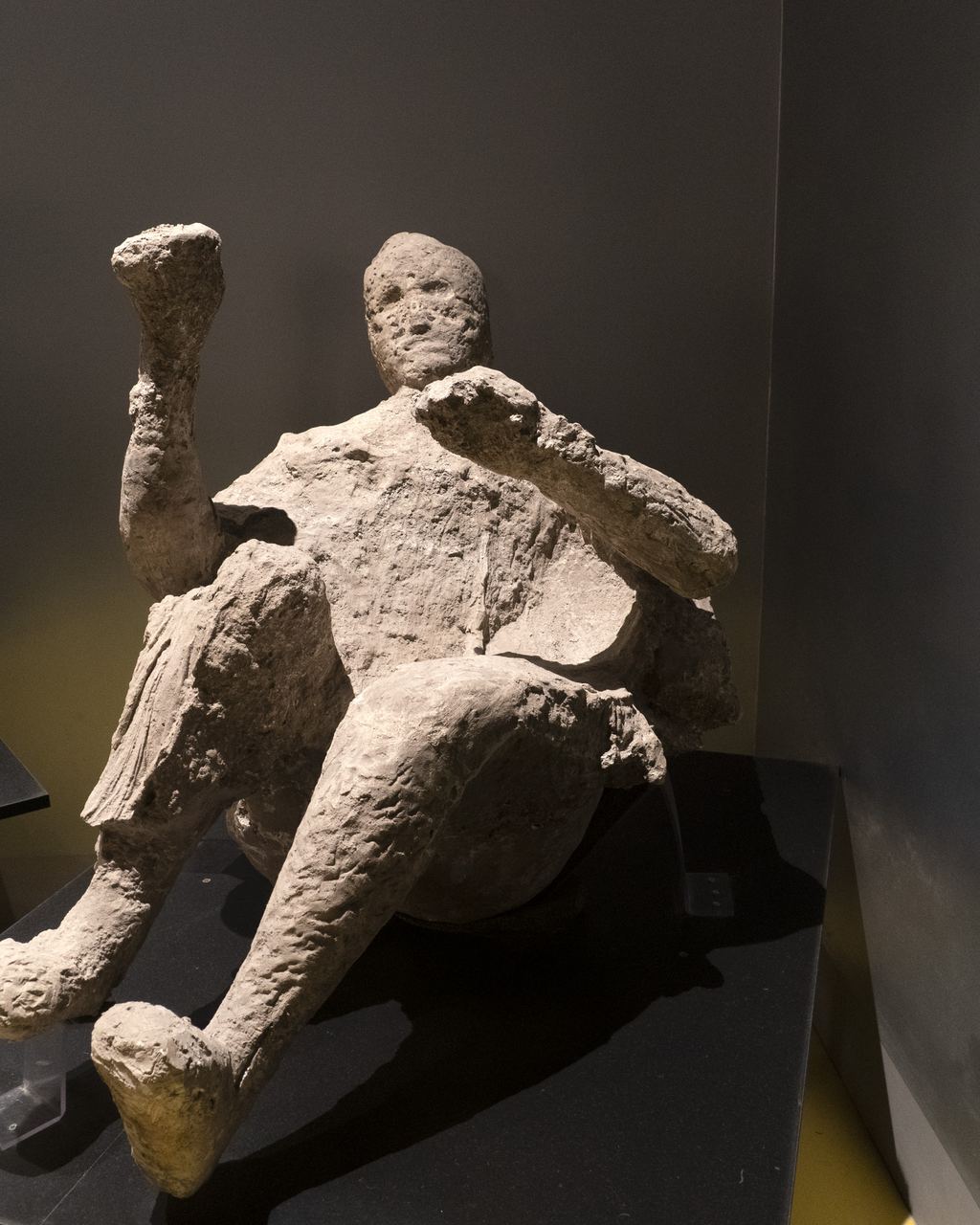
"The plaster casts are the bodies." False. A cast is plaster poured into the hollow a body left in hardened ash after it decomposed. In 2015, during restoration, 26 casts were scanned: none held a complete skeleton. The 2024 study of Pilli and colleagues reports that the casts had been handled heavily and probably restored with some invention, with metal rods added and bones removed before casting. Fragments of bone and teeth remain in some.
"There are 1,044 casts." False. The two numbers get swapped constantly. 1,044 victims were recovered in the excavated two thirds of Pompeii (Giacomelli et al. 2003). There are 104 casts (Pilli et al. 2024), and the Park says "a little over a hundred". Only victims buried in fine ash left a hollow worth filling. Those caught in the pumice left bones only.
"The cast with the gold bracelet is a mother holding her child." False. The cast from the House of the Golden Bracelet was read as a mother and child for generations. The 2024 DNA study found an adult male biologically unrelated to the child. The study does not say who the two were to each other.
"The embracing pair in the House of the Cryptoporticus are two sisters." False. The same study found that at least one of the pair was genetically male. For the second individual no usable data came back. The authors rule out sisters and mother and daughter, but DNA cannot show whether the two were lovers, friends or neither, so the "lovers" story that replaced the "sisters" story has no support in the data either. Five of the 104 casts yielded enough DNA, and all five were genetically male.
"One cast shows a pregnant woman." False. The scans of 2015 and the 2024 study read the swollen abdomen as crumpled fabric, not as a pregnancy. That is the study's reading of the scan.
"Everyone in Pompeii died." False. The count is 1,044 bodies in the excavated part, plus an estimated 100 more from scattered bones and about 464 in the unexcavated third (Giacomelli et al. 2003). The authors do not add the three figures, and neither do we. Estimates of the town's population run into the thousands. How many people left in time cannot be known, and the Park says the same: nobody will ever know exactly how many saved themselves.
"The man with the glass brain died at Pompeii." False. The vitrified brain belongs to a young man found on a bed in the Collegium Augustalium at Herculaneum (Petrone et al. 2020; Giordano et al. 2025). The 2025 study says the organic glass formed above 510 degrees C in a brief, dilute surge. It is the only known case of human tissue turned to glass this way, and it has nothing to do with Pompeii.
"The twisted poses of the casts prove a slow, agonizing death." Disputed. Mastrolorenzo and colleagues (2010) read the contorted postures as cadaveric spasm caused by sudden heat. The older view is a slower death by asphyxia. The Park's casts page sides with fast death by thermal shock. Poses are evidence, but not the kind that settles it.
"The victims suffocated on ash." Disputed. Mastrolorenzo and colleagues (2010) concluded that heat was the main cause. Giacomelli and colleagues (2003) saw no burns on bodies, clothes or frescoes and favored suffocation. Sparice and colleagues (2024) and Giacomelli and Scandone (2026) add earthquakes: walls fell and many people died while fleeing. A fair summary gives all three, as the hour-by-hour page does.
The city and its people
Claims about daily life are easy to repeat and hard to source. These are the ones tour guides and blogs state most firmly.
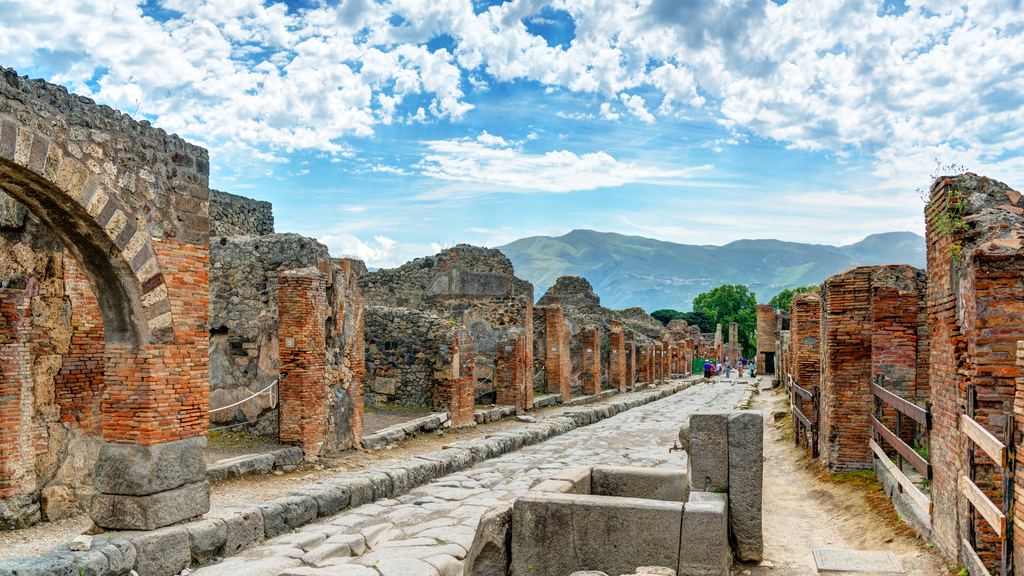
"Pompeii was a seaside town." Partly true. Strabo places Pompeii on the river Sarno and calls it the port of Nola, Nuceria and Acerra. It was a river port near the coast, not a beach resort. Do not plan your visit around a sea view.
"Every Pompeian house had a Cave canem mosaic." False. The mosaic that reads CAVE CANEM, "beware of the dog", is at the main entrance of the House of the Tragic Poet, where the Park says it is now protected by glass. The Naples museum shows a second dog mosaic labeled only as coming from Pompeii. The idea that every house had one is a tour-guide reflex. See the address book of Pompeii's houses.
"Pompeii had 20,000 inhabitants." Disputed. No ancient writer gives a figure, and the Park pages we read give none. Estimates in the literature run from about 10,000 to 20,000, and the lower ones come from counting houses. We do not pick a number. The same caution applies to the total of the dead.
"Pompeii has been completely excavated." False. UNESCO gives about 44 hectares as the excavated area, and Giacomelli and colleagues put it at roughly two thirds of the city. The Park says its recent digs in Regio IX are limited to what is needed to secure the excavation fronts. A third of the town is still under the ash, by choice.
"The red walls of Pompeii are the original paint." Partly true. Marcaida and colleagues (2019) heated fragments of Pompeian wall paint in the lab. Yellow ochre (goethite) turns into red hematite with heat: almost no change at 200 degrees C, 46.7 percent at 250, complete at 275. Some reds visitors see were therefore yellow before the eruption. It is a laboratory result on paint fragments, not a measurement of the eruption itself.
"An election campaign was under way when the volcano erupted." True. UNESCO records that elections were imminent and that political slogans cover the walls. In September 2023 the Park announced election inscriptions in a house in Regio IX, Insula 10, together with the last offering left on a household altar.
Discovery and aftermath
"Pompeii was forgotten for 1,700 years." False. The Park says survivors returned to recover what they could and that centuries of thieves tunneled through the deposit. At the end of the sixteenth century the architect Domenico Fontana cut a canal across the whole buried town. Systematic digging began only in 1748. What was missing was a patron, not knowledge. See how Pompeii was found.
"Pompeii was discovered in 1748." Partly true. The Park dates the start of excavation on the Civita hill to 1748, after about ten years of exploring Herculaneum. The inscription that named the town is dated to 1763 in standard histories. And Fontana's canal had already crossed the town at the end of the sixteenth century. "Discovered" compresses a long story.
"Emperor Titus rebuilt Pompeii." False. Suetonius (Titus 8) says Titus chose commissioners by lot from among the former consuls to relieve Campania, and applied the property of the dead who left no heirs to rebuilding the buried cities. The Park adds that the sites were nonetheless abandoned. Help was sent. The town was not rebuilt.
"The earthquake that damaged Pompeii happened in AD 62." Disputed. Tacitus (Annals 15.22) places the quake under the consuls of 62. Seneca (Natural Questions 6.1) names the consuls of 63 and reports that 600 sheep died in the Pompeian region (6.27.1). We write "AD 62 or 63". Repairs were still under way in 79, for example at Villa Regina.
"Everything found at Pompeii is in the Naples museum." Partly true. From the eighteenth century the best frescoes and mosaics were cut out and sent to Naples, which is why the Naples Archaeological Museum holds so much. Not everything went there. According to the Park, the bronze Hercules and deer from the House of Sallust is in the Palermo museum, and the treasure found in 1895 at Villa della Pisanella in Boscoreale was divided between the Louvre in Paris and the Rothschild Collection. Much remains in place, too.
Vesuvius itself
"Vesuvius is extinct." False. The Civil Protection Department says the volcano has been in quiescence since its last eruption in 1944, with only fumarole activity and low seismicity. The Vesuvius Observatory of INGV monitors it around the clock (as of November 2026). We make no forecast. See Vesuvius and Pompeii.
"AD 79 was Vesuvius's only big eruption." False. The Civil Protection Department lists large explosive eruptions in 472 and 1631. In 1631 pyroclastic flows hit the towns between Pollena and Torre Annunziata and killed more than 5,000 people, ending a rest of almost five centuries. Further major activity followed in 1906 and 1944.
"Spartacus hid on Vesuvius." True. Appian writes that the fugitives from the gladiator school at Capua took refuge on Mount Vesuvius (Civil Wars 1.116). Plutarch (Crassus 8 to 9) tells the same escape but says only "a hill". It happened roughly a century and a half before the eruption.
ut ego colligo
True, and rarely mentioned
Not every checked fact is a correction. These come from the same sources and are less repeated than they should be.
- On the night of the eruption at Stabiae, Pliny the Elder slept so soundly that people outside the door heard his heavy breathing (Epistles 6.16.13).
- Pliny the Younger, then 17, kept reading Livy and making notes while the ground shook, until a friend of his uncle scolded him (6.20.5).
- Pumice piled up at roughly 15 centimeters an hour in the open, and Giacomelli et al. (2003) put the collapse of roofs and part of the walls within about six hours of the start. Giacomelli and Scandone (2026) now argue that many roofs held for hours and that earthquakes brought them down later.
- One of the surges left a deposit only about 3 centimeters thick over some 80 square kilometers, and Mastrolorenzo and colleagues (2010) attribute most of the deaths in the flows at Pompeii to it.
- In August 2024 the Park announced two victims in a service room in Regio IX, a man and a woman with coins and jewelry, found in Insula 10 during the excavation.
- Seneca reports that 600 sheep died in the Pompeian region after the earthquake of AD 62 or 63 (Natural Questions 6.27.1).

Where to check a claim yourself
The Park of Pompeii publishes analysis pages on the casts, the streets and the aftermath of the eruption, and a list of open buildings that changes by the week. Our glossary defines the terms used here, and the daily life page covers the claims about food, baths and politics with the archaeological evidence behind them.
If a guide tells you something that sounds too neat, ask what the source is. Good answers exist for most of what we list above.
Questions about Pompeii facts and myths
Was Pompeii buried by ash or lava?
By ash, pumice and hot surges. UNESCO says Pompeii was buried largely by a thick layer of ash and lapilli, and there was no lava flow. See the hour-by-hour page.
Are the bodies at Pompeii real?
The people were real, the casts are plaster. Plaster was poured into hollows left in hardened ash, and some casts contain fragments of bone and teeth. Victims buried in the pumice were found as bones only. More in our page on the body casts.
When was Pompeii destroyed, August or October?
Disputed. The traditional date, from Pliny, is 24 August. A charcoal inscription of 17 October found in 2018 and several studies point to autumn, and the Park defended August in December 2024. We write the traditional date and say it is argued.
How many people died at Pompeii?
1,044 bodies have been recovered in the excavated part. The authors of that count estimate about 100 more from scattered bones and about 464 still buried, and nobody has a reliable total of the dead.
Who were the kissing couple of Pompeii?
No cast has been shown to be a kissing couple. The embracing pair in the House of the Cryptoporticus, long called sisters, includes at least one genetically male individual, and the study rules out sisters and mother and daughter without saying more.
Did anyone survive the eruption?
Yes, but nobody knows how many. The Park says survivors returned to recover their possessions, and Suetonius says Titus sent commissioners to relieve Campania. The number who escaped cannot be recovered from the evidence.
Will Vesuvius erupt again?
Nobody can say when. The Civil Protection Department describes the volcano as in quiescence since 1944 and monitored around the clock, and it keeps an evacuation plan for a red zone of 25 municipalities (as of November 2026). Details are on our Vesuvius page.
Why is Pompeii so well preserved?
Because it was sealed quickly. About three meters of pumice fell over many hours, and fine ash from the surges then filled the gaps, which kept the shape of buildings and of bodies. Herculaneum was sealed by deep material from surges and flows.
Read the full stories
Each of these pages goes further on one set of myths.
Data verified on . Primary sources and studies read in November 2026. Disputed points show both sides. Editorial Policy