
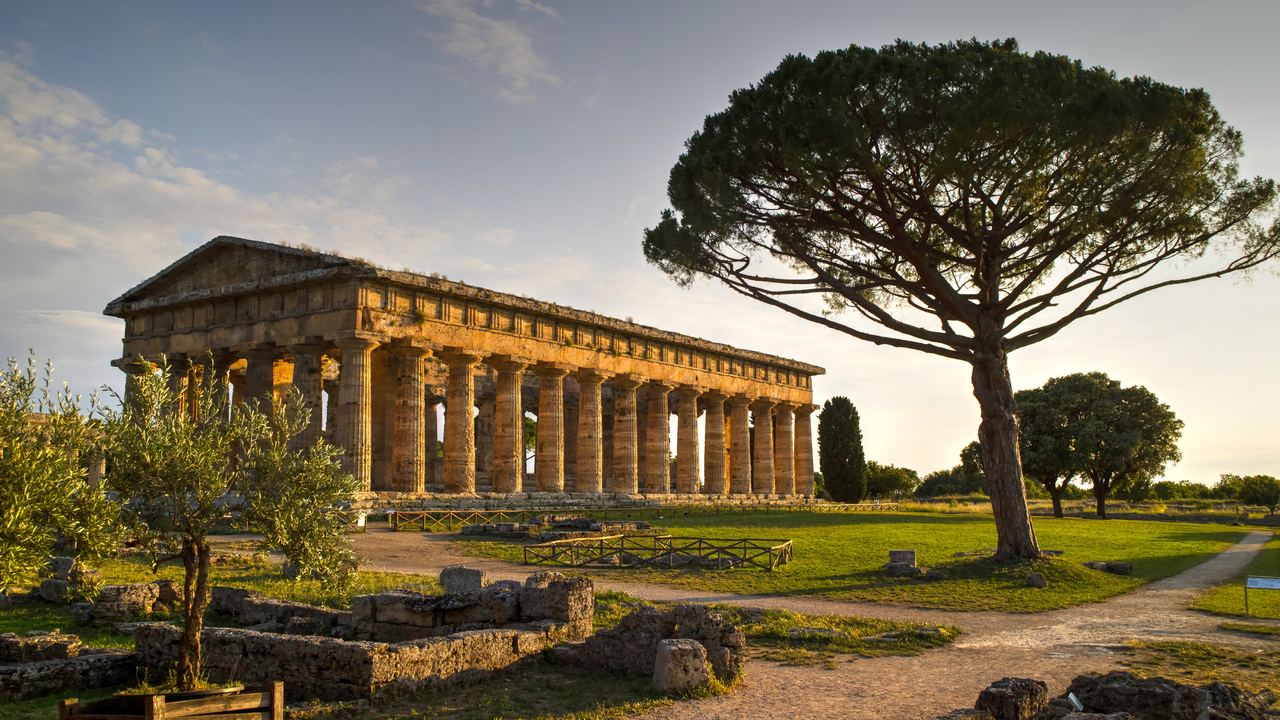
Paestum is a Greek city in southern Campania, and its three Doric temples, built between about 560 and 460 BC, are the reason to go. The site is flat and open, the national museum inside the ancient town holds the Tomb of the Diver, and nearly 5 km of walls still circle the streets. From Naples it is a single railway line to a station 800 meters from the gate. Plan on half a day, and a little more if you want the whole museum.
Three things to settle before you go. The temples have no roof and little cover around them, so pick your hour with the sun in mind. The Tomb of the Diver is in the museum, not at the temples. And the station is a walk from the entrance, not beside it.
What is Paestum, and how is it different from Pompeii?
The city began as Poseidonia, founded around 600 BC by colonists from Sybaris who settled on the plain of the Sele river, according to the Archaeological Parks of Paestum and Velia. Lucanian people took over at the end of the 5th century BC. Rome made it a colony in 273 BC and the name changed to Paestum. The town then shrank through late antiquity and the Middle Ages, and travelers on the Grand Tour rediscovered the temples in the 18th century. The Park states that the site has been on the UNESCO World Heritage list since 1998.
Pompeii is a Roman town you walk through house by house. Paestum is mostly sacred and civic architecture from the Greek period, with a Roman layer on top, so you will not wander through bedrooms and shops. You look at big temples, at the open ground of the forum, and at how successive cultures reused the same streets. If you have already done the Vesuvian sites, it is a different kind of visit rather than more of the same. Our guide to the sites beyond Pompeii puts it next to the others, and Pompeii or Herculaneum covers the closer pair.
Which temple is which at Paestum?
The names are the confusing part. Older signs and guidebooks use labels invented by 18th-century scholars, and the Park now gives different attributions. The table matches the two, using the Park's dates and column counts.
| Old name on signs | Modern attribution | Date | Columns | Where in the site |
|---|---|---|---|---|
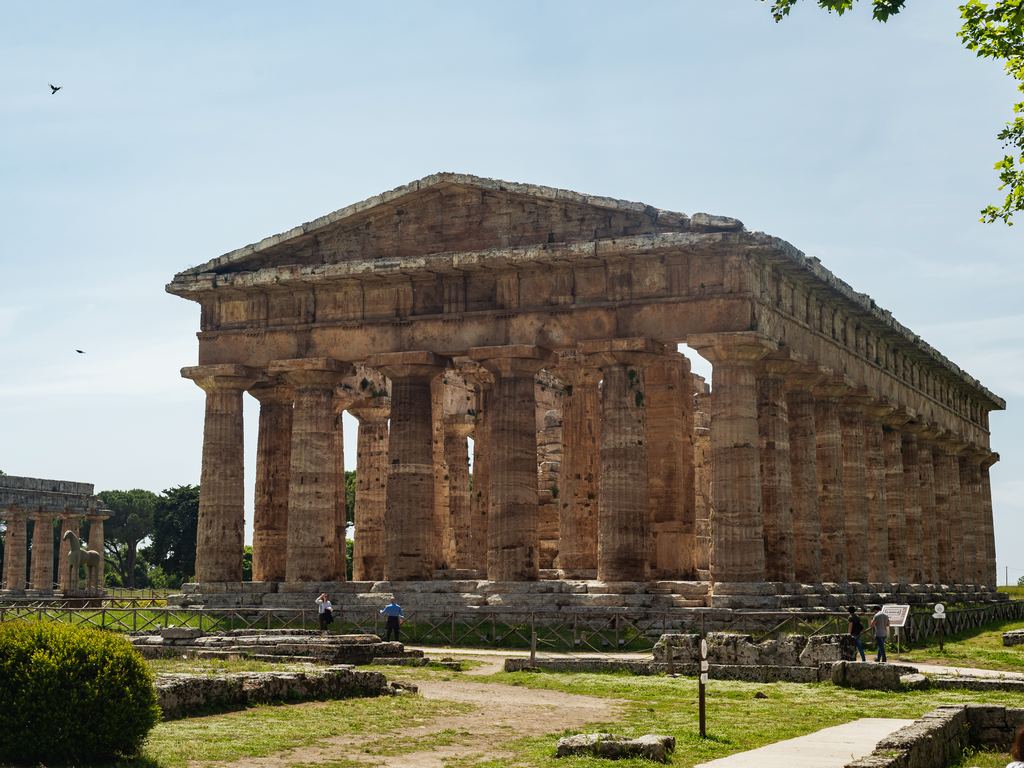
| Temple of Neptune | Deity unknown; Hera or Apollo suggested by votive finds | Completed c. 460 BC | 6 by 14 | Southern Sanctuary, near the main gate |
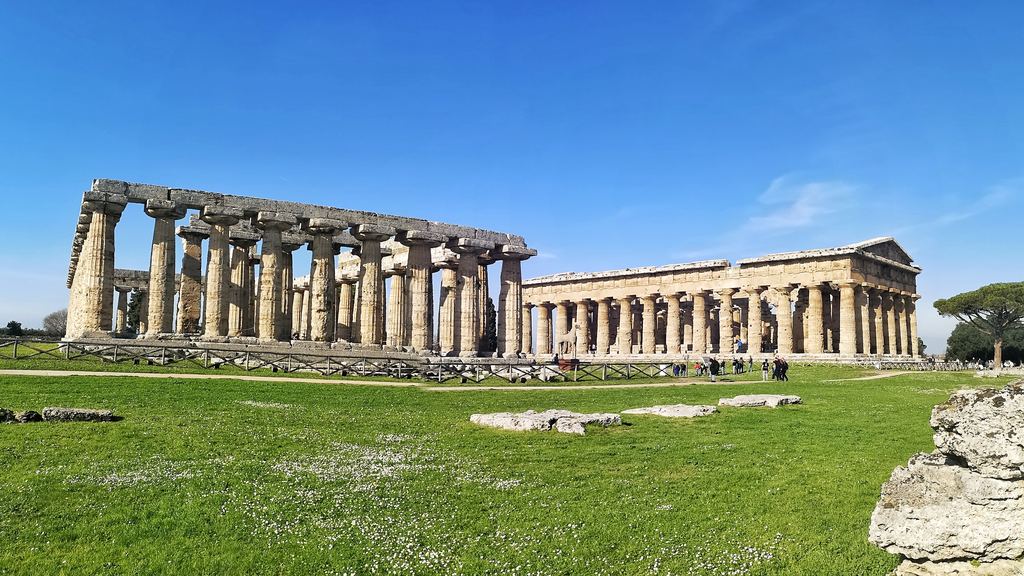
| Basilica | Hera, almost certainly | Begun c. 560 BC, finished c. 520 BC | 9 by 18 | Southern Sanctuary, beside the Neptune temple |
| Temple of Ceres | Athena (Athena-Minerva) | c. 500 BC | 6 by 13 | Northern Sanctuary, on a small artificial hill |
The Basilica, the temple of Hera
The name is a mistake that stuck. Eighteenth-century scholars took the building for a civic hall, a basilica, and the label survived long after the error was clear. The Park says it was almost certainly a temple of Hera, on the evidence of inscriptions and the offerings found nearby, and describes it as the first stone temple of Poseidonia. Count nine columns across the front and eighteen along the sides, topped by the broad, flattened capitals of an early Doric building. Parts of its painted terracotta roof survive, lion-head spouts included, which is how archaeologists could rebuild the roofline on paper.
The Temple of Neptune
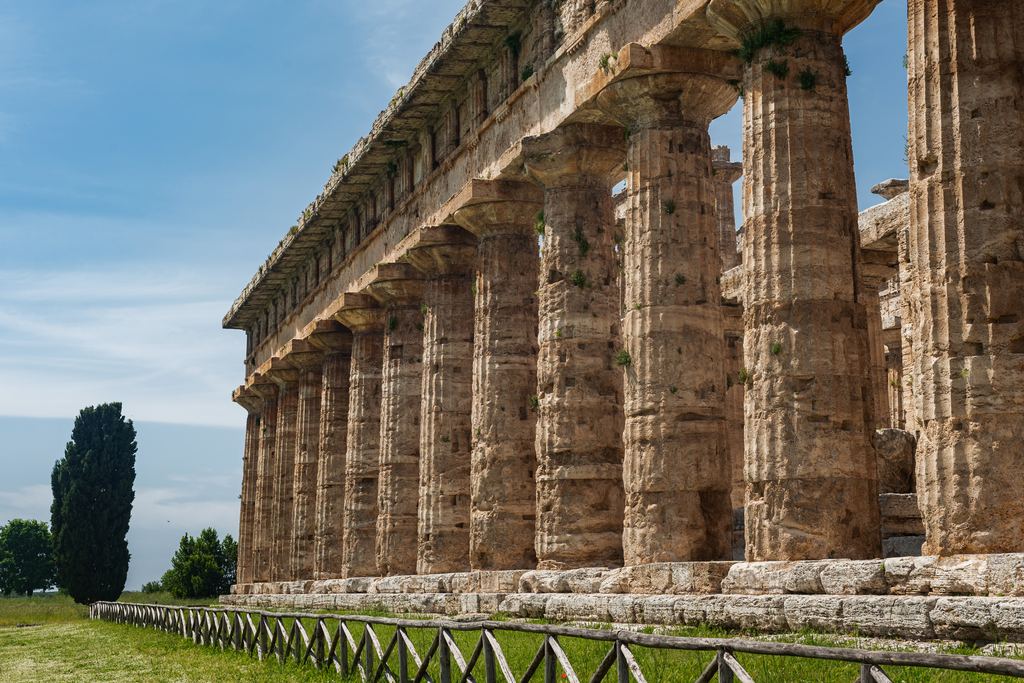
This is the one in most photographs. It was completed around 460 BC, with six columns by fourteen and a frieze of triglyphs alternating with plain metopes that may once have been painted. The plan is still easy to read: a porch, a main chamber divided into three aisles by two stacked rows of columns, and a back room reachable only from outside. On the name, the Park does not hedge: "We do not know for certain to which deity the temple was originally dedicated." Neptune comes from an 18th-century guess about the city's Greek name, and votive material buried north of the temple now points to Hera or Apollo.
The Temple of Athena
At the northern end of the site, around 500 BC, the people of Poseidonia raised a temple on a small artificial hill meant to look like an acropolis. It has six columns on the short sides and thirteen on the long ones, and its porch had Ionic capitals, an unusual touch in a Doric building. Offerings found here, mostly weapons bent out of shape on purpose before being dedicated, are what identify the goddess as Athena-Minerva. Older guidebooks still call it the Temple of Ceres. Enter by the main gate and this is the last big monument you reach.
What else is inside the ancient city?
The Park's map numbers eleven stops, and only three are temples. The agora, the civic square of the Greek city, later became the Roman forum, with shops, a market, a basilica, a comitium and an amphitheatre around it. On the agora stands the ekklesiasterion, a circular assembly space from about 470 BC carved into the slope so that the steps form a bowl. Nearby is the heroon, a cenotaph for the city's founder, a symbolic empty tomb under a sloping tiled roof once hidden by a mound of earth, built around 510 BC; inside it archaeologists found eight bronze vases and a black-figure amphora showing Heracles' ascent to Olympus. A small bath complex with cold, warm and hot rooms, and the Roman houses laid out after 273 BC, complete the ground-level picture.
One modern piece sits between the Basilica and the Neptune temple: Il Cavallo di Sabbia (The Sand Horse), a contemporary sculpture by Mimmo Paladino installed in 2019. Love it or not, it makes you look at the two temples side by side. The whole archaeological area covers about 27 hectares.
Are the city walls worth your time?
The Park counts them among the better preserved defenses of any ancient city. The circuit runs for nearly 5 kilometers around a roughly trapezoid shape, interrupted in two places where a Bourbon-era road cut through. There were four main gates (Porta Aurea to the north, Porta Sirena to the east, Porta Giustizia to the south, Porta Marina to the west), 47 small side openings for sorties, and 28 towers, mostly square. The wall is two faces of travertine blocks tied by cross walls and filled with earth and limestone, between 5.5 and 6.5 meters thick.
The earliest phase belongs to the Lucanian period, in the 4th century BC. Traces near Porta Giustizia suggest an earlier Greek defense of earth bank and wooden palisade from the 6th or 5th century BC. Treat the walls as an extra rather than a given: a full loop of nearly 5 km is a different outing from a temple visit, and which stretches you can reach on a given day is a question for the Park.
What is in the museum, and where is the Tomb of the Diver?
The National Archaeological Museum of Paestum stands inside the ancient city. It was designed in the 1930s to house a cycle of carved stone metopes from the sanctuary of Hera on the Sele, finished and opened in 1952, and given a completely new layout in October 2023. The route runs bottom to top like an excavation. Prehistory is in the basement, the Greek and Lucanian city on the ground and first floors, and the Roman city to the present on the second floor.
Three things to look for. The metopes from the Sele sanctuary, carved around 570 to 560 BC with mythological scenes. The painted slabs from Lucanian tombs of the 5th to 4th centuries BC. And a bronze statue of the silenus Marsyas found in the Roman forum. The last is the room the Park singles out as the museum's best-known piece.
The Tomb of the Diver was found in 1968 at Tempa del Prete, about 2 km south of the city, and dates to around 480 to 470 BC. The Park calls it the only known tomb of the 5th century BC in the Greek world with figurative wall paintings. Five painted slabs line the chamber: on the walls a banquet with wine, music and the game of kottabos, and on the lid the young man diving into water that gives the tomb its name. The most widely accepted reading is symbolic, the passage from life to death. A tortoiseshell lyre and an Attic oil flask were buried with the dead man. The room is named after Mario Napoli, who found it, and the Park's museum page, read on 5 November 2026, lists it as part of the visit route.
Inside the museum
A painted tomb from the age of the temples
The Diver's tomb is roughly contemporary with the Neptune temple, so a visit lets you compare two very different surviving traces of the same city: public stone architecture outside, private painted ritual underground. Allow at least an hour for the museum. The museum also offers guided visits to its storerooms; the Park posts when those are available.
How do you get to Paestum from Naples, Salerno, Rome or Sorrento?
The Park's own directions are short. By train, take the Naples Centrale to Reggio Calabria line and get off at Paestum; the archaeological site is about 800 meters from the station. By car, leave the A3 Salerno to Reggio Calabria motorway at Battipaglia if you come from the north or at Eboli if you come from the south, then follow the signs. The address is Via Magna Grecia 919, Capaccio Paestum, in the province of Salerno. The Park also runs a free shuttle between Paestum and Velia on the first Sunday of each month and on special event days.
We did not read the Trenitalia timetable for this page, so there are no departure times or journey times here; they depend on the type of train and change with the timetable. Check that your train calls at Paestum before you buy, because not every service on that line stops there.
| Starting from | Simplest way | Watch out for |
|---|---|---|
| Naples | Train on the Naples Centrale to Reggio Calabria line, get off at Paestum, walk 800 m | Confirm the train stops at Paestum; returns are the tight part of the day |
| Salerno and the Amalfi Coast | Reach Salerno first, then take the same line south | The Amalfi Coast has no railway, so the day starts with a bus or ferry |
| Rome | High-speed train to Naples or Salerno, then change onto the southbound line | We could not confirm a direct service on the Trenitalia timetable |
| Sorrento | Circumvesuviana to Naples, then the southbound line | A long day; staying in Naples or Salerno shortens it |
| By car | A3 motorway, exit Battipaglia (from north) or Eboli (from south) | Follow the Paestum signs; check parking with the Park before you drive |
Paestum is in the province of Salerno, on the plain south of the Gulf of Salerno, not on the Amalfi Coast, whatever some travel pages say. If you are choosing a base, our where to stay page compares Naples, Sorrento and Pompei, and getting to Pompeii covers the Naples end of the journey.
How long do you need, and what does the ticket cover?
Our estimate is three to four hours for the temples, forum and museum together, and a full day if you add the walls or stop for a long lunch. That is our judgment, not a Park figure. The ticket is better value than it looks: a single admission covers the archaeological areas of Paestum and Velia and the Paestum museum and is valid for three consecutive days. Velia is a separate site farther south, and the nearest station is Ascea, 2.5 km from it, so do not count on adding it to a half-day trip.
Booking is not mandatory, according to the Park, and children under 12 must be accompanied by an adult. The ticket is cheaper from December to February than from March to November; the current amounts, reductions and free days are on our tickets page, checked 5 November 2026. The Park recommends flat, comfortable shoes.
On hours, the Park publishes seasonal opening hours on its ticket page, and the summer and winter timetables differ. Hours and closing days can also change in the low season: in autumn 2025 the Park closed the museum and the archaeological area on Mondays for several weeks. Check that page the week you travel.
Entrances
Main gate or Porta Cerere?
The Main Gate, with one of the Park's two ticket offices, opens near the Southern Sanctuary where the Neptune temple and the Basilica stand. Porta Cerere is at the northern end by the Athena temple and can be used to enter or leave if you already hold a ticket. A simple plan: enter at the main gate, work north through the forum, take in the Athena temple, and leave by Porta Cerere toward the museum.
When is the best time to visit Paestum?
The site is flat and exposed, and the temples stand in open ground. Summer is the hard season. The nearest WMO station for 1991 to 2020, Capo Palinuro about 50 km to the south-east, has gaps in its record, so we use Capri, across the gulf and about 70 km away, as a rough guide rather than a measurement for Paestum: its average daily high is 31.7 degrees C in July and 32.4 in August, with 23 and 26 days a month at 30 or above. January averages 13.7 and November 18.3. The same pattern holds on the coast near Pompeii; see our page on Pompeii in summer for the tactics that apply here too.
In practice, March to May and October to November give you walkable temperatures. From June to August be at the gate at opening, finish the open ground before midday, and keep the museum for the hottest hours. Winter has short days and the cheaper ticket, and the same stone temples in low light.
Should you take a tour, or go on your own?
Going alone works well here. The site is small enough to understand with a map, the museum is clearly arranged, and the Park's own directions reach every point. A guide is worth it if you want the 18th-century naming mistakes and the votive evidence explained on the spot, or if the train plus walk is more logistics than you want. Day tours and small-group visits with an archaeologist exist; our More of Campania page has the formats and typical prices, so this guide does not repeat them.
If you prefer someone else to handle the train
Day trips to Paestum and other Campanian sites from our More of Campania collection.
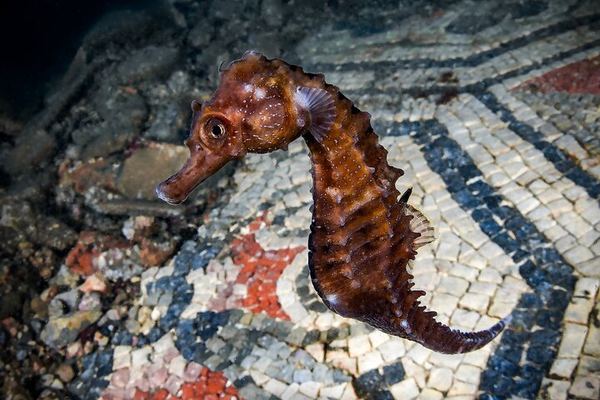
Baia Double Dive for Certified Divers among Sunken Roman Mosaics and Villas
Two dives from the Subaia hub at the Port of Baia, five minutes by boat from the site, among the mosaics, columns and statues of the underwater Roman park.
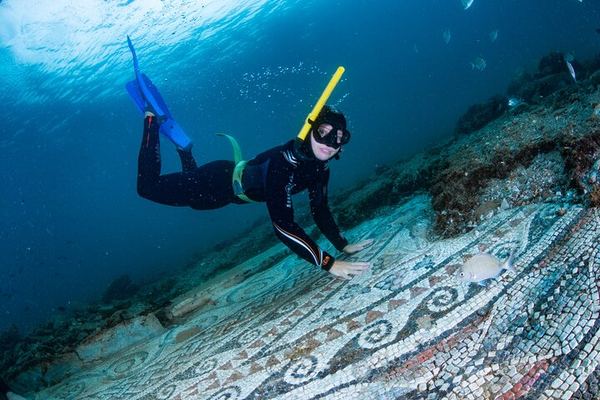
Baia Snorkeling Tour with Expert Guide, Two Sites among Submerged Roman Remains
Snorkelers follow an expert guide over Roman domus and architecture about 5 meters down in the Baia archaeological park, with two stops at different spots.
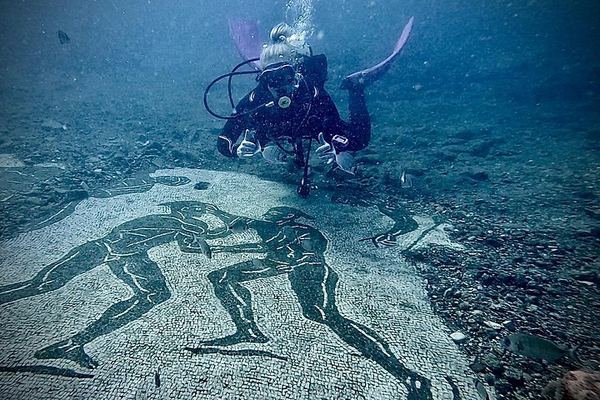
Baia Submerged Park Guided Dive for Certified Divers from Bacoli by RIB Boat
A dive of about an hour at the sunken Roman city of Baia, under five minutes by boat from a dive center in Bacoli, with equipment and park ticket included.
Ratings collected by Viator and Tripadvisor
Paestum: common questions
Is Paestum worth visiting if I have already seen Pompeii?
Yes, because it is a different kind of site. Pompeii is a Roman town of houses and streets. Paestum is a Greek city whose three Doric temples date from about 560 to 460 BC, with a museum that holds a rare 5th-century Greek painted tomb.
How long does a visit to Paestum take?
Our estimate is three to four hours for the temples, forum and museum, and longer with the city walls. The Park does not publish a recommended duration that we could find.
Do I need to book a ticket for Paestum?
The Park says booking is not mandatory. One ticket covers Paestum, Velia and the museum for three consecutive days. For amounts and reductions see our tickets page.
Which temple is the Temple of Neptune, really?
It is the large temple completed around 460 BC with six by fourteen columns. The Park says the deity is unknown; votive finds suggest Hera or Apollo. The Neptune name comes from an 18th-century mistake.
Where is the Tomb of the Diver?
In the National Archaeological Museum of Paestum, in a room named after Mario Napoli. The tomb was found in 1968 about 2 km south of the city and dates to around 480 to 470 BC. It is not at the temples.
Can I visit Paestum as a day trip from Sorrento or the Amalfi Coast?
It is possible but long. From Sorrento you take the Circumvesuviana to Naples and then the southbound line. From the Amalfi Coast you reach Salerno first. Staying in Naples or Salerno makes the day shorter.
Is Paestum on the Amalfi Coast?
No. It is at Capaccio Paestum in the province of Salerno, on the plain south of the Gulf of Salerno. Some travel pages place it on the Amalfi Coast by mistake.
Can I visit the Heraion on the Sele?
Sometimes. The Heraion on the Sele, the sanctuary of Hera north of the city that gave the museum its metopes, is visited by guided tour with booking, and the Park can suspend access for maintenance. Parts of the Park's sites can close for works; check the Park's notices page before you plan around it.
Data verified on . Park pages for Paestum, the walls, the museum, tickets and directions; WMO normals for climate. We are not affiliated with the Park. Editorial Policy