
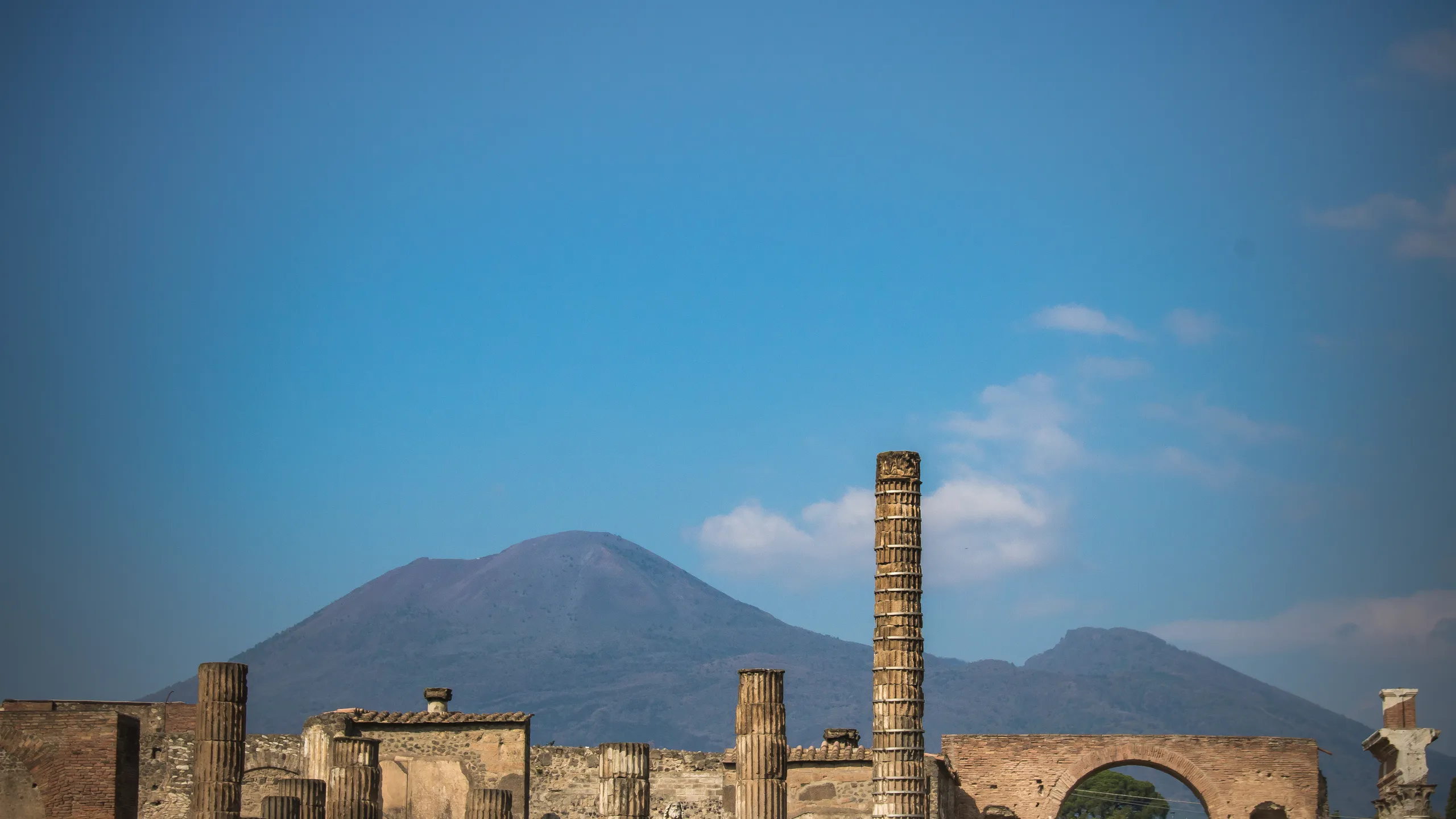
The eruption of Vesuvius in AD 79 lasted less than two days, according to Italy's Civil Protection Department, and it destroyed Pompeii in two different ways. First came hours of falling pumice and small rocks, which piled up about three meters deep and pulled roofs down. Then fast, hot clouds of gas and ash, called pyroclastic surges, ran through the streets. There was no lava flow. Herculaneum, on the other side of the volcano, got the surges first and almost none of the pumice. The only clocks that hold up are Pliny the Younger's, so this page gives hours where he does, and calls everything else an estimate.
Which clocks can we trust?
Two letters from Pliny the Younger to the historian Tacitus (Epistles 6.16 and 6.20) are the only eyewitness account. Pliny was seventeen, staying at Misenum across the bay, and he wrote a generation later. His uncle, Pliny the Elder, commanded the fleet there and died on the other side of the gulf, at Stabiae. The letters never name Pompeii or Herculaneum. They name Misenum, Stabiae, Capri, a woman called Rectina, and a mountain that, Pliny says, was "found afterwards to come from Mount Vesuvius."
So when a page tells you what time the surge reached the Forum, it is quoting a volcanology paper, not an ancient witness. Pliny's clocks are few. A cloud is seen at Misenum around the seventh hour of the first day. Through the night the earth shakes and stones fall on his uncle's host at Stabiae. At the first hour of the second day the light is still weak and doubtful, and then the cloud comes down over the sea. His uncle's body is found when daylight returned, the third day counting from the last he had seen (Epistles 6.16.20).
Latin: "cuius similitudinem et formam non alia magis arbor quam pinus expresserit." English: "the appearance of which I cannot give you a more exact description of than by likening it to that of a pine tree."
The hour needs care too. Pliny's Latin reads hora fere septima, about the seventh hour, and Romans counted hours from sunrise, so the seventh falls in the early afternoon. Printed translations that say "one in the afternoon" are making a conversion, not quoting him. The same goes for the date, which gets its own section below.
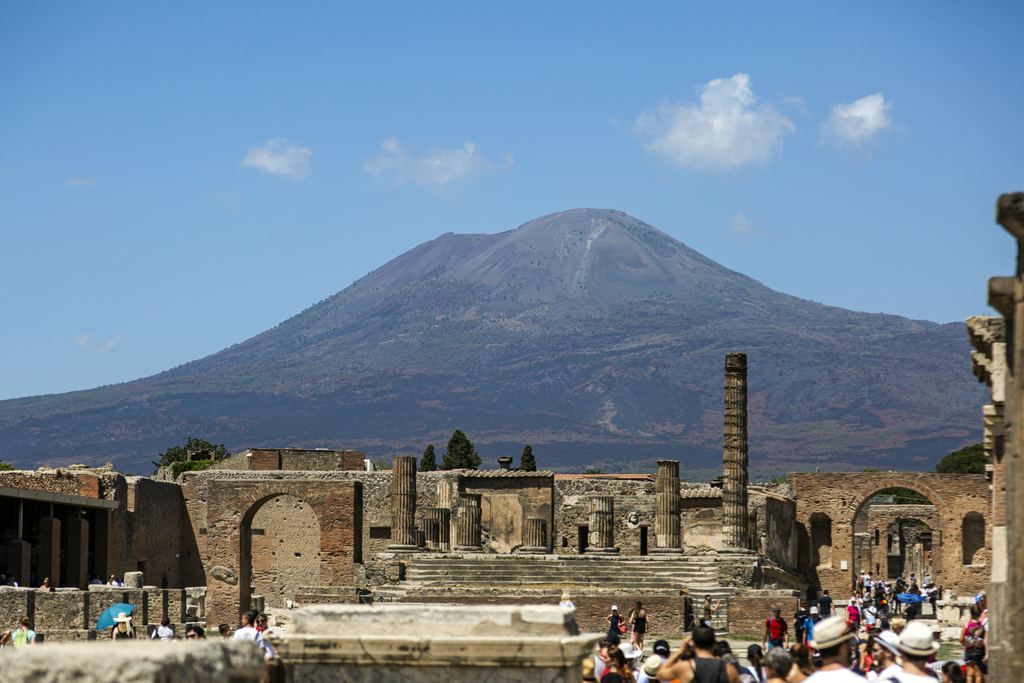
What happened, phase by phase
Volcanologists number the deposits differently: S1 to S6 in Sigurdsson and Mastrolorenzo, EU units in Cioni, letters in Luongo. The table uses no numbers of its own. Where a figure comes from one study, the last column names it, and the estimates are estimates.
| Phase and clock | What happens | Pompeii | Herculaneum | Source |
|---|---|---|---|---|
| Before: days | Tremors, which Campanians treated as ordinary. | Repairs after the earlier earthquake (AD 62 or 63) are still under way, for example at Villa Regina. | Nothing specific recorded in our sources. | Pliny 6.20.3; Giacomelli et al. 2003 |
| Opening: before the seventh hour of day 1 | A column of gas and pumice rises, 14 to 26 km with white pumice and about 32 km with grey; another study gives 30 to 33 km. Pliny sees it as a pine. | White pumice, then grey lapilli, start to fall, blown south-east. | Largely spared: the wind carries the pumice away from it. | Pliny 6.16.5; Giacomelli 2003; Pensa 2023 |
| Pumice fall: afternoon, night, into day 2 | Lapilli rain without a pause. Estimates run from 12 to about 22 hours. | About 3 m pile up, 15 cm an hour in the open. Within six hours of the start, roofs and some walls begin to fail. Victims of this phase: 394, or 38% of those found. | Little pumice reaches the town. | Giacomelli 2003; Park of Pompeii |
| First surges, night of day 1 on the traditional chronology | Parts of the column collapse and the first dilute currents run down the flanks. | The earliest currents stop outside the north-western walls (S1 to S3 in Mastrolorenzo's count). | A dilute surge leaves 20 to 80 cm of ash at about 555 to 495 degrees C; denser ones follow at roughly 465 to 315. People sheltering in the boathouses on the shore are among the victims. | Mastrolorenzo 2010; Pensa 2023 |
| Peak of destruction | The most destructive phase lasts only about 5 to 6 hours. | Later surges pass the walls. One deposit only about 3 cm thick is blamed for most of the deaths by flow. Temperatures 180 to 380 degrees C, mostly 240 to 340. Victims in the flows: 650, or 62%. | About 20 m of deposits build up above the first surges. | Giacomelli 2003; Mastrolorenzo 2010; Cioni 2004; Pensa 2023 |
| Dawn of day 2: the first hour (Pliny) | At Misenum the light is faint, the ground heaves, the sea draws back, and the cloud settles over the water and hides Capri. Then darkness. | By morning most structures are badly damaged. | No separate account. | Pliny 6.20; Giacomelli 2003 |
| Final phase | The magma chamber collapses and strong earthquakes follow. The last currents are cooler, with no sign of high temperature on buildings in the top layers. | Walls fall in the quakes; some people who had sheltered for hours are hurt as they run. | Buried under the new deposits. | Giacomelli 2003; Sparice 2024; Giacomelli and Scandone 2026 |
| Years after | Rain remobilizes the loose deposits and washes them downslope. | The town is abandoned; survivors return to recover valuables. | Abandoned. | Giacomelli 2003; Park of Pompeii |
Pompeii: hours of pumice, then minutes of heat
The pumice phase is the part most people skip, and it is where more than a third of the recovered victims died. For at least 12 hours, and by some estimates 20 or 22, small rocks and pumice fell on a town with no way to shake it off. The Park of Pompeii says the victims of this first phase are known only from bones, because pumice does not keep the shape of a body the way fine ash does. Roofs gave way under the load. Giacomelli and colleagues found that most people who died in this phase, between 80 and 88 percent, were inside buildings.
Then the surges arrived. One of them left a deposit about 3 cm thick, spread over some 80 square kilometers, yet Mastrolorenzo and colleagues attribute most of the deaths by flow in Pompeii to it. A thin layer does not mean a mild event: it was fast, hot and left little behind. At Pompeii, about 10 km from the vent, the temperatures measured on rock fragments in the deposits sit between 180 and 380 degrees C, mostly between 240 and 340.
The two phases killed in different ways. The first phase killed with weight and collapse over many hours. The second killed in minutes. A single sentence like "everyone died instantly" fits only the second.
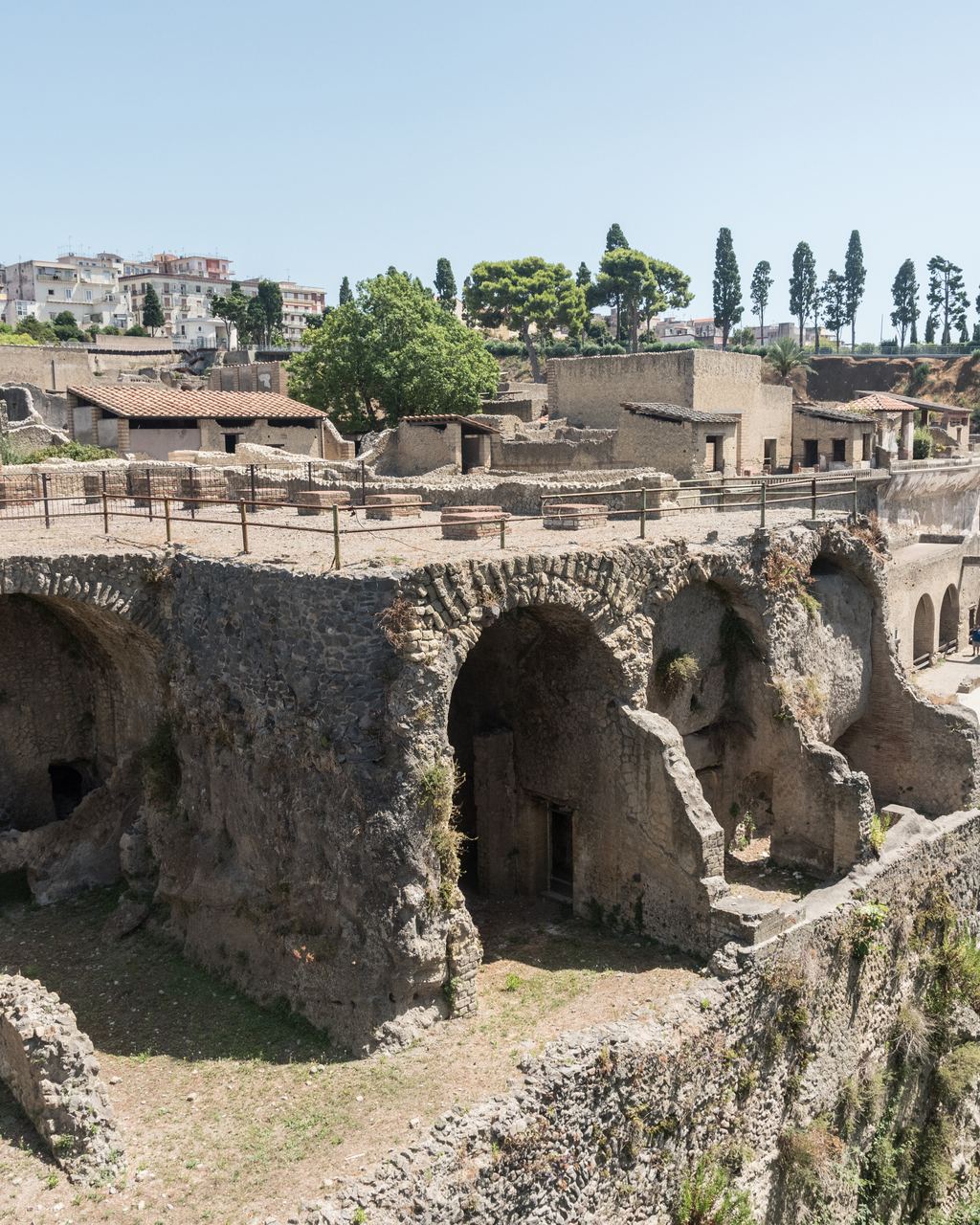
Herculaneum: no pumice, heat first
Herculaneum lay upwind of the worst of the pumice fall, so no heavy layer built up while its people waited. The first current into town was a dilute surge that left 20 to 80 cm of ash, measured by Pensa and colleagues at roughly 555 to 495 degrees C in its first stage. On the ancient shoreline, in a row of vaulted boathouses, excavators found skeletons: about 300 according to UNESCO. Other counts run higher, so no single figure is safe.
A young man found on a bed in the Collegium Augustalium has a brain that turned to glass. Giordano and colleagues (2025) say it formed above 510 degrees C, in a brief dilute surge, followed by rapid cooling. That body is from Herculaneum, not Pompeii, though pages often mix them up.
Which day was it? The date nobody can settle
Pliny's Latin reads nonum Kal. Septembres hora fere septima: the ninth day before the Kalends of September, about the seventh hour. Counted the Roman way, that gives 24 August. The date on most pages is that conversion, and it is the traditional one. The manuscripts do not fully agree: the ninth-century Mediceus reads "the ninth day before the Kalends of September" (24 August); a fifteenth-century copy in Paris gives no month; a printed edition of 1474 reads November; Rosini in 1797 proposed December (Getty Museum summary of the textual record).
In October 2018, archaeologists in Regio V found a charcoal inscription in a room being renovated in the House of the Garden: XVI K Nov, the sixteenth day before the Kalends of November, which is 17 October. It has no year. The Park first presented it as a sign the eruption came later than August. The reply is that charcoal can survive on a wall for more than a year, so the line may be a year old. A 2022 review by Doronzo and colleagues in Earth-Science Reviews argued for late October or early November, and a critique by Altamura appeared in 2023. P. W. Foss, a philologist, defends August in his 2022 book on Pliny and Vesuvius.
In December 2024 the Park's director, Gabriel Zuchtriegel, told the Guardian that the manuscripts leave no alternative to August: "either you confirm Pliny or you have to simply assume that he made a mistake." Plant remains such as chestnuts prove nothing, he argued, because August varieties exist.
| Position | Main evidence | Who argues it |
|---|---|---|
| 24 August (traditional) | The Latin text of Pliny; Cassius Dio, in the Loeb translation, places the eruption at the very end of summer. | The Park of Pompeii (2024); Foss (2022) |
| Autumn, October or later | The 17 October charcoal line; pomegranates and walnuts; heavier clothing on some victims; braziers; new wine already in storage jars; a wind study on where the ash fell. | Doronzo and colleagues (2022); Rolandi and colleagues (2008); the Getty Museum summary (2019) |
We write "the traditional date, 24 August" and mean exactly that: the date in the textbooks, not a settled fact. A page that states the date without mentioning the argument has picked a side without telling you.

How did people die? Three answers
Researchers do not agree, and a fair summary gives the positions rather than a verdict.
Heat. Mastrolorenzo and colleagues (2010) studied 93 casts at Pompeii, 37 bodies at Oplontis and 78 skeletons at Herculaneum, and concluded that heat was the main cause of death, not suffocation by ash. Their threshold: at least 250 degrees C at 10 km from the vent could kill instantly, even indoors. The Park's own page on the casts says victims of the surge died of thermal shock.
Suffocation. Giacomelli and colleagues (2003) saw no burns on bodies, clothes, objects or frescoes, and noted that the victims lie above the base of the flow deposit, so the first currents were not what killed them. For them the later flows asphyxiated people.
Collapse. Recent work adds a third cause. Sparice and colleagues (2024) tie wall collapses in the Insula of the Chaste Lovers to earthquakes during the eruption, and report crushing injuries on two skeletons. Giacomelli and Scandone (2026) suggest many people died as they fled the tremors, after roofs had held for hours.
These can all be true of different people on different streets. The shapes of the casts do not settle it: Mastrolorenzo reads them as cadaveric spasm from heat, others as a slower agony.
Pliny the Elder's own death is an opinion. His nephew writes that he fell and died, "suffocated, as I conjecture, by some gross and noxious vapour." The Latin is ut ego colligo, "as I gather." His body, found when daylight returned, the third day counting from the last he had seen (Epistles 6.16.20), looked to Pliny more like a sleeper than a dead man.
How many died? Why no total exists
Pompeii has a precise number of bodies found and no precise number of dead. Herculaneum has a range. The totals you see online are sums of unlike things.
| Place | Figure | What it counts | Caveat |
|---|---|---|---|
| Pompeii | 1,044 | Victims recovered in the roughly two thirds of the town that has been excavated: 394 in the pumice fall, 650 in the flows. | Bodies, not casts. There are about a hundred casts (104 by the latest count). |
| Pompeii | About 100 more | Estimated from scattered bones. | An estimate by the same authors. |
| Pompeii | About 464 more | Estimated for the unexcavated third. | An estimate; the authors do not add the three figures. |
| Herculaneum | About 300 to 350 | Skeletons on the ancient shore and in the boathouses. | UNESCO says about 300; other published counts are higher. |
| Whole eruption | Unknown | No primary source gives a total of deaths. | Nor is the population of Pompeii known; estimates run from about 10,000 to 20,000. |
How many people escaped cannot be known. A figure of about 2,000 deaths circulates; it comes from one volcanology glossary entry and no archaeological count backs it, so we leave it out. For how the casts relate to these numbers, see the page on the body casts.
After the eruption
The empire answered fast. According to Suetonius (Titus 8), the emperor Titus chose commissioners by lot from among the former consuls to relieve Campania and applied the property of victims who left no heirs to rebuilding the damaged towns. Cassius Dio (66.24) tells a similar story, with the property of the heirless dead going to the inhabitants. The Park says the cities were abandoned, survivors came back to recover what they could, and centuries of looting followed. The story of what happened next is told in our history of the excavations. For the volcano itself, see Vesuvius and Pompeii, including what the Civil Protection Department says about monitoring.
Keep reading
The eruption is the start of several stories.
Questions people ask about the eruption
Was Pompeii buried by lava?
No. UNESCO describes Pompeii as buried largely by ash and lapilli, and Herculaneum by surges and flows of volcanic material. There was no lava flow in AD 79.
How long did the eruption of AD 79 last?
Less than two days, according to the Civil Protection Department. At Pompeii the pumice fell for at least 12 hours, and the most destructive phase of surges lasted about five to six hours.
What time did the eruption start?
Nobody knows. Pliny saw the cloud at about the seventh hour, and it must have started before then, because a message had already reached his uncle. Modern clock times are estimates.
Did Pliny write about Pompeii?
No. His letters name Misenum, Stabiae and Capri, but not Pompeii or Herculaneum.
How many people died at Pompeii?
The bodies recovered number 1,044, in about two thirds of the excavated town. The authors estimate roughly 100 more from scattered bones and 464 still buried, but nobody has a reliable total of deaths.
Did most people die instantly?
About 62 percent of the recovered victims were in the surge deposits, where death was fast. The other 38 percent died earlier, during the pumice fall, and mostly indoors.
Was the eruption on 24 August?
That is the traditional date, from Pliny. The Park defends it. Others argue for autumn on the basis of a charcoal inscription dated 17 October and plant remains. There is no consensus.
Is the brain made of glass from Pompeii?
No. The vitrified brain was found at Herculaneum, in the Collegium Augustalium.
Could it happen again?
Vesuvius has been quiet since 1944 and the Observatory monitors it around the clock. The Civil Protection Department keeps an evacuation plan for a red zone of 25 municipalities, Pompeii among them (as of November 2026). See our Vesuvius page.
Data verified on . Studies and the Park's pages checked 5 November 2026; Pliny quoted from public-domain texts. Editorial Policy