
Daily life in Roman Pompeii happened mostly outdoors and in public. People ate at street counters called thermopolia, bought bread from neighborhood bakeries, spent afternoons at the public baths and read election slogans painted on the walls. We know this because the eruption of AD 79 stopped the city in the middle of its routine: coins still in a snack-bar jar, a skeleton clutching its savings at a laundry door, a repainting job left half drawn. This page follows a day from the street outward and, for each moment, names the clue in the ruins and its address.
Addresses use the Regio.Insula.Entrance system explained in our address book of Pompeii's buildings, and unfamiliar words such as impluvium or apodyterium are in the glossary. One caution before you plan a route: which buildings can be entered changes from week to week, so we never say a place is open. The Park keeps the list at pompeiisites.org/en/houses.
How do we know what a Pompeian day was like?
Three kinds of evidence carry almost everything on this page: buildings that still hold their equipment (a counter, a millstone, a laundry basin), writing on walls (painted notices, scratched graffiti, mosaic greetings) and objects left where they were dropped. Ancient authors say little about ordinary Pompeians. Tacitus reports a riot, and we come to it below.
Most of what we know about ordinary days comes from small practical things: a counter, a millstone, a laundry vat, a scribble. Nobody built those to impress anyone, which is why they are reliable.
The picture is also a late one. The city had been shaken by an earthquake in AD 62 or 63 (Tacitus and Seneca disagree on the year), and many buildings were still being repaired in 79. Some of the best daily-life evidence is, literally, construction work in progress. The eruption itself is on its own page.
What did a Pompeian street look like?
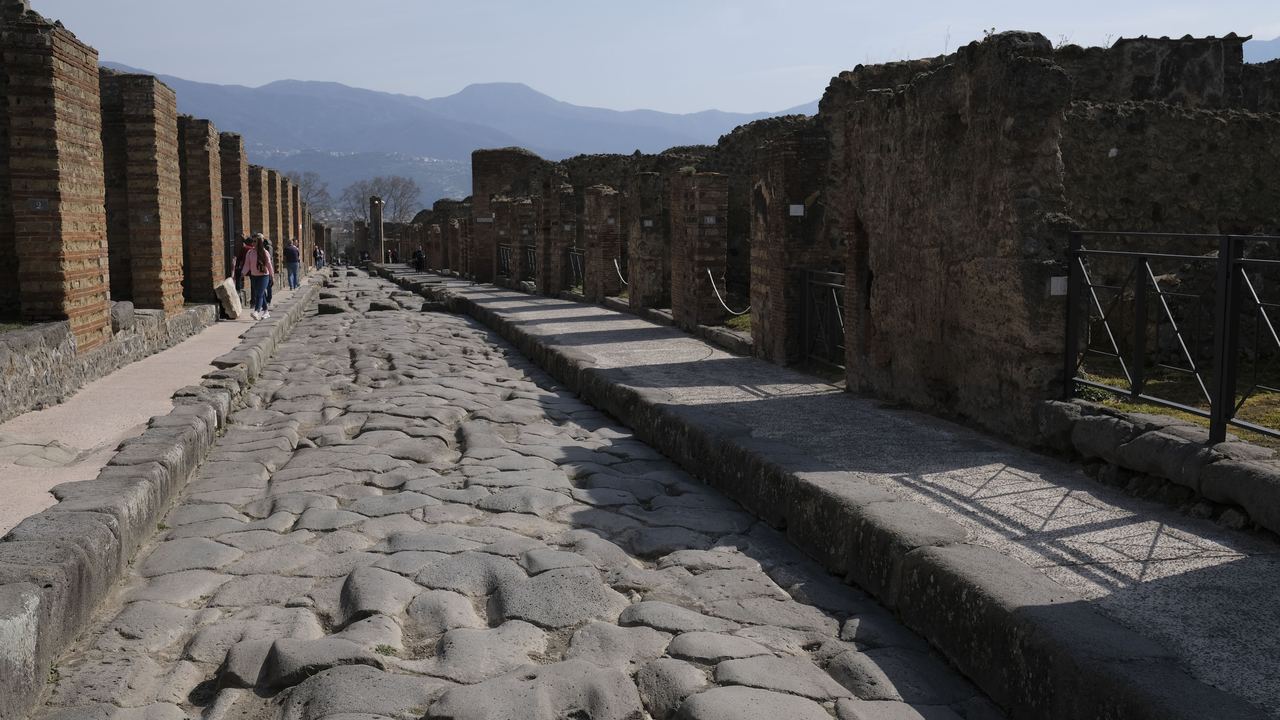
The Park's own site text describes the Via dell'Abbondanza as the city's main east-west road and points out three details. The street is "crowned", cambered so that rain ran off to the sides instead of pooling. Large oval stepping stones span the roadway so a pedestrian could cross with dry feet. And at the approach to the Forum stands a fountain dedicated to Concordia and Abundance, which the Park's text calls the only travertine fountain there.

Water came to the city from the Augustan aqueduct of Serino, near Avellino. At the highest point of Pompeii (42 meters), the castellum aquae split it into three pipes at different heights. The Park adds a telling detail: the castellum was damaged in the earthquake and does not seem to have been in use at the time of the eruption, while about 40 street fountains around the city were.
Where did Pompeians eat out?
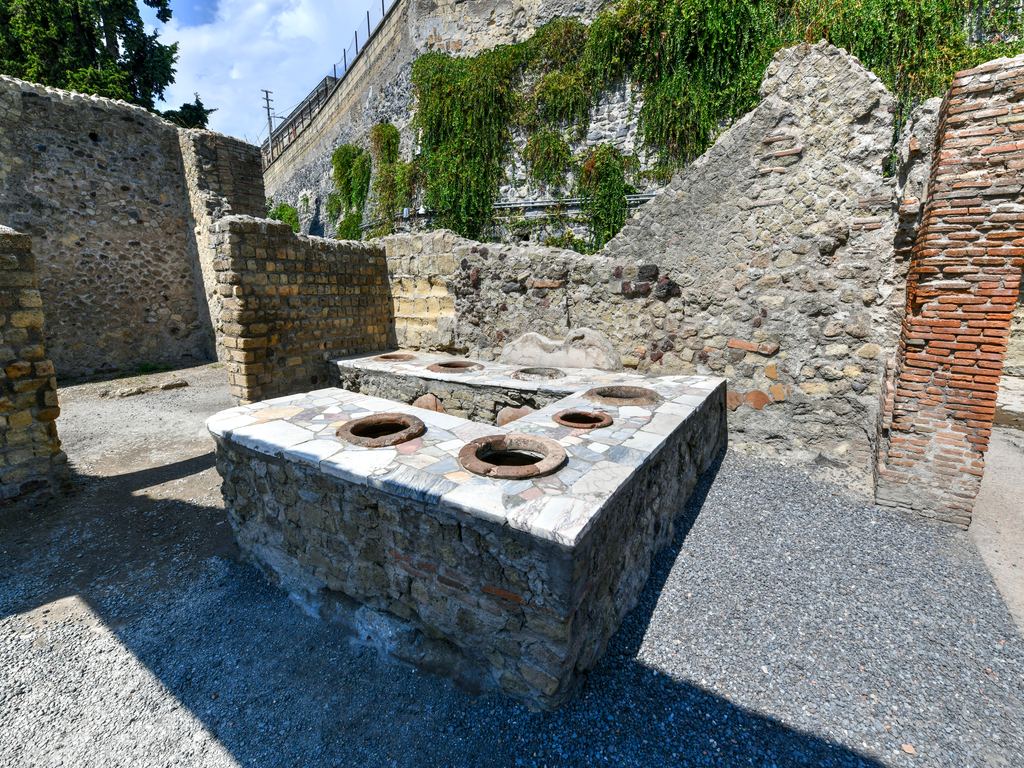
A thermopolium (the name is Greek, "a place that sells something hot") served hot food and drinks from large jars, dolia, sunk into a masonry counter. According to the Park, it was customary for middle- and lower-class Romans to eat the midday meal outside the home, and there are at least eighty examples in Pompeii alone (Park press release, 2021). Three are easy to place:
The Thermopolium of Regio V stands at the crossing of the Vicolo delle Nozze d'Argento and the Vicolo dei Balconi. It was dug in two stages, partly in 2019 and fully in 2020, and its painted counter shows a Nereid riding a sea-horse together with animals that, in the Park's words, were likely prepared and sold there. We do not give a street number because we could not find one in a Park source.
The Thermopolium of Vetutius Placidus (I.8.8-9) opens on the Via dell'Abbondanza; the Park's list marked it "visible from outside" when we read it on 5 November 2026. Its counter is richly decorated, and the back wall holds a small shrine to the household Lares, the owner's Genius, Mercury (trade) and Dionysus (wine). A hoard of coins was found in one of the counter jars, probably the last takings. The Park's audio text adds that grooves in the counter top let the owner test coins against a standard size, a defense against counterfeits. (The Park's pages disagree with each other on how heavy the hoard was, so we leave the weight out.)
The Thermopolium of Asellina (IX.11.2) was excavated in 1911 with almost all its furnishings: plates, goblets, jugs and cups in terracotta, bronze and glass, four jars set in a marble-topped counter, and a brick oven with a bronze boiler. At the back lay 22 wine amphorae, still visible among the lapilli. Painted inscriptions on the facade name Asellina and the women who served with her: Aegle, Maria and Zmyrina.
What was on the menu?
No menu survives, but the Park's site text reads the evidence this way: wine served seasoned with spices, soups of cereals and legumes, and, to eat standing up, focaccia, olives, eggs and cheese. Think of a quick stop between errands, not of a restaurant. The photo shows a thermopolium counter at Herculaneum, a few miles from Pompeii.
Who baked the bread?
In a Pompeian bakery the mill and the oven shared one room. The Bakery of Popidius Priscus (VII.2.22) has five millstones of volcanic stone, each made of a cone-shaped base (meta) and an hourglass-shaped upper stone (catillus). Grain went into the upper stone, which was pulled around "by slaves or animals" in the Park's wording. A large oven stands in the middle. There is no sales counter, so the Park thinks the bread was probably made to order, sold wholesale or carried out by street vendors called libani.
The animals are real. In the Insula of the Chaste Lovers (IX.12.6), the barn next to a bakery held the skeletons of the mules that turned the millstones and hauled the grain. According to Wikipedia, the town had at least 31 bakeries; the Park pages we read give no count, so treat the figure as a secondary estimate.
Who did the hard work?
Pompeii was a slave-owning society, and the ruins say so plainly. The Park describes the Fullery of Stephanus (I.6.7), a house converted into a laundry, where the workers, "almost all slaves", trod cloth for hours in a liquid made of human and animal urine, collected in pots along the streets. The impluvium became a washing basin and the roof a drying terrace. A skeleton carrying a hoard of coins lay near the entrance; electoral inscriptions suggest, though they do not prove, that it was Stephanus himself.
The same pattern shows up elsewhere. Bakery millstones were pulled by slaves or animals. The women of the Lupanar, below, were mostly enslaved. And the banker Lucius Caecilius Iucundus (House V.1.26) left an archive of 154 waxed tablets recording sums paid between AD 52 and 62 to people for whom he had sold goods, "especially slaves", or collected rents, keeping a commission of 1 to 4 percent. Selling human beings was ordinary business, and it paid a commission.
We give no figure for how many people in the city were enslaved. We found no primary source that offers a count, and any number you see is a guess. Free workers were there too, but the sources we used say little about them.
What happened at the baths?
The bathing sequence was the same everywhere: changing room (apodyterium), cold room (frigidarium), warm room (tepidarium), hot room (calidarium). Four complexes show different sides of it.
The Stabian Baths (VII.1.8) date to the 2nd century BC according to the Park, which counts them among the earliest bathhouses known in the Roman world. Hot air circulated through wall pipes and double floors, fed by furnaces and portable braziers. The women's section was smaller and plainer, with its own door marked Mulier on the Via del Lupanare.
The Forum Baths (VII.5.2) were built soon after the colony's founding in 80 BC and had separate entrances for women and men. More than 500 lamps turned up at the men's entrance, which the Park links to evening openings. The Suburban Baths (VII.16.a), under the Marina Gate, were private. Small erotic paintings in the changing room advertise, in the Park's reading, activities in the rooms upstairs, "probably intended for prostitution". There is also a small cold pool with a waterfall from an artificial cave.
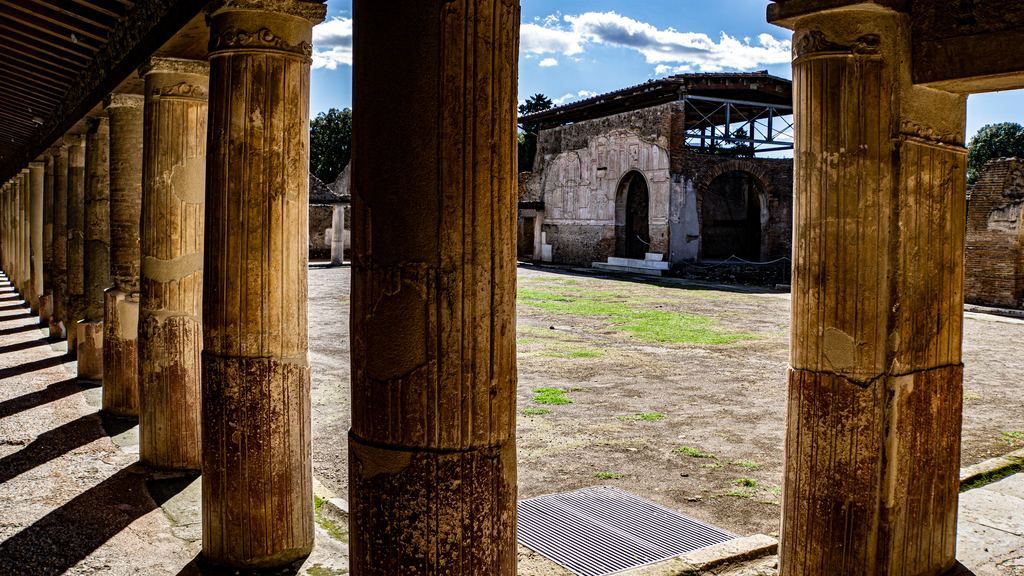
The Central Baths (IX.4.5) fill a whole block and were still under construction in AD 79. Basins lack their marble, and columns and capitals lie scattered where craftsmen were working on them. They had several windows for light and ventilation, and no division between women's and men's areas, so the Park assumes the sexes entered at different times.
What was written on the walls?
UNESCO's description of the site gives the headline: "An election was imminent at the time of the eruption, and there are many political slogans scrawled on walls, as well as others of a more personal nature, often defamatory." Writing was everywhere. The House of Julius Polybius (IX.13.1-3) carries inscriptions on its facade and nearby that tie its owner to the city's administration, and the Park used electoral inscriptions to guess who owned the fullery. At the entrance of the House of Sirico (VII.1.25 and VII.1.47), a floor mosaic greeted the owner's daily crowd of supporters with Salve lucru, "Welcome, money!"
I am amazed, o wall, that you have not collapsed under the weight of such silliness.
The Park's site text reads it as a weary reader poking fun at politicians.
What happened at the Forum and the market?
The Forum was where the city's civic, legal, commercial and religious life met. The Basilica (VIII.1.1), 1,500 square meters and dated by the Park to 130-120 BC, held business dealings and the law courts. The Macellum (VII.9.7), the covered market, had a large room with a masonry counter, perhaps for selling fish, and a round structure at the center of its courtyard that served for selling and cleaning fish. Its walls were painted with scenes of daily life, among them the selling of fish and poultry.
The Building of Eumachia (VII.9.1) was paid for by a priestess of Venus, Eumachia, and her son, who dedicated it to the citizens, as an inscription over the side entrance says. The Park's text suggests it may have been a market and a reference point for the fullers' guild. The Park's text offers two readings of a jar set under a landing near the entrance: a collector of urine for the fullers, or an amplifier for heralds making announcements, a use it draws from Vitruvius.
What was a Pompeian house for?
A house did more than shelter a family. A typical domus had an atrium with a rainwater basin, bedrooms (cubicula), a dining room (triclinium), an office (tablinum) and a garden court (peristyle). It was also the owner's address for business. Caecilius Iucundus kept his bank records at home. Publius Vedius Siricus received supporters there every day. The House of Sallust (VI.2.4), by the Park's account, was probably turned into a hotel after the earthquake.
Work in progress is the best clue. In the Insula of the Chaste Lovers (IX.12.6), the House of the Painters at Work still shows preparatory drawings on a wall, interrupted before the colors went on; the Park suggests the work was perhaps repairing damage from an earthquake a few days before the eruption. The House of Julius Polybius had amphorae and heaps of lime waiting beside the tablinum. How the painters worked is the subject of our page on wall painting.
How did Pompeians spend an evening or a holiday?
The Large Theatre (VIII.7.20) held up to 5,000 people and the neighboring Odeon, used for music and recitations, 1,500 to 2,000. Seats were divided by rank: magistrates and nobles at the bottom, the middle classes in the center, plebeians at the top (Park audio text). The amphitheatre (II.6), built around 70 BC on the initiative of two magistrates, held up to 20,000, which means spectators came from neighboring towns as well.
Tacitus records what happened when the two crowds met. In AD 59, at a gladiator show, insults between Pompeians and the people of Nocera turned to stones and then swords (Annals 14.17). The Senate banned such gatherings at Pompeii for ten years, and the Park notes the ban was lifted in AD 62, after the earthquake. After the earthquake the theatre's foyer, the Quadriporticus (VIII.7.16), became a gladiators' barracks. Victims found there include four enslaved people and eighteen free people, one a woman with rich jewelry. The parade weapons found in two wooden boxes are in Naples.
Where did Pompeians bury their dead?
Outside the walls, along the roads. The Necropolis of the Herculaneum Gate stretches along the road toward Naples, and the tombs visible there date from the 1st century BC onward. Two have a semicircular tuff bench, a schola, granted by the city council to deserving citizens; one belongs to Mamia, a public priestess who died around AD 29 and had built the Temple of the Genius of Augustus. The tomb of Naevoleia Tyche and Munatius Faustus shows a double seat, the honor of sitting in the front row at the theatre, and a ship entering port.
What do we actually know about the Lupanar?
The Lupanar (VII.12.18-19, entrance on the Vicolo del Lupanare) is the brothel of Pompeii. The Park describes a two-floor building: the owner's and slaves' lodgings on top, and on the ground floor five rooms, each with a built-in bed and closed by a curtain, along a corridor with a latrine at the end. The women were mostly Greek and Eastern slaves, paid between two and eight asses, when a glass of wine cost one. Small erotic paintings in the corridor "informed customers" of the services offered. The name comes from lupa, "she-wolf", a Latin word for a prostitute.
That is where the solid facts end. Wikipedia reports more than 150 graffiti transcribed inside the Lupanar. It also says that early excavators counted 35 brothels by treating any building with erotic paintings as one, while a stricter count gives nine single-room establishments besides the Lupanar. We have not checked those figures against the primary editions. The tales that the paintings were a picture menu for foreign sailors, or that carved phalluses on pavements pointed the way, are popular interpretations, not findings. We leave them out.
Clue by clue: what to look for and where
| Clue in the ruins | What it tells us | Where to see it |
|---|---|---|
| Cambered street, big oval stepping stones | Rain drained to the sides and people crossed on dry stone | Via dell'Abbondanza and other main streets |
| Masonry counter with sunk jars | Hot food and drink served to take away | Vetutius Placidus I.8.8-9; Asellina IX.11.2; Regio V corner of Vicolo delle Nozze d'Argento and Vicolo dei Balconi |
| Millstones and a central oven | Grinding and baking in one workshop, animal or slave power | Popidius Priscus VII.2.22; Insula of the Chaste Lovers IX.12.6 |
| Raised basin and roof terrace | A house turned into a laundry | Fullery of Stephanus I.6.7 |
| Changing room, hot room, separate women's door | The bathing sequence and who used it when | Stabian VII.1.8; Forum VII.5.2; Suburban VII.16.a; Central IX.4.5 |
| Fountain and water tower | Public water was part of the street scene | Concordia fountain on Via dell'Abbondanza near the Forum; Castellum aquae near the Vesuvius Gate in Regio VI |
| Mosaic greeting at an entrance | Patrons and clients met at home | House of Sirico VII.1.25 and VII.1.47 |
| Banker's archive of 154 wax tablets | Credit, rents and slave sales with a fee | House of Caecilius Iucundus V.1.26 (bronze portrait at the Naples museum) |
| Fish counter and market paintings | Where and how food was sold | Macellum VII.9.7 |
| Unfinished columns and bare basins | A city still rebuilding in AD 79 | Central Baths IX.4.5; House of Julius Polybius IX.13.1-3 |
| Tiered seating | Social rank decided where you sat | Large Theatre VIII.7.20; Amphitheatre II.6 |
| Tombs lined along a road | Burial outside the walls, with public honors for some | Necropolis outside the Herculaneum Gate |
Keep exploring
Three pages that pair with this one.
Daily life in Pompeii: common questions
What is a thermopolium?
A Roman snack bar. Hot food and drinks were stored in large jars sunk into a masonry counter and served to people on the street. The Park counts at least eighty in Pompeii.
What did Pompeians eat when they ate out?
The Park's site text lists spiced wine, soups of cereals and legumes, focaccia, olives, eggs and cheese. No menu survives, so this is a reading of the evidence, not a document.
Where did people get water?
From an aqueduct that reached a water tower at the city's highest point, then through pipes to street fountains. The Park counts about 40 fountains in use in AD 79.
Did men and women bathe together?
At the Stabian and Forum Baths the sexes had separate sections and entrances. At the unfinished Central Baths there was no division, which the Park takes to mean that men and women came at different times.
Were there slaves in Pompeii, and what did they do?
Yes. The evidence shows enslaved people working in laundries, bakeries and the brothel, and slaves being sold through a banker's books. We found no reliable count of how many there were.
Is the Lupanar really a brothel?
Yes. The Park calls it one and describes rooms with built-in beds, curtains and erotic paintings in the corridor. Stories about what individual paintings or carvings meant are interpretation.
How many graffiti survive?
Many, but we found no reliable total in a primary source, so we do not quote one. UNESCO says only that there are many political slogans and many personal, often defamatory, ones.
Which of these places can I visit?
That changes often. Check the Park's list of houses at pompeiisites.org/en/houses, and use our address book to find each building by its number.
Next: how the walls were painted
Many of the buildings above kept painted walls. Learn to tell the four styles apart before you walk in.
Data verified on . Building facts: the Park's own pages. Counts of bakeries and of the Lupanar's graffiti are secondary and flagged as such. We did not check which buildings are open. Editorial Policy