
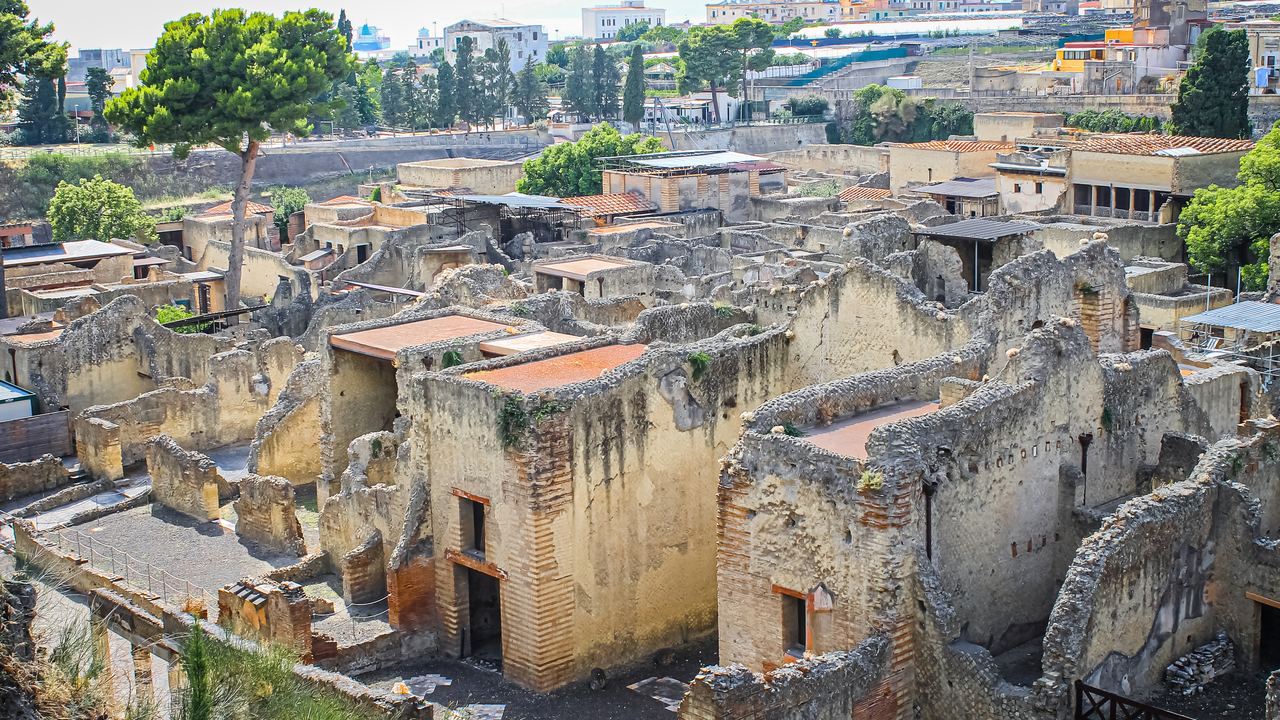
Choose Pompeii if you want scale: a whole Roman town of streets, a forum, an amphitheater and hundreds of houses, to be walked over half a day or more. Choose Herculaneum if you want a smaller site that you can finish in about two hours, with carbonized wood still in place and a quieter atmosphere. With a full day you can do both: Ercolano Scavi and Pompei Scavi stations are 21 minutes apart on the express Circumvesuviana. The order depends on where you sleep and on the season, and the sections below explain how to decide.
The two sites are not rivals. Pompeii shows how a whole city worked; Herculaneum shows what a house was made of, because the heat that killed its people also turned its timber to charcoal instead of destroying it.
Which one should you choose if you only have time for one?
Match the site to the traveler rather than to a ranking. The table below turns the facts into a recommendation, and every row can be checked against the figures further down.
| If you... | Go to... | Why |
|---|---|---|
| Have one full day and want the classic picture | Pompeii | Streets, forum, amphitheater and the casts; the Park's only duration is a 2018 FAQ line (2 to 3 hours), so we plan on half a day to a full day. |
| Have about half a day | Herculaneum | About two hours on the Park's FAQ, and the station is a 6-minute walk from the entrance. |
| Want to see wooden beams, doors or furniture | Herculaneum | The Park documents carbonized wood and food from the surge deposits. |
| Hope for a calmer visit | Herculaneum | About 520,000 visitors in 2024 against roughly 4 million at the Pompeii excavations in the same year. |
| Travel with a large dog | Herculaneum | Herculaneum allows dogs of any size, with limits inside some buildings; Pompeii limits them to 10 kg and 40 cm. |
| Want the amphitheater and long straight streets | Pompeii | Pompeii has the amphitheater and the Via dell'Abbondanza; Herculaneum's excavated area is much smaller, with over 4 ha visible. |
| Are visiting in July or August and want the shorter walk | Herculaneum | Fewer hectares to cover, although neither site is cool. |
| Are interested in the dead of AD 79 | Both | Pompeii has about a hundred body casts (104 in the 2024 count); Herculaneum has the waterfront vaults with about 300 skeletons. |
How do Pompeii and Herculaneum compare on the facts?
These figures come from the two Parks, the 2022 Pompeii services charter, UNESCO and published research. Where they disagree, we say so. The Pompeii areas differ because they measure different perimeters: the 2022 charter gives about 66 ha for the whole archaeological area, of which about 45 excavated, while the Park's FAQ and UNESCO give 44 ha for the excavated area. Prices are left out on purpose: they live on one page, Pompeii tickets explained.
| Fact | Pompeii | Herculaneum |
|---|---|---|
| Area | About 66 ha, of which about 45 excavated (Carta dei servizi 2022); the Park's FAQ says 44 ha | About 20 ha estimated, over 4 ha visible (Park) |
| Depth of burial | 4 to 6 m of ash and pumice (reference works) | About 20 m of volcanic material (Park) |
| Time to allow | Half a day to a full day (the Park's FAQ of 2018 says at least 2 to 3 hours) | About 2 hours |
| Our planning range | Half a day to a full day | Two to three hours |
| Wood and food | Not the Park's emphasis; the famous survivals are plaster casts and wall paintings | Carbonized furniture, doors, beams, a boat, food, cloth and rope (Park) |
| The dead | 1,044 victims found (Giacomelli et al., 2003); 104 casts (Pilli et al., 2024) | About 300 skeletons found in 1980 in nine of the twelve waterfront vaults (Park) |
| Visitors | About 4.07 million at the excavations in 2024 (Park); 4.00 million in 2025 | 521,514 in 2024 (Ministry of Culture) |
| Ticket structure | Named ticket with day and time slot; ID checked; daily cap of 20,000 | Separate ticket; no cap or named-ticket rule found |
| Hours | Summer 9:00 to 19:00, last entry 17:30. Winter 9:00 to 17:00, last entry 15:30 | Summer 8:30 to 19:30 at the gates, last entry 18:00, excavation to be left by 19:00. Winter 8:30 to 17:00, last entry 15:30, excavation to be left by 16:40 |
| Left luggage | Paid, at two of the three gates | Free (Park FAQ) |
| Dogs | Up to 10 kg and 40 cm, carried inside buildings | Any size, with limits inside some buildings |
| Closed to visitors | Some buildings rotate in and out of the visitable list; the Park publishes it on its houses page | The Villa of the Papyri, still largely buried, and the ancient theater, both closed for works with no reopening date (Park, as of 5 November 2026) |

Why did Herculaneum keep its wood?
Because of how it died. Pompeii was buried under falling pumice and ash and then hit by pyroclastic currents. Herculaneum, closer to the volcano, was struck early by surges of superheated gas and ash, and the Park says the heat was over 400 °C. A 2023 study in Scientific Reports (Pensa and colleagues) measured the first surge at roughly 555 to 495 °C, so the two figures differ and we do not choose one. At that temperature wood does not burn away. It carbonizes, and the Park lists furniture, doors, stairs, beams, partitions, a boat, food, textiles and ropes among the organic finds.
You will read that Herculaneum is the place where you see upper floors. UNESCO's entry for the site supports it, noting the "noteworthy conservation of upper floors" thanks to the pyroclastic material that buried the town; we did not find the claim on the Park's own pages. The carbonized timber is the other thing you can verify on the ground, and so is the way the town was buried: by about 20 meters of material, much deeper than Pompeii, which is one reason why far less of Herculaneum has been uncovered.
For the full story of the eruption, read the eruption of AD 79. For the Herculaneum visit itself, the Herculaneum category collects tours and tickets.
Is Herculaneum really less crowded?
By the numbers, yes. The Ministry of Culture counted 521,514 visitors at Herculaneum in 2024. In the same year the Pompeii excavations had about 4.07 million in the Park's own series (other official tables differ by a few percent); the 4,267,233 figure that circulates for 2024 is the total of all four Park sites and not Pompeii alone. The order of magnitude is clear: close to eight visitors at Pompeii for every one at Herculaneum.
That is also why the ticket rules differ. Pompeii runs a named ticket with a time slot and a daily cap of 20,000 entries (15,000 in the morning, 5,000 in the afternoon). For Herculaneum we found no cap and no named-ticket rule. That absence is not a guarantee that none exists, so check the Park's page before a peak date. Crowd seasons for both sites follow the same months, which our crowd calendar shows for Pompeii.
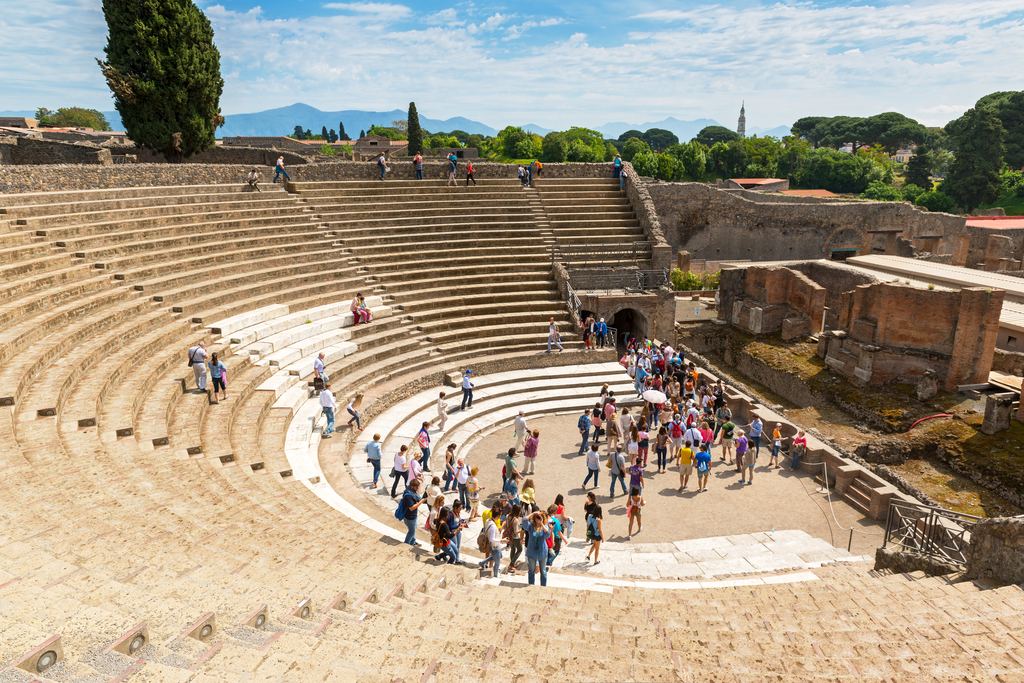
Scale
What Pompeii has that Herculaneum does not
Pompeii offers distance. The amphitheater, the Forum, the Via dell'Abbondanza and the Villa dei Misteri are separated by long walks over stone paving with shade that the Park does not quantify. The list of houses open to visitors changes week to week, so we do not name them: the Park publishes it at pompeiisites.org/en/houses. If you want to plan a route, our itineraries guide gives four, from two hours to two days.
How do the tickets work if you visit both?
You buy two tickets. The Herculaneum Park's FAQ answers the question about a joint ticket with a flat "No": you buy the single ticket at each site's ticket office. Reseller bundles exist, but they are packages made by the resellers and not a Park product. At Pompeii the ticket is named, tied to a day and time slot, and checked against ID, so book the Pompeii slot first and fit Herculaneum around it, not the other way round. The three-day ticket covers the Pompeii Park's own sites, including Oplontis, Stabiae and Boscoreale. Pompeii+ adds only the Villa of the Mysteries, the Villa of Diomede and Villa Regina at Boscoreale. Neither covers Herculaneum, which is run by a separate Park. All prices, the reductions and the free days are on the tickets page.
How do you do both in one day?
Both stations are on the Circumvesuviana Naples to Sorrento line, in this order from Naples: Ercolano Scavi, then Pompei Scavi-Villa dei Misteri. In the express timetable valid from 17 October 2026, Ercolano Scavi is 15 minutes from Napoli Garibaldi and Pompei Scavi is 21 minutes beyond it; from Sorrento, Pompei is 35 minutes away and Ercolano Scavi about 56. The rule that follows: visit the site closer to your base first and finish at the farther one, so you never double back. From Naples that means Herculaneum, then Pompeii. From Sorrento it means Pompeii, then Herculaneum. The Herculaneum entrance is a 6-minute walk from its station, according to the Park.
| Season | Base | Order | Why |
|---|---|---|---|
| Winter schedule (15 October to 15 March) | Naples | Herculaneum from 8:30, then Pompeii by midday | Herculaneum opens half an hour earlier and takes about two hours; Pompeii's last entry is 15:30 and it closes at 17:00, so arrive by midday. |
| Winter schedule | Sorrento | Pompeii at 9:00, then Herculaneum | Pompeii first uses the longer window; Herculaneum's last entry is also 15:30, so leave Pompeii by about 13:00. |
| Summer schedule (16 March to 14 October) | Naples | Herculaneum early, Pompeii after lunch | Follows the train and avoids backtracking. The price is a hot afternoon at Pompeii; in extreme heat, start at Pompeii at 9:00 and return to Herculaneum before its 18:00 last entry. |
| Summer schedule | Sorrento | Pompeii at 9:00, Herculaneum in the afternoon | Puts the larger and more exposed site in the morning; Herculaneum's last entry is 18:00. |
The order is a judgment call, so treat the table as reasoning, not a rule. The firm limits are the ones in the Parks' timetables: whichever site comes second must be entered before its last-entry time, and the train between them takes 21 minutes plus a walk. Do not forget lunch, the transfer, and the fact that the Pompeii time slot is fixed in advance. Winter days are the tightest: a Rome-based day trip with both sites loses about four and a half hours to the trains. Tours that join the two sites exist in our Pompeii and Herculaneum category.
When is it better to split them into two days?
Split them whenever the one-day plan asks you to hurry. The clearest cases:
- July and August. Midday at Pompeii is hard on children and older visitors, and Herculaneum in the afternoon does not fix it.
- Travel with small children. Herculaneum alone is a good half day; Pompeii needs its own.
- Limited mobility. Pompeii's step-free route, "Pompei per tutti", is over 3.5 km long and has its own limits; at Herculaneum the Park lists free wheelchairs at the ticket office, subject to availability, as of November 2026. See our accessibility guide.
- A guided visit at both sites. Two guided tours of two hours each, plus travel, rarely leave energy for a third stop.
- Interest in the villas. Oplontis and Boscoreale are part of the same Park as Pompeii and need their own time; see the quiet villas.
The Naples Archaeological Museum holds most of the finds from both towns, so a visit there helps decide how much of each you want. Pompeii at the Naples museum lists what to look for.
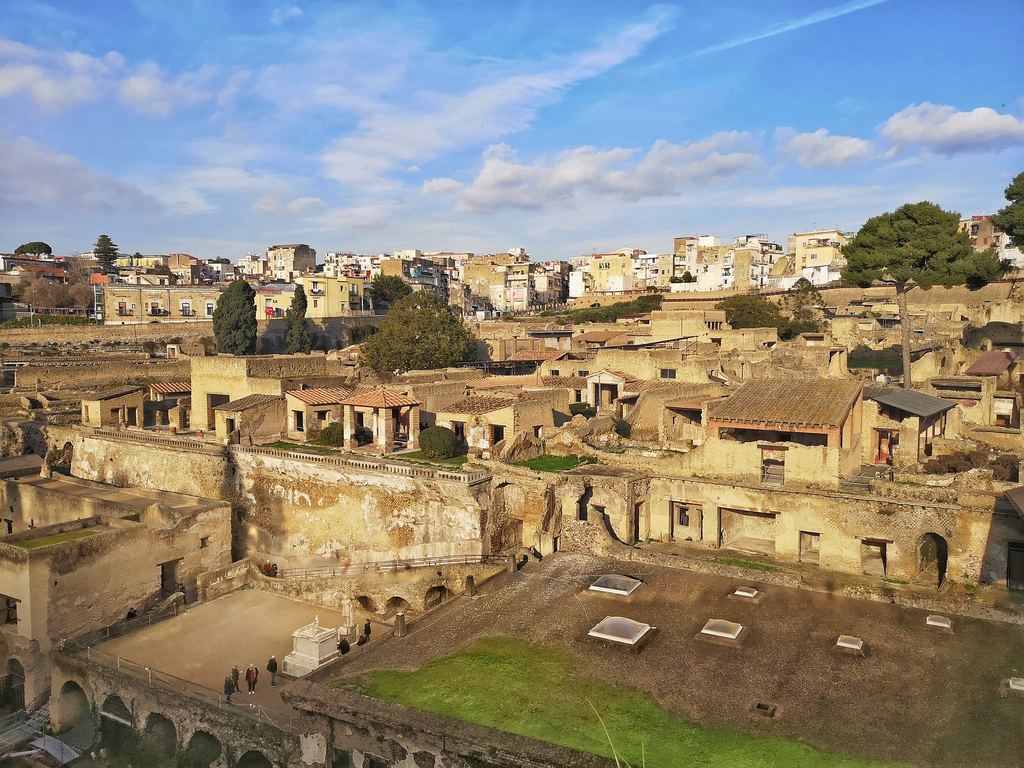
Planning both sites?
See tours that cover Pompeii and Herculaneum in one day, with transfer and tickets arranged.
Pompeii or Herculaneum: common questions
Is Herculaneum worth visiting if I have seen Pompeii?
Yes, for different reasons. Herculaneum shows carbonized wood, the waterfront vaults and a more compact town buried under about 20 m of material. It adds less new if all you want is the layout of a Roman street.
How many hours do I need at each site?
The Herculaneum FAQ says about 2 hours. The Pompeii Park gives no current figure (its FAQ line of 2018 says at least 2 to 3 hours). Our planning range is half a day to a full day for Pompeii and two to three hours for Herculaneum.
Which site is better preserved?
They are preserved differently. Herculaneum has carbonized wood and food because of the hot surges; Pompeii has far more streets and buildings uncovered. Neither is better, and the choice depends on what you want to see.
Is there a combined ticket for Pompeii and Herculaneum?
No. The Herculaneum Park's FAQ says you buy the single ticket at each site. Resellers sell bundles, but those are their own packages.
Which site is better for children?
Herculaneum is the easier first visit: shorter, with a 6-minute walk from the station. Pompeii suits older children. Both show human remains, so see our guide to visiting with kids.
Which site is better on a hot day?
Neither is cool. Herculaneum requires less walking in the sun. In summer start at the site you will spend the longest in, early, and carry water.
Can I do Pompeii and Herculaneum from Rome in one day?
It is possible, but the trains take about two hours and a quarter each way, and the winter last entry is 15:30. A guided day from Rome is often the more realistic choice; see our From Rome category.
Does Herculaneum limit daily visitors?
We found no daily cap and no named-ticket rule on the Park's pages. That does not prove there is none, so check before a peak date.
Data verified on . Pompeii and Herculaneum Parks' FAQs and visitor pages; Carta dei servizi 2022; Pensa et al. 2023; Pilli et al. 2024; EAV timetable of 17 October 2026. Editorial Policy