
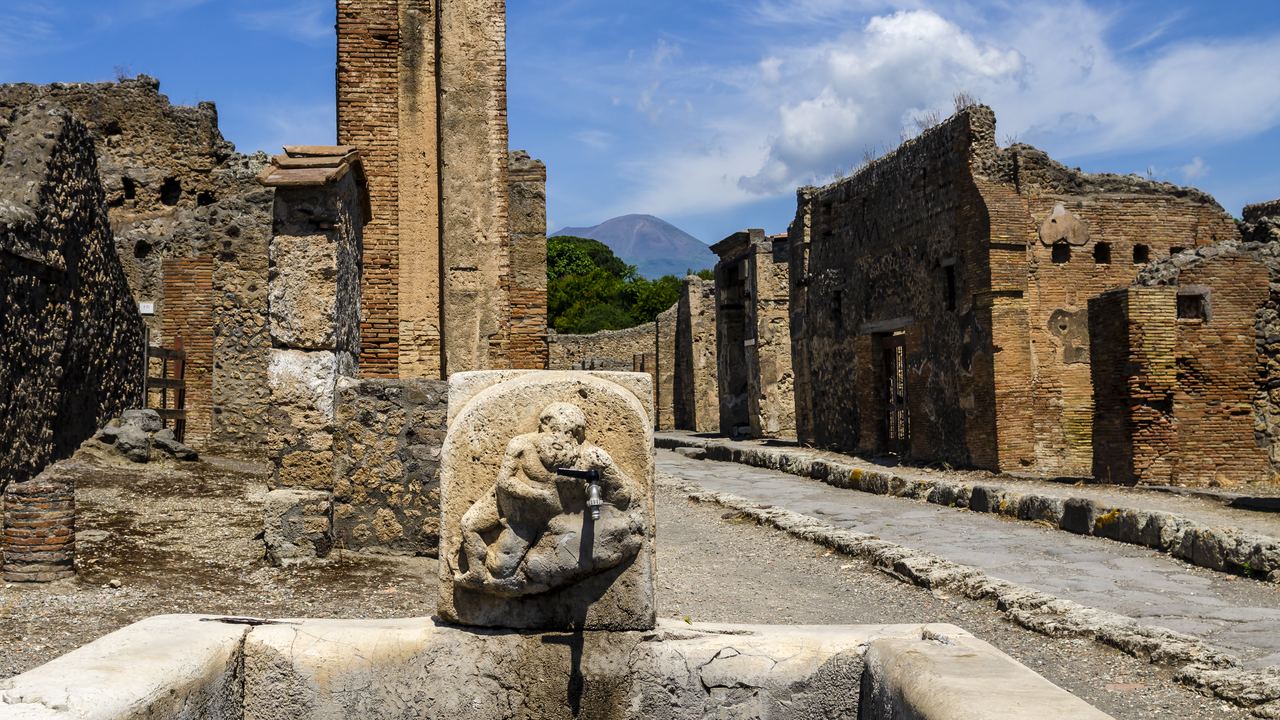
A Pompeii address such as VI.15.1 reads Regio, Insula, Entrance: Regio VI, block 15, door 1, which is the House of the Vettii. The city is divided into nine regiones (I to IX), each regio into numbered blocks called insulae, and each doorway on a block has its own number. Giuseppe Fiorelli devised the scheme in the 1860s, and archaeologists still use it. This page explains the rule, then lists 49 buildings by regio with what you see and where the best-known pieces ended up.
pompeii.museum is an independent site. We are not affiliated with the Pompeii Archaeological Park, the Ministry of Culture or any other body, which is why we send you to the Park's own pages for anything that changes, starting with which buildings you can enter.
How do you read an address like VI.15.1?
Three numbers, always in the same order. The Roman numeral is the regio, one of the nine areas. The first Arabic number is the insula, a block of buildings. The last is the entrance, a single door on that block. Doors sometimes carry a letter, as in V.2.i or VII.16.a. So IX.11.2 is Regio IX, insula 11, door 2.
The words are younger than the city. Michael Binns, in his Latin-Italian-English glossary hosted by Pompeii in Pictures, calls regio "a purely modern term" for a group of insulae. He adds that in Latin an insula was strictly a block owned by one person, and that reading it as a block bounded by streets is a modern habit. None of this changes how you use the numbers, but it explains why you will not find "Regio VI" on any ancient text.
| Address | Regio | Insula | Entrance | Building |
|---|---|---|---|---|
| VI.15.1 | VI | 15 | 1 | House of the Vettii |
| I.10.4 | I | 10 | 4 | House of the Menander |
| VII.1.8 | VII | 1 | 8 | Stabian Baths |
| IX.11.2 | IX | 11 | 2 | Thermopolium of Asellina |
| II.2.2 | II | 2 | 2 | House of Octavius Quartio |

Why does one house have two addresses?
Because an address points to a door, not to a house. A large domus can open onto the street twice, and shops attach to the front. The House of the Tragic Poet carries two numbers, VI.8.3 and VI.8.5: the Park describes a main entrance with the Cave canem mosaic and a side entrance that leads straight to the peristyle. The House of Sirico has both VII.1.25 and VII.1.47. The House of the Centenary has IX.8.3 and IX.8.6. The House of Julius Polybius is written as a range, IX.13.1-3. The amphitheatre is just II.6, with no door number, and the villas and tombs outside the gates have no Regio address at all.
Why don't the numbers in old books match?
They moved. Pompeii in Pictures notes that the numbering has changed over the years: what an old book calls II.4 may be II.1 now. Its example is the House of the Vettii, which the excavation reports (Notizie degli Scavi) placed in insula 12 of Regio VI until January 1897 and later reclassified as insula 15.
In a book older than a century, search by the building's name, not its number. Names also vary between languages, so the first column below gives the Italian name in brackets.
Where do the addresses on this page come from?
The addresses come from Pompeii in Pictures, a privately run site whose authors we could not verify. That makes them a secondary source, and we say so. The Park itself rarely prints a Regio.Insula.Entrance on its building pages; a few do, such as the Julius Polybius page with "Insula 13, nos. 1-3". Everything else (what you see, where the finds are) comes from the Park's pages for each building, which we read on 5 November 2026, and from Wikipedia only where the Park is silent. We name a painting style only when a source states it, so many rows say nothing on the subject; the four styles are explained on our wall painting page.
How do you find a building once you are inside?
Treat the address as a way to identify a building, not to navigate to it. The Park's own list of buildings runs by name, so the working routine is short:
- Find the building in the tables below and note its Italian name.
- Look the name up in the Park's list of houses (linked in the next section) to see whether it can be entered.
- Follow the name on the map you carry. The printed Park map we checked in November 2026 is a 2019 edition, so it does not show later closures and reopenings.
Regio V is partly unexcavated. For a route that links the main sights in a sensible order, use our itineraries.
Which houses are open?
We do not say, and you should distrust any page that does. The Park publishes its own list of houses and their hours at pompeiisites.org/en/houses. When we read it on 5 November 2026 it carried notes such as "visible from outside" and "temporarily closed" next to individual buildings. Buildings close and reopen, and the list is edited as it happens. A fixed list copied onto a third-party page goes stale within weeks, and ours would too.
A row in the tables below tells you what a building contains. It does not tell you that you can walk in. Check the Park's list the week you go.
Regio I: the Menander, a laundry and the Garden of the Fugitives
Regio I suits houses with a story. The House of the Menander has the silver hoard and the Iliad scenes, and the Garden of the Fugitives is where the victims' casts are still on site (see the body casts page).
| Building | Address | What you see | Where the famous pieces are |
|---|---|---|---|
| House of the Citharist (Casa del Citarista) | I.4.5 | Named after a bronze statue of Apollo playing the cithara; home of the Popidii family. | The Park page does not say where the statue is. |
| House of the Ceii (Casa dei Ceii) | I.6.15 | Late-Samnite facade with white stucco panels; an impluvium made of amphora fragments; a small garden painted with wild animals and Egyptian-style landscapes. | In situ. |
| Fullery of Stephanus (Fullonica di Stephanus) | I.6.7 | A laundry: a tub where the impluvium would be, a drying terrace, and a skeleton found at the entrance with coins. | In situ. |
| House of the Ephebe (Casa dell'Efebo) | I.7.10 | Probably the house of the wine merchant Publius Cornelius Tages. A garden triclinium has an <i>opus sectile</i> floor panel with rose and lotus flowers that the Park calls unique in Pompeii. | The bronze ephebe, adapted as a lamp-bearer and the source of the house's name, is in the Naples museum, per the Park. |
| House and thermopolium of Vetutius Placidus | I.8.8-9 | A snack-bar counter with a shrine to the Lares, the Genius, Mercury and Dionysus; a summer dining room. | In situ. |
| House of the Menander (Casa del Menandro) | I.10.4 | Atrium with scenes from the Iliad and the Odyssey, a Rhodian peristyle, a portrait of Menander in the portico, a small bath suite. | The hoard of 118 silver pieces, found in a cellar, is in the Naples Archaeological Museum. |
| House of the Lovers (Casa degli Amanti) | I.10.11 | A verse painted in the peristyle: like bees, lovers lead a life sweet as honey. The Park calls its two-story peristyle unique in Pompeii. | In situ. |
| Garden of the Fugitives (Orto dei Fuggiaschi) | I.21.2 | A garden with the casts of victims of the eruption. | The casts are on site. |
Regiones II and III: the amphitheatre and the gladiators' school
Regio II has the amphitheatre, which the Park says held up to 20,000 spectators, and the great palaestra, a square of about 140 by 140 meters. Regio III contributes a single entry to our list.
| Building | Address | What you see | Where the famous pieces are |
|---|---|---|---|
| House of Octavius Quartio (Casa di Octavius Quartio) | II.2.2 | A long garden with water channels (<i>euripi</i>), a shrine of Isis, a summer dining couch, and a grotto-like niche with mythological frescoes signed by a certain Lucius. | In situ. |
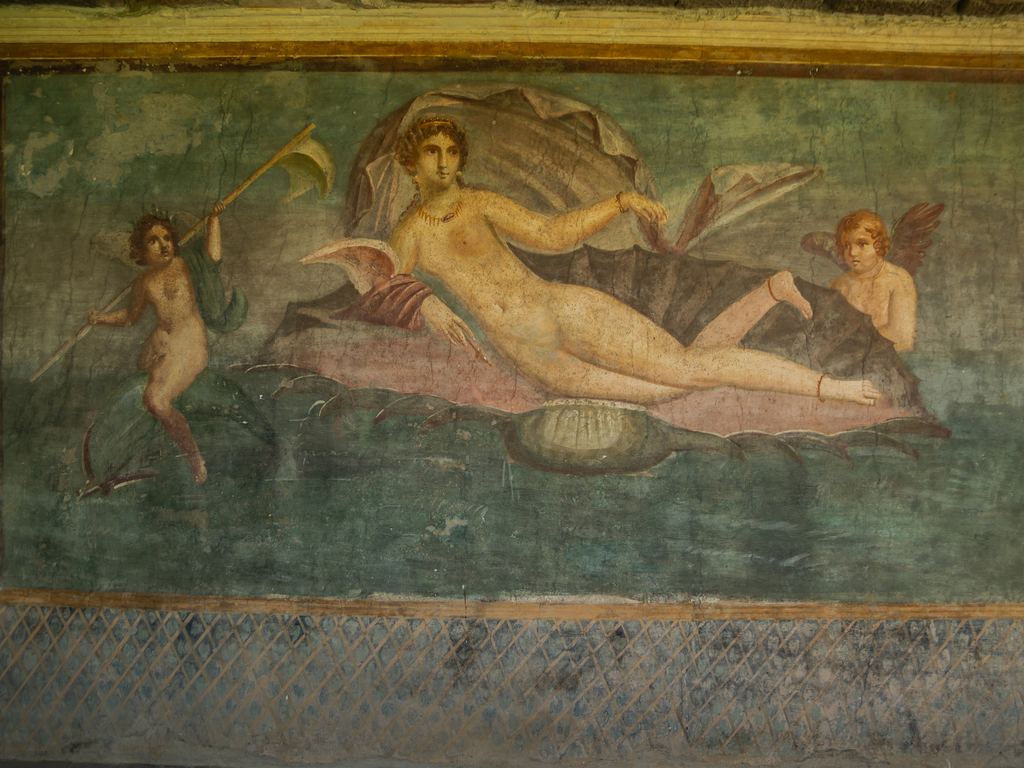
| House of the Venus in the Shell (Casa della Venere in conchiglia) | II.3.3 | A large fresco of Venus in a shell at the back of the peristyle, and one of the big reception rooms (<i>oecus</i>). | In situ. |
| Amphitheatre (Anfiteatro) | II.6 (no door number) | Seating for up to 20,000, per the Park, which dates the building to 70 BC and calls it the oldest of the known Roman amphitheatres. The parapet around the arena was painted with gladiators. | In situ. |
| Great Palaestra (Grande Palestra) | II.7.1 | A porticoed square of about 140 x 140 m with a 23 x 35 m pool. The Park says it hosts a permanent exhibition of the frescoes and finds from the Moregine triclinia. | The Moregine finds are shown on site. |
| Schola Armaturarum | III.3.6 | Seat of a military-style association, built a few years before the eruption. The Park records a collapse in 2010 and a restoration project begun in 2015. | In situ. |

Regio V: a banker, a silver wedding and a snack bar
Regio V is still partly unexcavated, and it produced the recent finds, including a decorated snack bar. That one has no door number on any primary source we found, so the table gives its corner instead.
| Building | Address | What you see | Where the famous pieces are |
|---|---|---|---|
| House of Caecilius Iucundus (Casa di Cecilio Giocondo) | V.1.26 | A tufa portal. The banker's archive of 154 wax tablets was found here, and two marble reliefs from the household shrine show the effects of the AD 62 earthquake on public buildings, per the Park. | The bronze portrait of the banker Lucius Caecilius Iucundus is in the Naples museum. |
| House of the Silver Wedding (Casa delle Nozze d'Argento) | V.2.i | Atrium with Corinthian columns in tufa and a Rhodian peristyle; the present layout dates to 40-30 BC. | In situ. |
| House of Marcus Lucretius Fronto (Casa di Marco Lucrezio Frontone) | V.4.a | A simple facade hides a richly painted house: the Triumph of Bacchus and Ariadne in the tablinum, hunting scenes in the garden. The magistrate Marcus Lucretius Fronto appears in election notices on the facade. | In situ. |
| Thermopolium of Regio V | Corner of Vicolo delle Nozze d'Argento and Vicolo dei Balconi; no door number found | An L-shaped counter painted with a Nereid on a sea-horse among dolphins, and a still life of animals sold in the shop; excavated 2018-2020. | In situ. |
Regio VI: the great houses
Regio VI is where the famous names cluster: Vettii, Faun, Tragic Poet, Labyrinth. It is also the region where the question "is it still here or in Naples?" matters most, so read the last column.
| Building | Address | What you see | Where the famous pieces are |
|---|---|---|---|
| House of Sallust (Casa di Sallustio) | VI.2.4 | Samnite layout from around 180 BC, a facade of limestone blocks, a tufa impluvium, painted imitations of marble slabs; Actaeon and Diana in the garden. | The bronze Hercules and the stag from the impluvium are in Palermo's regional archaeological museum, not in Naples. |
| House of Pansa (Casa di Pansa) | VI.6.1 | Takes up a whole insula; tufa facade; an Oscan inscription painted in red and protected by glass; a peristyle of 16 columns with a pool. | In situ. |
| House of the Tragic Poet (Casa del Poeta Tragico) | VI.8.3 (Cave canem entrance: VI.8.5) | The CAVE CANEM mosaic at the entrance, under glass; a traditional atrium; Ariadne abandoned by Theseus in the dining room; a shrine in the peristyle. | The Cave canem is on site. The Naples museum shows another Cave canem mosaic labelled only "from Pompeii". Mythological panels from the house are in Naples, among them the Sacrifice of Iphigenia. |
| House of the Dioscuri (Casa dei Dioscuri) | VI.9.6 | Two atria joined by a Rhodian peristyle with a pool; an atrium with 12 tufa columns; the Park links it to the same workshop as the House of the Vettii. | The main paintings are in Naples, per the Park. |
| House of the Anchor (Casa dell'Ancora) | VI.10.7 | An anchor mosaic at the entrance; a rear on two levels with terrace and garden; a shrine of Venus with rudders. | In situ. |
| House of the Labyrinth (Casa del Labirinto) | VI.11.10 | Double atrium and peristyle; a four-columned atrium; a Corinthian hall with 10 columns decorated, per the Park, in the Second Style; a Theseus and the Minotaur mosaic framed by a labyrinth. | In situ. |
| House of the Faun (Casa del Fauno) | VI.12.2 | Two atria and two peristyles; HAVE in marble inlay on the threshold; a copy of the dancing Faun in the impluvium; a copy of the Alexander mosaic in the exedra. | The originals, the bronze Faun and the Alexander mosaic, are in the Naples museum. |
| House of the Vettii (Casa dei Vettii) | VI.15.1 | A painted Priapus beside the door; a peristyle garden full of statues and fountain jets; a room with a frieze of cupids selling wine, making perfume and doing other trades; a kitchen shrine. | In situ. The Park cites no pieces in Naples. |
| House of the Golden Cupids (Casa degli Amorini Dorati) | VI.16.7 | A Rhodian peristyle with a pediment; a large room with mythological paintings and a rosette mosaic; a household shrine and a second place of worship. | In situ. |
| Water tower (Castellum aquae) | Regio VI, near the Vesuvius Gate; no door number | The distribution point at the highest spot in the city (42 m), fed by the Serino aqueduct, with three pipes at different levels. | In situ. |
Regio VII: the Forum's flank, baths and a bakery
Regio VII wraps the north and east of the Forum, so it mixes civic buildings with ordinary street life: two bath complexes, a bakery, a brothel. Daily-life context for several of these rows is on the daily life page.
| Building | Address | What you see | Where the famous pieces are |
|---|---|---|---|
| Forum (Foro) | Regios VII and VIII, central square | Re-paved in travertine at the start of the imperial age; some slabs carry a groove for the bronze letters of a large inscription. The Park notes that the excavators, from 1813, found the area already stripped of its decoration in antiquity. | Little survived in place; the Park does not list pieces in Naples. |
| Stabian Baths (Terme Stabiane) | VII.1.8 | Baths the Park dates to the 2nd century BC; the men's section. | In situ. |
| House of Sirico (Casa di Sirico) | VII.1.25 and VII.1.47 | A greeting, SALVE LUCRU, at the entrance; a hall with frescoes of the Trojan War. | One fresco from the hall is in Naples, per the Park. |
| Bakery of Popidius Priscus (Panificio di Popidius Priscus) | VII.2.22 | A mill room with millstones and an oven. | In situ. |
| House of the Wounded Bear (Casa dell'Orso Ferito) | VII.2.45 | A mosaic of a wounded bear and HAVE at the entrance; a dining room with Danae and Perseus and Narcissus; a mosaic fountain with Venus. | In situ. |
| Forum Baths (Terme del Foro) | VII.5.2 | Built after the Sullan colony (80 BC); separate entrances for women and men. | In situ. |
| Sanctuary of Apollo (Santuario di Apollo) | VII.7.32 | A cult place with an archaic temple of the 6th century BC; copies of Apollo and Diana. | The bronze originals of Apollo and Diana are in Naples; copies stand on site. |
| Temple of Jupiter (Tempio di Giove, the Capitolium) | VII.8.1 | The Capitolium on the Forum, with pits in the podium for old offerings and two equestrian statues at the sides. | In situ. |
| Building of Eumachia (Edificio di Eumachia) | VII.9.1 | On the east side of the Forum, built by the priestess Eumachia. The Park notes that the marble portal with acanthus scrolls found here actually belonged to the neighboring Temple of the Genius of Augustus. | The statues of Concordia Augusta and of Eumachia are in Naples; a copy is on site. |
| Lupanar | VII.12.18-19 | Two floors: five ground-floor cells, each with a built-in masonry bed, along a corridor with small erotic paintings, and the owner's and slaves' quarters above. Entrance from Vicolo del Lupanare. | In situ. |
| Suburban Baths (Terme Suburbane) | VII.16.a | Under the Marina Gate; small erotic paintings in the changing room; a small cold plunge with a waterfall and a mosaic. | In situ. |
Regio VIII: the theatre quarter and the sea terrace
| Building | Address | What you see | Where the famous pieces are |
|---|---|---|---|
| Basilica | VIII.1.1 | The law court and business hall along the Forum. | In situ. |
| Sanctuary of Venus (Santuario di Venere) | VIII.1.3 | An artificial terrace with views over the gulf; Venus was patron goddess of the colony. | A gold lamp weighing 896 g, a gift of Nero, is in Naples, per the Park. |
| Large Theatre (Teatro Grande) | VIII.7.20 | Built in the middle of the 2nd century BC and restored in the Augustan age by the architect Marcus Artorius Primus, named in an inscription. | In situ. |
| Temple of Isis (Tempio di Iside) | VIII.7.28 | Excavated from 1764, with a meeting hall and a sacrarium painted with episodes of the myth of Isis. The Park says Mozart, who visited in 1770, drew on it for the first staging of <i>The Magic Flute</i>. | All furnishings and statues are in the Naples museum, per the Park. |

Regio IX: the Via dell'Abbondanza and a house still under construction
| Building | Address | What you see | Where the famous pieces are |
|---|---|---|---|
| Central Baths (Terme Centrali) | IX.4.5 | The Park calls them the largest bath complex in the city, filling a whole block of Regio IX. Still unfinished in AD 79: columns and capitals lie scattered where craftsmen were working, and a domed <i>laconicum</i> with four apses is the hot-dry room. | In situ. |
| House of the Centenary (Casa del Centenario) | IX.8.3 and IX.8.6 | A household shrine with Bacchus, grapes and a snake, per Pompeii in Pictures. The Park page carries no text. | Not stated. |
| Thermopolium of Asellina (Termopolio di Asellina) | IX.11.2 | A counter with four sunken storage jars and a brick oven with a bronze boiler; the names of Asellina and her companions (Aegle, Maria, Zmyrina) are painted on the facade along Via dell'Abbondanza. | 22 wine amphorae at the back are still visible in the lapilli, per the Park. |
| Insula of the Chaste Lovers (Insula dei Casti Amanti) | IX.12.6 | The dining room whose paintings give the block its name; a room with unfinished preparatory drawings, the House of the Painters at Work; a bakery. | One find is in Naples, per Pompeii in Pictures. |
| House of Julius Polybius (Casa di Giulio Polibio) | IX.13.1-3 | A First Style facade with tall doors and dentil cornices; a peristyle with still lifes; a work site at the time of the eruption, with amphorae and lime. | In situ. |
Outside the walls: two villas
The two villas sit beyond the Herculaneum Gate and have no Regio address. They are not covered by every ticket type, so confirm that on our ticket page before you plan the walk.
| Building | Address | What you see | Where the famous pieces are |
|---|---|---|---|
| Villa of Diomede (Villa di Diomede) | Outside the Herculaneum Gate | Among the first buildings dug at Pompeii (1771-1774), and a stop for 19th-century travelers who left graffiti, Cavour among them. | Not stated. |
| Villa of the Mysteries (Villa dei Misteri) | Outside the Herculaneum Gate | A continuous Dionysiac frieze on three walls, a reconstructed wine press, Egyptian-style miniatures in the tablinum. The Park dates the paintings to the Second Style, 80-70 BC. | In situ. |
Where did the famous pieces end up?
Frescoes, mosaics and architecture mostly stayed where they were. The portable objects (bronzes, statues, silver, the best-detached panels) went to the museum in Naples during the 18th- and 19th-century digs, with exceptions. The pattern in this page's tables:
- Naples: the bronze Faun, the Apollo and Diana bronzes, the Menander silver, the Iucundus portrait, Nero's gold lamp.
- Palermo: Sallust's bronze Hercules and stag.
- Still at Pompeii: the Cave canem, the Vettii frescoes, the Villa of the Mysteries frieze.
The detail for Naples is on our museum page. Room availability there changes, so check the museum's own site before you plan around a piece.
Want someone to find the houses for you?
Guided visits at the site follow the main addresses in this page and handle the route.
Pompeii 2.5-Hour Small Group Tour with Archaeologist and Skip-the-Line Entry
A site-only visit: 2.5 hours in Pompeii with an archaeologist, skip-the-line entry and tickets included, in a small group that ends at sunset over the ruins.
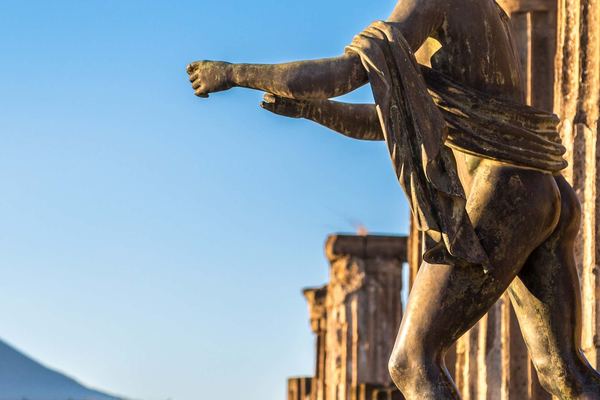
Pompeii 2-Hour Guided Tour with Entrance Ticket and English-Speaking Guide
Entrance to the archaeological site is covered on this English-speaking walk past the House of the Faun, the thermal baths, the Lupanar and the Basilica.
Pompeii 2-Hour Guided Tour with Licensed Archaeologist, Ticket and Cameo Workshop Stop
A licensed archaeology guide leads the two hours inside the ruins after a stop at a traditional cameo workshop, and the entrance fee is included in the booking.
Ratings collected by Viator, Tripadvisor and Civitatis
Questions about Pompeii addresses
What does VI.15.1 mean?
Regio VI, insula 15, entrance 1. It is the address of the House of the Vettii. The numbers run from the broadest unit (the regio) down to the door.
How many regiones does Pompeii have?
Nine, numbered I to IX. The division is modern, a legacy of Giuseppe Fiorelli's work in the 1860s, and it groups blocks of buildings rather than reflecting any ancient district.
Why do some buildings have two addresses?
The address names a door. A big house may have two street doors, as the House of the Tragic Poet does (it is written VI.8.3 and VI.8.5), and the shops at the front have their own numbers.
Which Pompeii houses are open?
We do not list them, because the list changes. The Park keeps its own at pompeiisites.org/en/houses.
Does the Park use these addresses?
Rarely. Its building pages are organized by name, and only a few print a Regio.Insula.Entrance. Our addresses come from Pompeii in Pictures, a private website we treat as a secondary source.
Is the Cave canem mosaic in Naples?
The one in the House of the Tragic Poet is on site, at the entrance, under glass. The Naples museum has a separate Cave canem mosaic labelled only as coming from Pompeii.
Is the Alexander mosaic still in the House of the Faun?
A copy is. The original is in the Naples museum, which as of 5 November 2026 lists it as under restoration and not on display.
Is this site connected to the Archaeological Park?
No. pompeii.museum is independent and not affiliated with the Park or the Ministry of Culture.
Keep going: what these buildings were for
The addresses tell you where. The daily life page tells you what the snack bars, bakeries and baths were doing.
Data verified on . Addresses: Pompeii in Pictures (secondary). Descriptions: the Park's building pages. We did not check which buildings are open. Editorial Policy