
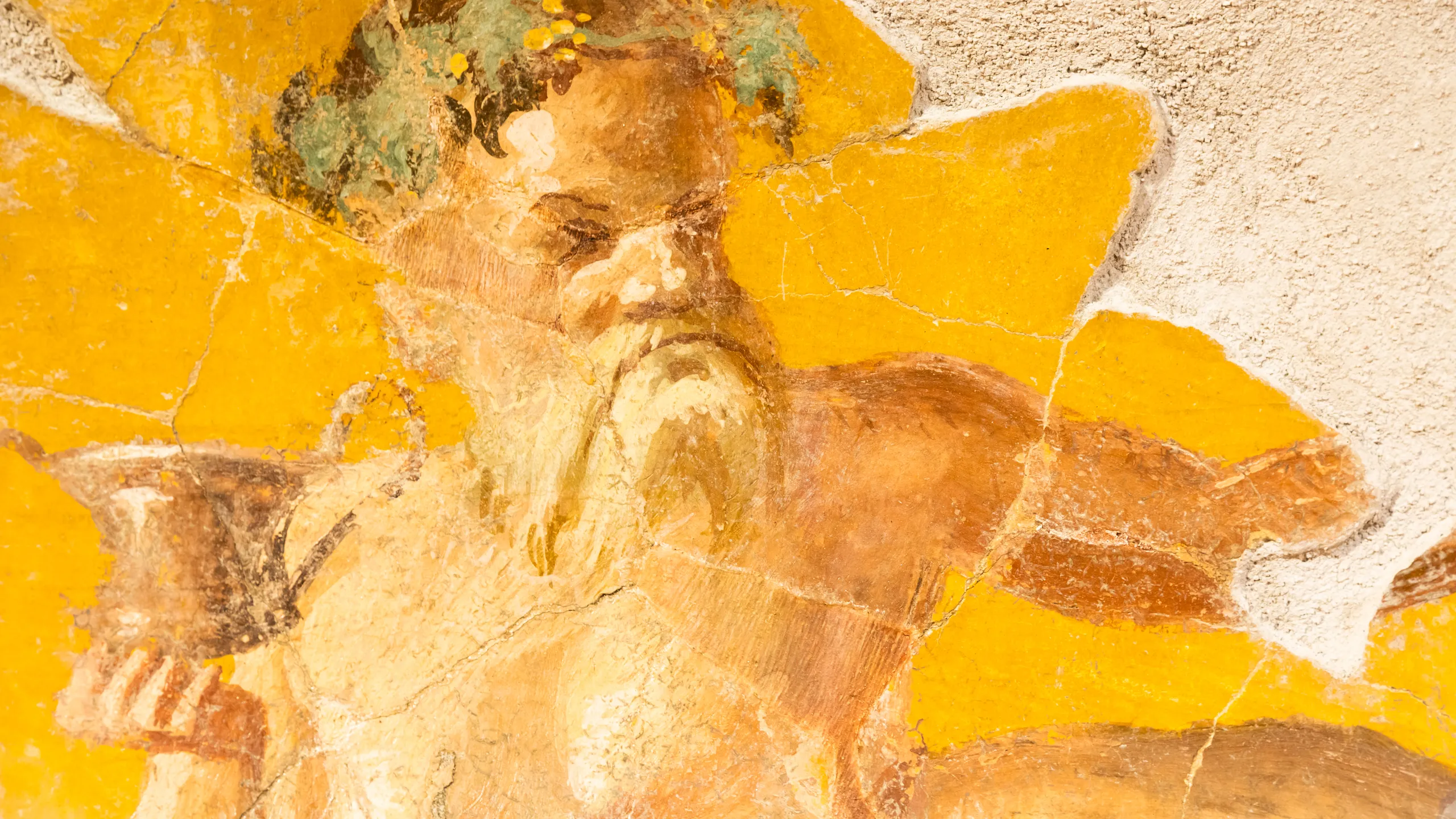
Pompeian wall painting is sorted into four styles, a scheme worked out by the German archaeologist August Mau in 1882. The First Style (roughly the 3rd century to about 80 BC) imitates colored marble in molded plaster. The Second (1st century BC) paints architecture so the wall seems to open into deeper space. The Third (from about 20 BC) sets small, delicate pictures on flat fields of color. The Fourth (about AD 60-79) crowds them together again. The dates are conventions, and the styles overlap on real walls.
Below: the technique, the pigments (including what the eruption did to some yellows), a method for reading a wall on site, and which paintings are still where the Romans put them and which are in Naples. Terms like tablinum are in the glossary, and every address below follows the system explained in our address book of buildings.
What are the four Pompeian styles?
| Style | Rough dates | What the wall looks like | At Pompeii | In Naples |
|---|---|---|---|---|
| First (incrustation, structural) | c. 3rd century to 80 BC | Stucco molded and painted to look like blocks of colored marble. No figures. | Basilica VIII.1.1 (Park: keeps its First Style); House of Sallust VI.2.4 (painted marble slabs); facade of the House of Julius Polybius IX.13.1-3 | None cited on the museum's page |
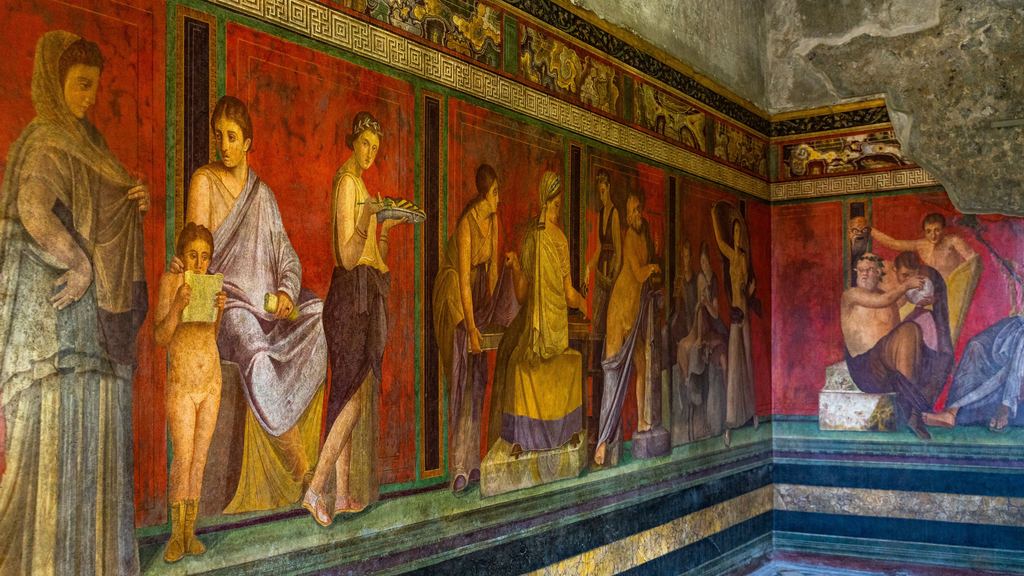
| Second (architectural) | 1st century BC; the Villa of the Mysteries took its shape in 80-70 BC | Painted columns, ledges and doors that push the wall back; landscapes and stage-like scenes | Villa of the Mysteries (outside the Herculaneum Gate); oecus of the House of the Labyrinth VI.11.10 (both Park) | Boscoreale, Villa of Publius Fannius Synistor: megalographias and an architecture with door and masks |
| Third (ornamental) | c. 20 BC to the mid-1st century AD | Flat fields of one color, slender candelabra and plant stems, tiny pictures that seem to float | The "black salon" with Trojan War scenes in Regio IX, Insula 10 (Park's excavation journal; a work site) | Boscotrecase, Villa of Agrippa Postumus: wall with an idyllic landscape (inv. 147501) |
| Fourth (intricate) | c. AD 60-79 | Busy walls: framed pictures, fantasy architecture, still lifes, myth scenes | House of the Vettii VI.15.1 (Ixion Room, per Wikipedia); House of Octavius Quartio II.2.2 (one fresco, per Pompeii in Pictures) | House of the Dioscuri, "Flying couple" (inv. 9135); Stabiae, Villa of Ariadne, carpet-like wall (inv. 9661). The museum shows these last in its chronological sequence; the Fourth Style label is the usual scholarly one, not the museum's |
A caution about the table: the Park's own pages seldom name a style. They name it for the Second Style rooms of the Villa of the Mysteries and the House of the Labyrinth, for the First Style of the Basilica and the Polybius facade, and for the Regio IX black room. The rest of the labels are scholars' attributions from secondary sources, and the Naples museum's web page orders its Frescoes section by style but does not label each piece with one.
Who was August Mau, and what is a "style"?
August Mau (1840-1909) worked for the German Archaeological Institute in Rome and published Geschichte der decorativen Wandmalerei in Pompeji in Berlin in 1882. His idea was that Pompeian wall decoration passed through four recognizable stages, which gave scholars a ruler to measure a wall against. It is a modern classification: no Roman called a wall "Second Style", and a later style keeps parts of the earlier ones, so the styles overlap on real walls.
For columns reeds are substituted; for pediments the stalks, leaves, and tendrils of plants; candelabra are made to support the representations of small buildings.
Vitruvius wrote under Augustus and already sounds like a critic of any era: taste had moved on, and he did not like where. The styles were fashions that clients chose, not periods that happened to the walls.
How was a Pompeian wall painted?
The standard Roman method, fresco, applies pigment to lime plaster while it is still drying, so the color becomes part of the wall. Before painting, the artist laid out the design. The Naples museum shows the toolkit: set squares and compasses for ruling the layout, pigments, and sinopias, the preliminary sketches that guided the brush.
The best proof of the process comes from the ruins. In the House of the Painters at Work (Insula of the Chaste Lovers, IX.12.6) the Park found a large room whose preparatory drawings had been laid on the plaster, before any color, when the eruption stopped the job. The Park also says the House of the Dioscuri was decorated by the same workshop as the House of the Vettii, so teams moved from house to house.
What is Pompeian red, and did the eruption change the colors?
Red and yellow dominate Pompeian walls, and the strong red is what people call Pompeian red. The yellow is ochre, whose coloring mineral is goethite; the red in the study below is hematite. Goethite turns into hematite when heated. A 2019 study by Marcaida, Maguregui, Morillas, Perez-Diez and Madariaga in Analytical and Bioanalytical Chemistry used that fact as a thermometer. They took nine painted fragments from Pompeii, heated them in the lab from 200 to 400 degrees C in 25-degree steps and measured with Raman imaging how much yellow had turned red.
| Temperature | Share transformed |
|---|---|
| 200 °C | 0.5% (almost none) |
| 225 °C | 26.9% |
| 250 °C | 46.7% |
| 275 °C | Complete; no further change up to 400 °C |
The authors' aim was to estimate how hot the pyroclastic flow was when it hit the walls. For a visitor, the finding means that some of the red you see was yellow in AD 79. The paper says some yellow-painted areas partly changed to red, not that every red wall was an accident. It is a laboratory experiment, not a measurement taken during the eruption, and eyes cannot tell the baked reds from the painted ones. The eruption itself is on its own page.
How do you read a wall when you are standing in front of it?
Five checks, in this order, cover most rooms:
- Look at the plinth, then the main field. Painted slabs of colored marble point to the First Style, or to a later wall with an old-fashioned base.
- Look for depth. Columns that seem to stand in front of the wall, a ledge, a door you could walk through: Second Style.
- Look for emptiness. Big flat fields of one color with thin ornament and a small picture in the middle: Third Style.
- Look for crowding. Many framed pictures, fantasy architecture, still lifes: Fourth Style.
- Allow for mixing. The Park says the earthquake of AD 62 led to the reconstruction of almost all buildings and wiped out most First Style decoration, which is why the Basilica is cited as a rare survivor.
Then ask whether you are looking at the original. Many of the best pictures were cut out of their walls long ago and now hang in Naples. The Park notes, for example, that the House of the Faun shows copies of mosaics whose originals are in the museum.
Painted walls: on the wall or in Naples?
| Building | Address | What the Park or museum says |
|---|---|---|
| Villa of the Mysteries | Outside the Herculaneum Gate | Continuous frieze on three walls still in the villa; other rooms in Second Style; Egyptian-style miniatures in the tablinum |
| House of the Labyrinth | VI.11.10 | Second Style paintings in the large oecus; Theseus and the Minotaur mosaic in a cubiculum |
| House of the Vettii | VI.15.1 | Frescoed rooms in place; the Park cites no pieces in Naples |
| House of the Tragic Poet | VI.8.3 | Ariadne abandoned by Theseus is the large mythological painting still visible; the originals of mosaics and other paintings are in Naples (for example the Sacrifice of Iphigenia, inv. 9112) |
| House of the Dioscuri | VI.9.6 | The main paintings are in Naples (for example inv. 9135) |
| House of Meleager | VI.9.2 | Frescoes from the house are shown in Naples |
| House of Sirico | VII.1.25 and VII.1.47 | Mythological frescoes of the Trojan War in the exedra; one of them is in Naples |
| Temple of Isis | VIII.7.28 | Paintings, statues and furnishings are in Naples, in the museum's Temple of Isis section |

Why are so many Pompeian paintings in Naples?
Because the first excavators took them. The museum's own text says that under the Bourbons "frescoes were literally pulled from the houses' walls and later framed as if they were paintings", which makes it hard to see each decoration as a whole. The Frescoes section describes itself as a manual of Roman mural painting from the 1st century BC to the 1st century AD, with the techniques and styles in chronological order, and where possible the original room context.
Rooms in a museum open and close, so check the museum's schedule of open rooms before you plan around the Frescoes section. Our page on the Naples Archaeological Museum explains how to pair it with Pompeii.
What do the paintings show?
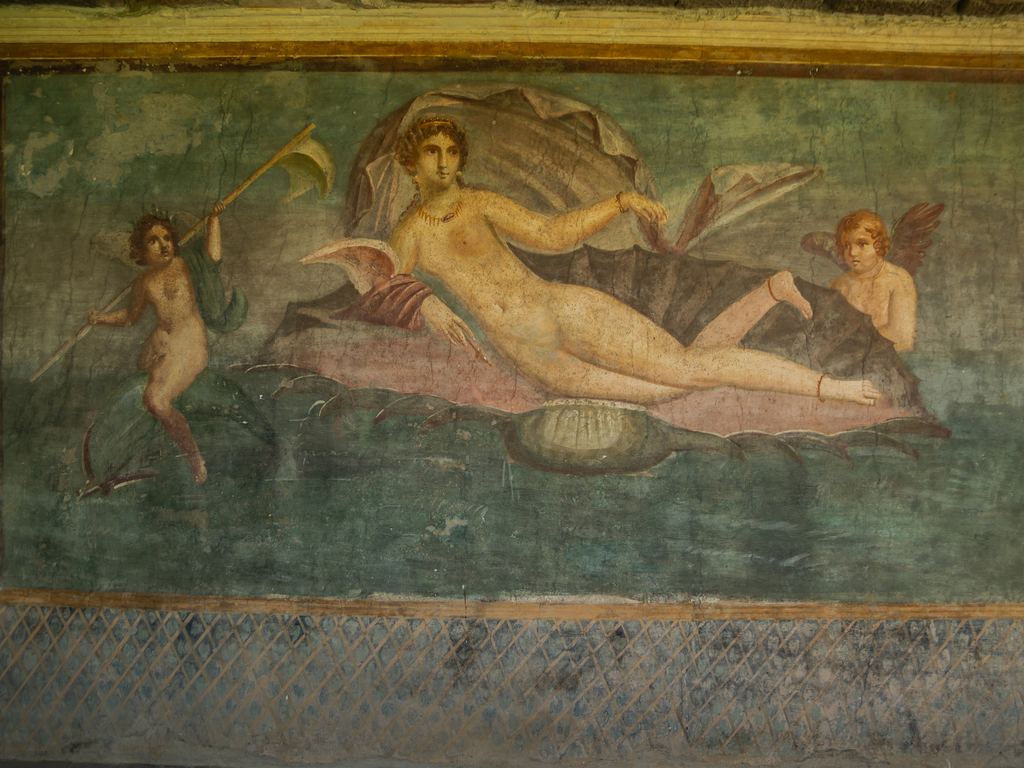
The museum groups the great themes as mythology, Homer and Greek tragedy, and then a lower register of portraits of private citizens and household-shrine paintings. At Pompeii you also find the Dionysiac initiation in the Villa of the Mysteries, Trojan War scenes in the House of Sirico, a Nereid on a snack-bar counter, and a painted garden of paradise behind the House of Venus in the Shell (II.3.3). Gladiators were painted on the amphitheatre's parapet, and fish and poultry sellers on the walls of the market, according to the Park. The daily-life evidence is the subject of another page.

Want someone to point out the styles?
A guided visit at the site is the easiest way to be shown which wall belongs to which style.
Pompeii 2.5-Hour Small Group Tour with Archaeologist and Skip-the-Line Entry
A site-only visit: 2.5 hours in Pompeii with an archaeologist, skip-the-line entry and tickets included, in a small group that ends at sunset over the ruins.
Pompeii 2-Hour Guided Tour with Entrance Ticket and English-Speaking Guide
Entrance to the archaeological site is covered on this English-speaking walk past the House of the Faun, the thermal baths, the Lupanar and the Basilica.
Pompeii 2-Hour Guided Tour with Licensed Archaeologist, Ticket and Cameo Workshop Stop
A licensed archaeology guide leads the two hours inside the ruins after a stop at a traditional cameo workshop, and the entrance fee is included in the booking.
Ratings collected by Viator, Tripadvisor and Civitatis
Pompeian wall painting: common questions
What are the four Pompeian styles?
First (imitation marble in molded plaster), Second (painted architecture and illusion), Third (small pictures on flat color fields) and Fourth (crowded, framed scenes and fantasy architecture). August Mau defined them in 1882.
What is Pompeian red?
The popular name for the strong red that fills many Pompeian walls. Red and yellow dominate the paintings, and a 2019 laboratory study showed that some of the red was once yellow ochre, changed by the heat of AD 79.
Did the eruption change the colors?
In places, yes. Yellow ochre (goethite) turns to red hematite when heated, completely by 275 degrees C in the lab. The study did not claim that every red wall was altered.
Are the paintings still on the walls?
Many are, such as the frieze in the Villa of the Mysteries. Others were cut out in the 18th and 19th centuries and are in the Naples museum. The table above lists examples of each.
How were the walls painted?
With pigments on fresh lime plaster, after a layout of drawn guidelines and sinopia sketches. The Park found unfinished drawings of this kind in the House of the Painters at Work.
Why is the First Style so rare at Pompeii?
The Park says the earthquake of AD 62 led to the reconstruction of almost all buildings, which destroyed most First Style decoration. The Basilica is a rare place where it survives.
Is the Villa of the Mysteries part of the main ruins?
It stands outside the walls, beyond the Herculaneum Gate. Which ticket covers it is explained on our tickets page.
Can I see all four styles in one visit?
You can try, but the open buildings change often. Use the Park's list at pompeiisites.org/en/houses to see which of the buildings in the table are open on your day.
Find the painted houses by address
Our address book groups 49 buildings by regio and says what each shows and where its finds ended up.
Data verified on . Style dates and the Vettii and Quartio labels: Wikipedia and Pompeii in Pictures (secondary). Locations, Marcaida et al. 2019, museum text: primary. Open buildings not checked. Editorial Policy